 NL·0390
Herbarium of the Nature Library
- Name
- Crocodylus palustris
- Family
- Crocodylidae
- Native to
- India, Sri Lanka, Pakistan, Nepal and southeastern Iran; extinct in Bhutan and probably Myanmar; possibly surviving in Bangladesh
- Habitat
- Rivers, Lakes, Marshes, Reservoirs
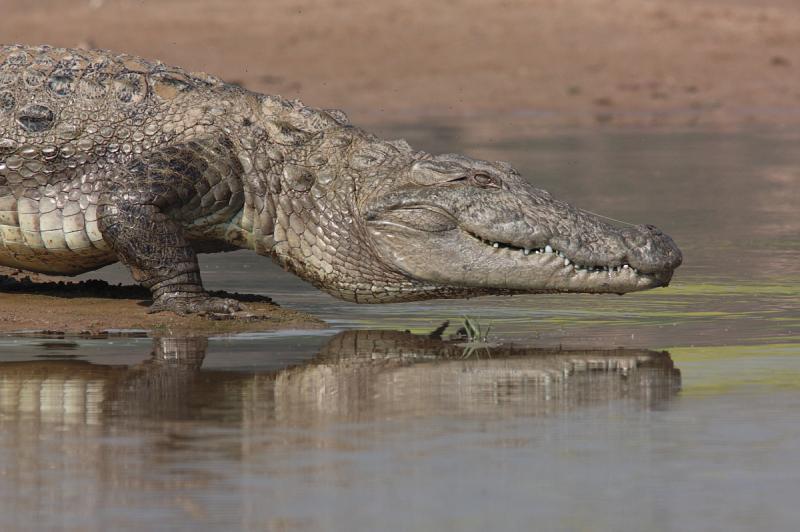
Mugger crocodile
Crocodylus palustris
Also calledMagar / Magarmachh (Hindi, Urdu) · Mugger (Anglo-Indian) · Kimbula (Sinhala) · Mudhalai (Tamil) · Gando (Balochi)
A broad-snouted crocodile of South Asia's rivers, lakes and reservoirs. It is adaptable and digs burrows to survive drought, and it has been seen balancing sticks on its snout to lure nest-building birds.
The mugger crocodile is a medium-sized broad-snouted crocodile, also known as mugger and marsh crocodile. It is native to freshwater habitats from south-eastern Iran to the Indian subcontinent, where it inhabits marshes, lakes, rivers and artificial ponds. It rarely reaches a body length of 5 m and is a powerful swimmer, but also walks on land in search of suitable waterbodies during the hot season. Both young and adult mugger crocodiles dig burrows to which they retreat when the ambient temperature drops below 5 °C (41 °F) or exceeds 38 °C (100 °F). Females dig holes in the sand as nesting sites and lay up to 46 eggs during the dry season. The sex of hatchlings depends on temperature during incubation. Both parents protect the young for up to one year. They feed on insects, and adults prey on fish, reptiles, birds and mammals. Wikipedia
What it can do
- iDigs burrows into riverbanks to escape heat and drought
- iiHas been seen balancing sticks on its snout near egret colonies during the nesting season, possibly to lure birds collecting nest material
- iiiTravels overland between water bodies
- ivLives in reservoirs, irrigation canals and town lakes
In the field
Field marks
- aBroad, heavy snout, the widest of any living Crocodylus
- bGrey to olive-brown body; juveniles banded
- cFourth lower tooth visible when the mouth is closed
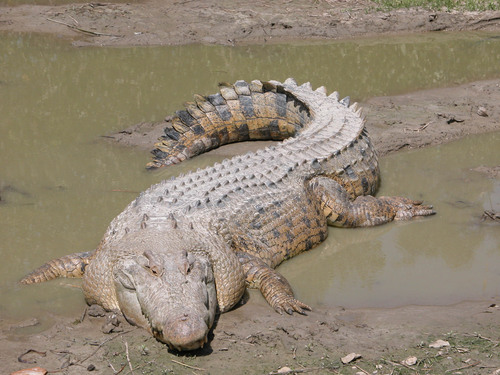
- dLacks the pair of bony bumps in front of the eyes seen on saltwater crocodiles
- Not to be confused with
- The gharial has a very thin snout. The saltwater crocodile, found in coastal areas such as the Sundarbans, Bhitarkanika and Sri Lankan estuaries, has a longer, narrower snout and bony ridges in front of the eyes.
- Where to see it
- National Chambal Sanctuary, Ranganathittu Bird Sanctuary (Karnataka), Vishwamitri River (Vadodara), Yala and Wilpattu (Sri Lanka), Bardia (Nepal)
- When
- Resident; nesting February–April
Life & habits
- Diet
- Fish, birds, turtles, deer, monkeys and other mammals
- Habitat
- Rivers, lakes, marshes, reservoirs, irrigation canals
- Size
- Males up to ~4–5 m; females ~2.5–3 m
Basks for long periods, often with its mouth open. Females dig nests in sandbanks and carry hatchlings to the water.
Where it lives
Recorded sightings
—
geo-referenced records in GBIF, from museums, herbaria and field observers.
Native range
India, Sri Lanka, Pakistan, Nepal and southeastern Iran; extinct in Bhutan and probably Myanmar; possibly surviving in Bangladesh
Drag the globe to turn it. Dots are where records exist, not a range map; darker means more records.
In the old herbals & bestiaries
No plate in the Source Library names this exact species, so these show its closest relatives as the old naturalists drew them: same genus, or the same kind of animal. Click a plate to read the page it came from, with translation.

Ortus sanitatis
Relative · 1491 · p.688

History of Animals, Book II: On Oviparous Quadrupeds
Relative · Conrad Gessner · 1586 · p.724

Museum of the Royal Society
Relative · Nehemiah Grew · 1681 · p.468

Recherche curieuse d'antiquités, venuës d'Italie, de la Grece, d'Egypte, & trouvées à Nimegue, a Sant...
Relative · Chevalier, Nicolas · 1714 · p.56

Unterhaltungen aus der Naturgeschichte / 3 Die Amphibien
Relative · Wilhelm, Gottlieb Tobias · 1794 · p.407

Unterhaltungen aus der Naturgeschichte / [Tafelband.]
Relative · Borkhausen, Moritz Balthasar (1760-1806) · n.d. · p.53

Ortus sanitatis
Relative · 1491 · p.540

Garden of Health
Relative · Jacob Meydenbach · 1491 · p.686

Garden of Health
Relative · Jacob Meydenbach · 1491 · p.538

Garden of Health (Hortus Sanitatis)
Relative · Jacob Meydenbach · 1491 · p.496
In the stacks
Searching the stacks…
Every page naming Crocodylus palustris in the Biodiversity Heritage Library →
Marginalia
At the shrine of Pir Mangho in Karachi, muggers have been kept in a pool for centuries and are fed by pilgrims, who consider them the saint's disciples. Rudyard Kipling's 'The Undertakers' (1895) features a mugger of a Ganges village.
Curiosity
In 2013 Vladimir Dinets reported muggers and American alligators balancing sticks on their snouts near bird colonies, probably the first known tool use by reptiles.
Kinship



Photographs: iNaturalist contributors under the licences shown. Records: GBIF.org. Historical plates: Source Library (CC BY-SA 4.0; originals public domain). Summary text: Nature Library editors and Wikipedia (CC BY-SA). Medicinal and edibility notes are historical and educational, not advice. iNaturalist taxon 26063.