 NL·0407
Herbarium of the Nature Library
- Name
- Dasypus novemcinctus
- Family
- Dasypodidae
- Native to
- South America (to northern Argentina), Central America, Mexico and the southern and central USA (expanding north)
- Habitat
- Tropical forest, Grassland, Scrub, Farmland
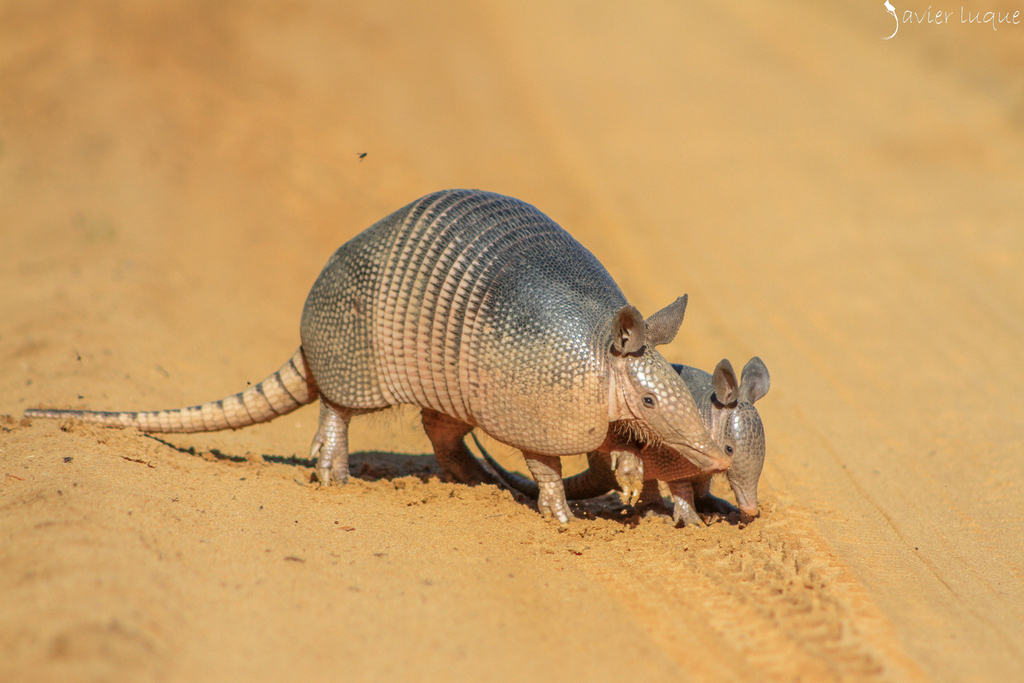
Nine-banded armadillo
Dasypus novemcinctus
Also calledTatu-galinha (Portuguese) · Armadillo de nueve bandas (Spanish) · Ayotochtli (Nahuatl, 'turtle-rabbit') · Tatú (Guaraní) · Cachicamo (Venezuelan Spanish)
A bony-shelled digger of the Americas that has spread steadily north through the USA since the 19th century. Females almost always give birth to genetically identical quadruplets, all from one fertilised egg. It is also one of the few animals other than humans that naturally carries leprosy.
The nine-banded armadillo, also called the nine-banded long-nosed armadillo or common armadillo, is a species of armadillo native to South America. The Mexican long-nosed armadillo of North America was formerly treated as a subspecies of the nine-banded armadillo. Wikipedia
What it can do
- iGives birth to identical quadruplets from a single egg (polyembryony)
- iiCan hold its breath for about six minutes, walking across stream bottoms or gulping air to float
- iiiLeaps about 1 m into the air when startled
- ivDigs dozens of burrows used later by other animals
In the field
Field marks
- aLeathery, armoured shell with a shoulder shield, a hip shield and 7–11 (usually 8–9) movable bands in between
- bLong, armoured, tapering tail
- cSmall, pointed head and large upright ears
- dSigns: shallow conical feeding holes 'snout-pokes' in lawns and leaf litter; burrows about 20 cm wide
- Not to be confused with
- Other Dasypus species in South America are very similar; seven-banded and southern long-nosed armadillos differ in band count and range. Six-banded armadillo is yellowish with fewer, wider bands.
- Where to see it
- Florida and Texas, e.g. Aransas National Wildlife Refuge and Big Thicket; Pantanal (Brazil); Los Llanos (Venezuela)
- When
- Resident year-round
Listen
Looking for field recordings…
Life & habits
- Diet
- Insects and other invertebrates (beetles, ants, termites, larvae), small vertebrates, eggs and fruit
- Habitat
- Forest, scrub and grassland with soft soil
- Size
- Body 38–58 cm, tail 26–45 cm; 3–7 kg
- Lifespan
- About 7–15 years
Mostly nocturnal in summer and active by day in cool weather. Digs for food with its nose to the ground, sniffing out prey.
Where it lives
Recorded sightings
—
geo-referenced records in GBIF, from museums, herbaria and field observers.
Native range
South America (to northern Argentina), Central America, Mexico and the southern and central USA (expanding north)
Drag the globe to turn it. Dots are where records exist, not a range map; darker means more records.
In the old herbals & bestiaries
Woodcuts and engravings matched from the Source Library’s scanned books by name. Plates marked “relative” show a close kin rather than this exact species. Click a plate to read the page it came from, with translation.

Medicinal History of the Things Brought from Our West Indies
Nicolás Monardes · 1574 · p.175

Recherche curieuse d'antiquités, venuës d'Italie, de la Grece, d'Egypte, & trouvées à Nimegue, a Sant...
Chevalier, Nicolas · 1714 · p.56

Florentine Codex, Vol. 3 (Books 10-12)
Bernardino de Sahagún · 1577 · p.446

Histoire Naturelle des Indes (The Drake Manuscript)
Anonymous (French) · 1586 · p.68

Ten Books of Exotic Things
Carolus Clusius · 1605 · p.129

Ten Books of Exotic Things
Carolus Clusius · 1605 · p.704

Historia naturalis Brasiliae
Willem Piso / Georg Marcgraf · 1648 · p.376

Treasury of Medical Matters of New Spain
Francisco Hernández · 1651 · p.363

Theater of Earthly Creatures
Anonymous · 1672 · p.181

Theater of Earthly Creatures
Anonymous · 1672 · p.182
In the stacks
Searching the stacks…
Every page naming Dasypus novemcinctus in the Biodiversity Heritage Library →
Marginalia
The Aztecs called it ayotochtli, 'turtle-rabbit', and Andean musicians made the charango, a small lute, from armadillo shells. It is the state small mammal of Texas.
Curiosity
Its startle leap is so high that it often strikes the undersides of cars, a major cause of roadkill.
Kinship





Photographs: iNaturalist contributors under the licences shown. Records: GBIF.org. Historical plates: Source Library (CC BY-SA 4.0; originals public domain). Summary text: Nature Library editors and Wikipedia (CC BY-SA). Medicinal and edibility notes are historical and educational, not advice. iNaturalist taxon 47075.