 NL·0264
Herbarium of the Nature Library
- Name
- Deinacrida heteracantha
- Family
- Anostostomatidae
- Native to
- Formerly Northland and Auckland region, New Zealand; natural population now only on Hauturu-o-Toi / Little Barrier Island, with translocated populations on other predator-free islands
- Habitat
- Temperate rainforest, Island forest
Wētāpunga (Little Barrier giant wētā)
Deinacrida heteracantha
Also calledWētāpunga (Māori) · Giant wētā (New Zealand English)
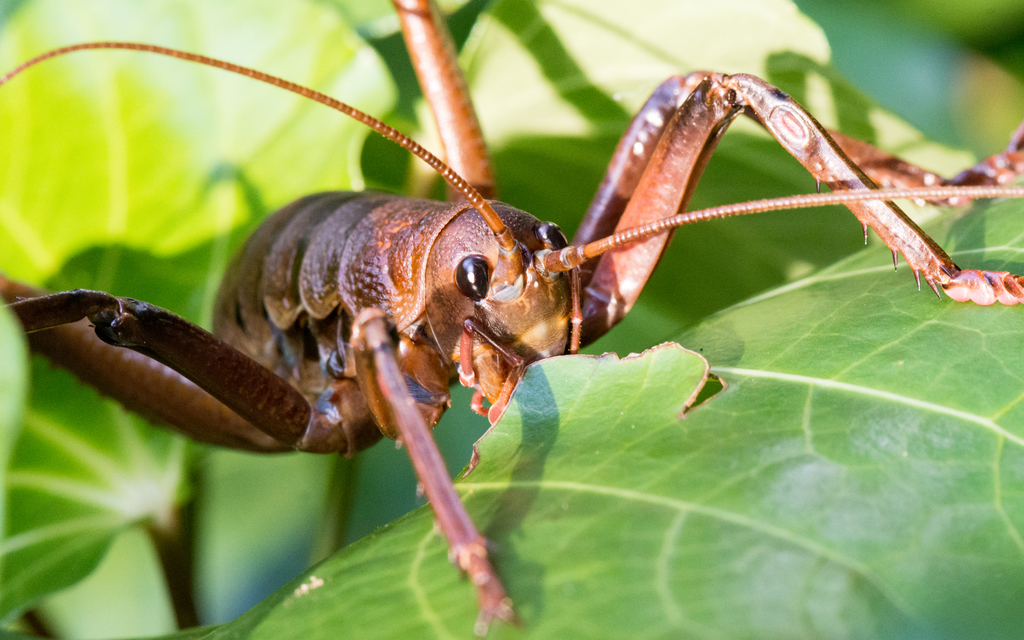
A giant cricket-like insect from New Zealand and one of the heaviest insects in the world; a pregnant female has been weighed at 71 g. Wiped out on the mainland by introduced rats, it survived on Hauturu-o-Toi (Little Barrier Island).
Deinacrida heteracantha, also known as the Little Barrier giant wētā or wētāpunga, is a wētā in the order Orthoptera and family Anostostomatidae. It is endemic to New Zealand, where it survived only on Hauturu. This very large flightless wētā mainly feeds at night, when it can be found above ground in vegetation. It has been classified as vulnerable by the IUCN due to ongoing population declines and restricted distribution. Its NZTCS threat classification was changed to "Threatened - Nationally increasing" in 2022 because it has been successfully translocated to seven predator-free islands. Wikipedia
What it can do
- iOne of the heaviest insects ever weighed, up to about 70 g
- iiWingless and slow, it evolved in the absence of land mammals
- iiiKicks spiny hind legs upward in defence
In the field
Field marks
- aVery large, heavy, wingless body, brown with darker bands
- bLong, thick hind legs covered in spines
- cLong antennae, longer than the body
- dFemales with a long, curved ovipositor
- Not to be confused with
- Tree wētā (Hemideina) are much smaller, and males have very large heads and jaws. Other giant wētā (Deinacrida spp.) occupy different regions of New Zealand.
- Where to see it
- Hauturu-o-Toi has restricted access; captive-bred wētāpunga are bred at Auckland Zoo and released to islands such as Motuora and Tiritiri Matangi.
- When
- Year-round; nocturnal
Listen
Looking for field recordings…
Life & habits
- Diet
- Leaves of native trees and shrubs; also fruit and flowers
- Habitat
- Forest canopy and scrub; hides by day in tree holes and among foliage
- Size
- Body up to about 10 cm; weight to about 70 g in gravid females
- Lifespan
- Up to about 2 years
It is nocturnal and arboreal, climbing down to the ground mainly to lay eggs in soil.
Where it lives
Recorded sightings
—
geo-referenced records in GBIF, from museums, herbaria and field observers.
Native range
Formerly Northland and Auckland region, New Zealand; natural population now only on Hauturu-o-Toi / Little Barrier Island, with translocated populations on other predator-free islands
Drag the globe to turn it. Dots are where records exist, not a range map; darker means more records.
In the stacks
Searching the stacks…
Every page naming Deinacrida heteracantha in the Biodiversity Heritage Library →
Marginalia
In Māori tradition wētāpunga are named for Punga, ancestor of ugly and deformed creatures. The species' decline began after kiore (Pacific rats) and later European rats reached New Zealand.
Curiosity
The 71 g record female, weighed in 2011, was photographed eating a carrot from the hand of the naturalist who found her.
Kinship





Fact-checked: 1 correction made to this sheet. Photographs: iNaturalist contributors under the licences shown. Records: GBIF.org. Historical plates: Source Library (CC BY-SA 4.0; originals public domain). Summary text: Nature Library editors and Wikipedia (CC BY-SA). Medicinal and edibility notes are historical and educational, not advice. iNaturalist taxon 85238.