 NL·0437
Herbarium of the Nature Library
- Name
- Esox lucius
- Family
- Esocidae
- Native to
- Circumpolar in fresh and brackish waters of North America, Europe and northern Asia; introduced to Spain, Ireland (disputed) and parts of western North America
- Habitat
- Lakes, Slow rivers, Weedy bays, Brackish Baltic coasts
Northern pike
Esox lucius
Also calledShchuka щука (Russian) · Hecht (German) · Brochet (French) · Gädda (Swedish) · Hauki (Finnish) · Ginoozhe (Ojibwe)
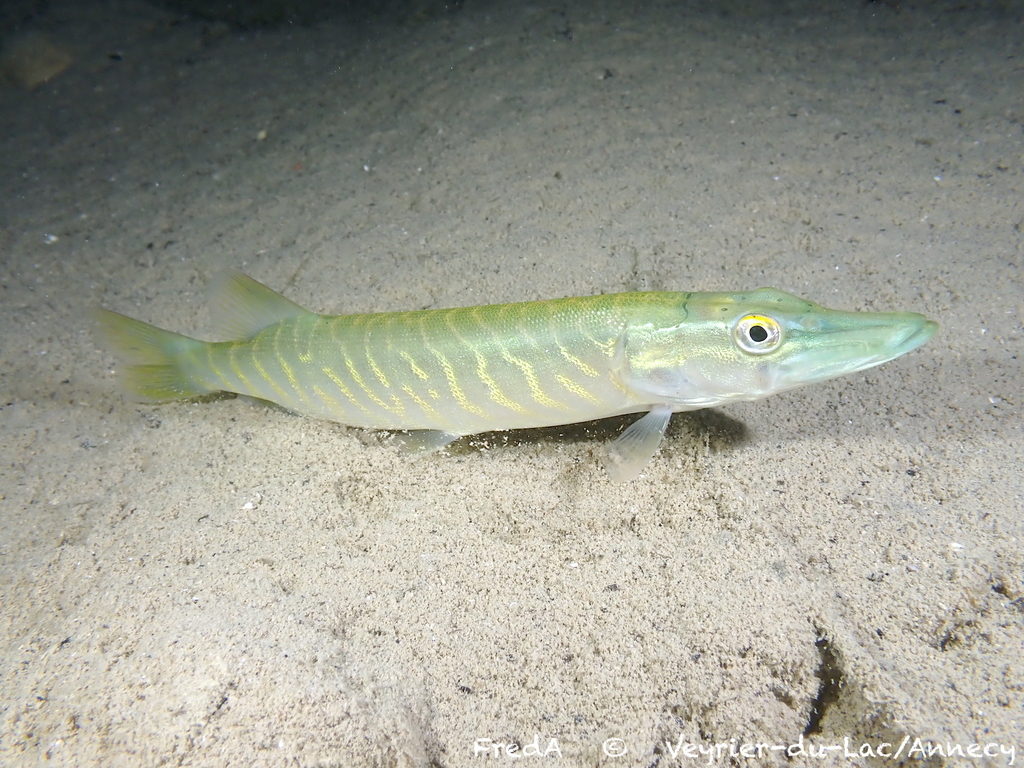
A long ambush predator of weedy northern lakes, with a duck-bill jaw full of backward-pointing teeth. It is one of the few freshwater fish native around the whole Northern Hemisphere.
The northern pike, also known as jack, northern or simply pike, is a species of carnivorous fish of the genus Esox (pikes). It is commonly found in fresh waters of the Northern Hemisphere. Wikipedia
What it can do
- iLaunches from a standstill with extreme acceleration, driven by dorsal and anal fins set far back near the tail
- iiSwallows prey up to about half its own length, including ducklings, frogs and other pike
- iiiSenses vibrations through a lateral line and sensory pores on the head, so it can hunt in murky water
- ivLives in the brackish Baltic Sea as well as fresh water
In the field
Field marks
- aLong, torpedo-shaped body with dorsal and anal fins set far back near the forked tail
- bFlattened, duck-billed snout and a mouth lined with sharp teeth
- cOlive-green to brown with rows of pale, bean-shaped spots (light markings on a dark background)
- dCheek fully scaled, gill cover scaled only on the upper half
- Not to be confused with
- Muskellunge (E. masquinongy) has dark bars or spots on a light background, pointed tail lobes and no scales on the lower cheek. Chain pickerel (E. niger) is smaller, with a dark chain-like net pattern and a dark bar under the eye.
- Where to see it
- Lakes of Finland, Sweden and Ireland; the Baltic archipelagos of Stockholm and Åland; Canadian Shield lakes of Manitoba, Ontario and Saskatchewan
- When
- Resident; spawns March–May just after ice-out
Life & habits
- Diet
- Carnivore: fish (including smaller pike), frogs, crayfish, small mammals and ducklings
- Habitat
- Clear to tannin-stained lakes, slow rivers and weedy backwaters; Baltic coastal bays
- Size
- Commonly 40–90 cm; females to about 1.5 m and over 25 kg
- Lifespan
- Usually 10–15 years; over 25 in cold northern waters
Hovers motionless among weeds, then strikes sideways in a split second. It spawns very early in spring, often right after ice-out, scattering eggs over flooded grass.
Where it lives
Recorded sightings
—
geo-referenced records in GBIF, from museums, herbaria and field observers.
Native range
Circumpolar in fresh and brackish waters of North America, Europe and northern Asia; introduced to Spain, Ireland (disputed) and parts of western North America
Drag the globe to turn it. Dots are where records exist, not a range map; darker means more records.
In the old herbals & bestiaries
Woodcuts and engravings matched from the Source Library’s scanned books by name. Plates marked “relative” show a close kin rather than this exact species. Click a plate to read the page it came from, with translation.


In the stacks
Searching the stacks…
Every page naming Esox lucius in the Biodiversity Heritage Library →
Marginalia
In the Russian folktale 'By the Pike's Command' (Po shchuchyemu veleniyu), the lazy Emelya catches a magic pike that grants his wishes. The 'Emperor's Pike', supposedly ringed by Frederick II in 1230 and caught 267 years later, is a well-known medieval hoax; its skeleton in Mannheim turned out to be assembled from several fish.
Curiosity
The Finnish national epic Kalevala tells how the hero Väinämöinen made the first kantele, a harp-like instrument, from the jawbone of a giant pike.
Kinship

Fact-checked: 1 correction made to this sheet. Photographs: iNaturalist contributors under the licences shown. Records: GBIF.org. Historical plates: Source Library (CC BY-SA 4.0; originals public domain). Summary text: Nature Library editors and Wikipedia (CC BY-SA). Medicinal and edibility notes are historical and educational, not advice. iNaturalist taxon 55387.