 NL·0440
Herbarium of the Nature Library
- Name
- Exocoetus volitans
- Family
- Exocoetidae
- Native to
- Tropical and subtropical oceans worldwide
- Habitat
- Open ocean (pelagic)
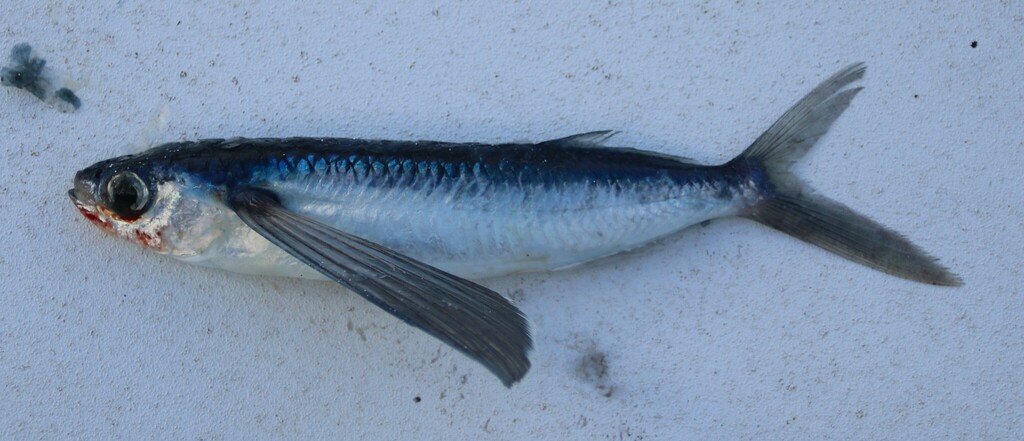
Tropical two-wing flyingfish
Exocoetus volitans
Also calledPez volador (Spanish) · Tobiuo (Japanese) · Malolo (Hawaiian) · Ikan terbang (Malay) · Exocet (French)
A blue-backed ocean fish that escapes predators by bursting from the sea and gliding on enlarged pectoral fins. A single glide can carry it tens of metres, and it can extend a flight by sculling its tail in the water.
Exocoetus volitans, commonly known as the tropical two-wing flyingfish or blue flyingfish, is a species of ray-finned fish native to tropical and subtropical seas. It can glide above the surface of the sea to escape predators. Wikipedia
What it can do
- iGlides on wing-like pectoral fins at speeds above 50 km/h
- iiTaxis by beating the elongated lower tail lobe on the surface to relaunch without re-entering the water
- iiiFlights of 50 m are common; flyingfish have been filmed in the air for 45 seconds
- ivTwo-winged: unlike four-winged species, its pelvic fins are small
In the field
Field marks
- aVery long pectoral fins reaching the tail base
- bSmall pelvic fins (two-winged)
- cDeeply forked tail with a longer lower lobe
- dIridescent blue back, silvery belly
- eClear, unmarked pectoral fins in adults
- Not to be confused with
- Four-winged flyingfish (Cheilopogon, Hirundichthys) have large pelvic fins too; Exocoetus obtusirostris has a more blunt snout and fewer predorsal scales.
- Where to see it
- From ships' bows in the tropical Atlantic and Pacific; Barbados (where related flyingfish are a national symbol)
- When
- Year-round in warm seas
Life & habits
- Diet
- Zooplankton
- Habitat
- Surface waters of the open ocean, away from coasts
- Size
- Up to about 30 cm
- Lifespan
- About 1–2 years
When chased by mahi-mahi, tuna or billfish, it accelerates under water and launches into the air; it also leaps at night onto the lit decks of ships.
Where it lives
Recorded sightings
—
geo-referenced records in GBIF, from museums, herbaria and field observers.
Native range
Tropical and subtropical oceans worldwide
Drag the globe to turn it. Dots are where records exist, not a range map; darker means more records.
In the old herbals & bestiaries
Woodcuts and engravings matched from the Source Library’s scanned books by name. Plates marked “relative” show a close kin rather than this exact species. Click a plate to read the page it came from, with translation.

History of Animals, Book II: On Oviparous Quadrupeds
Conrad Gessner · 1586 · p.378

Athanasii Kircheri... Magnes sive de arte magnetica
Kircher, Athanasius · 1643 · p.761

Athanasii Kircheri Societatis Jesu Magnes sive de arte magnetica opus tripartium quo universa magnetis natura, eiusque in omnibus scientiis & artibus usus, nova medthodo explicatur, ac praeterae e viribus & prodigiosis effectibus magneticarum, aliarumque abditarum naturae motionum in elementis, lapidibus, plantis, animalibus, elucescentium, multa hucusque incognita natureae arcana, per physica, medica, chymica, & mathematica omnis generis experimenta recluduntur
Kircher, Athanasius · 1654 · p.559

The Natural History of Carolina, Florida and the Bahama Islands, Vol. 1
Mark Catesby · 1777 · p.281
In the stacks
Searching the stacks…
Every page naming Exocoetus volitans in the Biodiversity Heritage Library →
Marginalia
The French Exocet missile is named after flyingfish; Barbados, 'the land of the flying fish', depicts them on coins, though its fishery targets Hirundichthys affinis.
Curiosity
The name Exocoetus means 'sleeping outside' in Greek, from the old belief that flyingfish came ashore to sleep.
Kinship





Photographs: iNaturalist contributors under the licences shown. Records: GBIF.org. Historical plates: Source Library (CC BY-SA 4.0; originals public domain). Summary text: Nature Library editors and Wikipedia (CC BY-SA). Medicinal and edibility notes are historical and educational, not advice. iNaturalist taxon 120657.