 NL·0443
Herbarium of the Nature Library
- Name
- Falco peregrinus
- Family
- Falconidae
- Native to
- Every continent except Antarctica
- Habitat
- Cliffs, Coasts, Tundra, Cities
On eBird ↗
Peregrine Falcon
Live sightings near you, the range map, bar charts of when it is seen, and Macaulay Library photos and recordings.
Peregrine falcon
Falco peregrinus
Also calledShaheen (Urdu/Persian) · Shahin (Arabic, for related falcons) · Halcón peregrino (Spanish) · Yóu sǔn (Chinese) · Hayabusa (Japanese)
The fastest animal on Earth, reaching more than 320 km/h when stooping on prey. Wiped out from much of its range by DDT in the 1960s, it has recovered and now nests on city skyscrapers.
The peregrine falcon, sometimes referred to simply as the peregrine, is a bird of prey (raptor) in the family Falconidae known for its speed. A large, crow-sized falcon, it has a blue-grey back, barred white underparts and a black head. As is typical for bird-eating (avivore) raptors, peregrine falcons are sexually dimorphic, with females being considerably larger than males. Historically, the bird has also been known as the "black-cheeked falcon" in Australia and the "duck hawk" in North America. Wikipedia
What it can do
- iStoops at speeds recorded up to about 389 km/h
- iiBony tubercles in its nostrils deflect air so it can breathe in high-speed dives
- iiiArctic-breeding populations migrate up to ~25,000 km a year
- ivHas a third eyelid to protect its eyes in dives
In the field
Field marks
- aPowerful falcon with long pointed wings and a medium tail
- bAdult blue-grey above with a dark 'helmet' and broad moustache stripe
- cPale underparts finely barred
- dYoung birds brown above with streaked underparts
- Voice
- A harsh, rasping 'kak-kak-kak' near the nest
- Not to be confused with
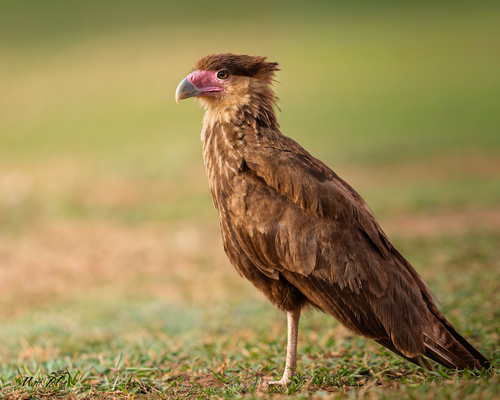
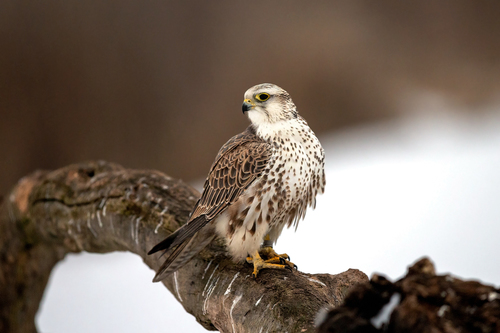
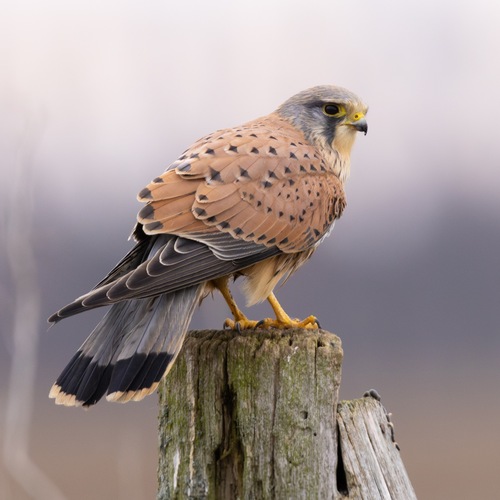
- Prairie falcon is pale brown with dark 'armpits'. Lanner falcon has a rufous crown and thinner moustache. Gyrfalcon is bulkier with broader wings. Hobby is smaller with rufous 'trousers'.
- Where to see it
- Sea cliffs and city buildings; many urban nests carry public webcams (e.g. Derby Cathedral, UK); migrants at Cape May and Falsterbo
- When
- Resident in much of its range; Arctic breeders migrate long distances
Listen
Looking for field recordings…
Life & habits
- Diet
- Mainly birds caught in flight, such as pigeons, ducks and shorebirds
- Habitat
- Cliffs, coasts, open country, and tall buildings in cities
- Size
- 34–58 cm; wingspan 74–120 cm
- Lifespan
- Up to about 15–20 years
It climbs high above prey, folds its wings and drops in a steep stoop, striking with clenched talons.
Where it lives
Recorded sightings
—
geo-referenced records in GBIF, from museums, herbaria and field observers.
Native range
Every continent except Antarctica
Drag the globe to turn it. Dots are where records exist, not a range map; darker means more records.
In the old herbals & bestiaries
Woodcuts and engravings matched from the Source Library’s scanned books by name. Plates marked “relative” show a close kin rather than this exact species. Click a plate to read the page it came from, with translation.

Hermann Schlegel — Traité de fauconnerie (1844)
Hermann Schlegel · 1844 · p.129

François Bouchard — Recueil de cent-trente-trois oiseaux des plus belles especes (1775)
François Bouchard · 1775 · p.52

François Bouchard — Recueil de cent-trente-trois oiseaux des plus belles especes (1775)
François Bouchard · 1775 · p.54
In the stacks
Searching the stacks…
Every page naming Falco peregrinus in the Biodiversity Heritage Library →
Marginalia
Prized in falconry from Mongolia to the Arab world; the 15th-century Boke of St Albans assigned it to earls. Its crash from DDT-thinned eggshells helped drive the US ban of DDT in 1972.
Curiosity
Its name means 'wanderer', because falconers caught young birds on migration rather than taking them from nests.
Kinship



Fact-checked: 1 correction made to this sheet. Photographs: iNaturalist contributors under the licences shown. Records: GBIF.org. Historical plates: Source Library (CC BY-SA 4.0; originals public domain). Summary text: Nature Library editors and Wikipedia (CC BY-SA). Medicinal and edibility notes are historical and educational, not advice. iNaturalist taxon 4647.