 NL·0444
Herbarium of the Nature Library
- Name
- Falco tinnunculus
- Family
- Falconidae
- Native to
- Europe, Africa, the Middle East, Central Asia and Asia to China and Japan
- Habitat
- Farmland, Temperate grassland, Steppe, Urban
On eBird ↗
Eurasian Kestrel
Live sightings near you, the range map, bar charts of when it is seen, and Macaulay Library photos and recordings.
Common kestrel
Falco tinnunculus
Also calledAwsaq (Arabic) · Kerkenez (Turkish) · Turmfalke (German) · Faucon crécerelle (French) · Cernícalo vulgar (Spanish) · Windhover (English dialect)
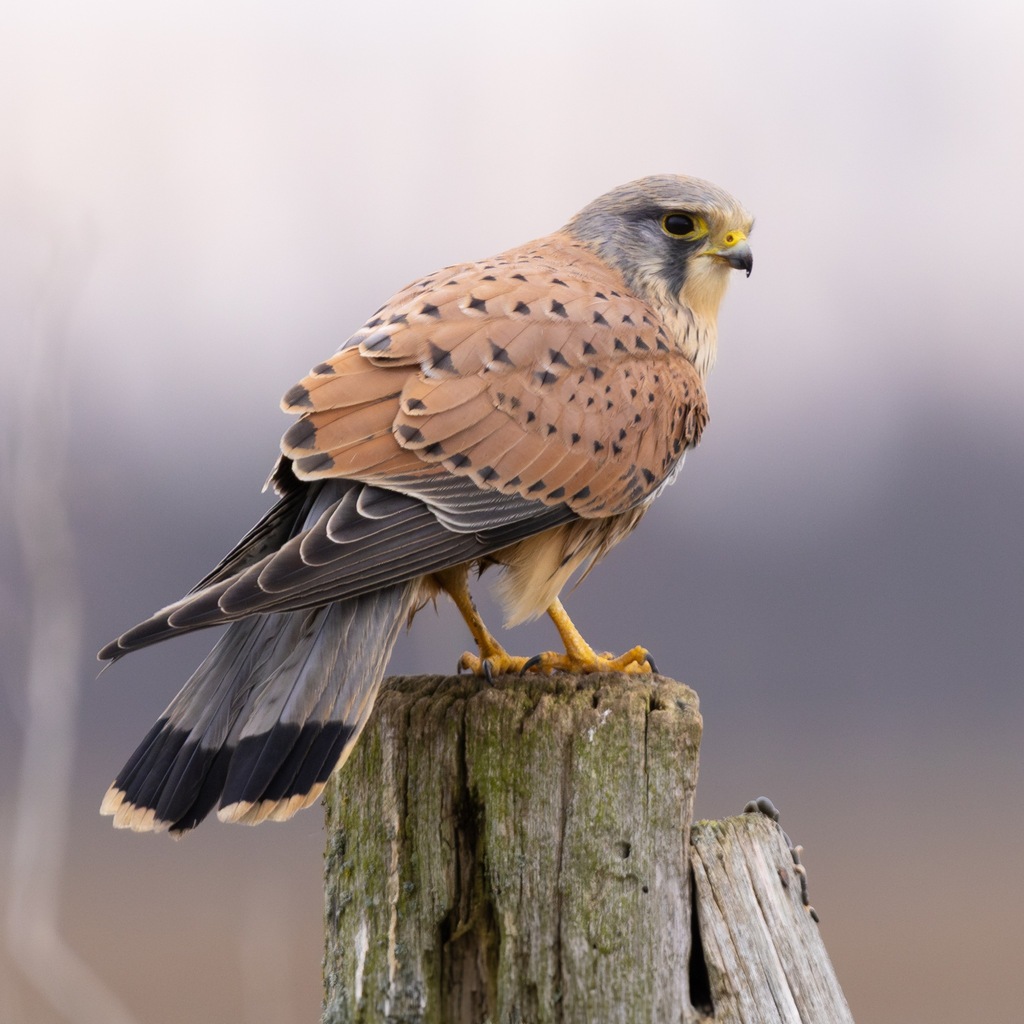
A small falcon famous for hovering motionless over roadside verges, head perfectly still while its wings and tail work against the wind. It is the most familiar bird of prey across much of Europe.
The common kestrel, also known as the European kestrel, Eurasian kestrel, Old World kestrel, is a species of predatory bird belonging to the kestrel group of the falcon family Falconidae. In the United Kingdom, where no other kestrel species commonly occurs, it is generally just called the "kestrel". Wikipedia
What it can do
- iHovers into the wind while keeping its head almost perfectly still
- iiSees ultraviolet light and can detect the UV-reflective urine trails of voles
- iiiNests in cliffs, old crow nests, buildings and nest boxes
- ivPopulations rise and fall with vole cycles
In the field
Field marks
- aMale: blue-grey head and tail with a black tail band, spotted chestnut back
- bFemale: brown above with barring, barred tail
- cLong, pointed wings; long tail
- dBlack moustache mark
- Voice
- A shrill, rapid 'kee-kee-kee' near the nest.
- Not to be confused with
- Lesser kestrel (Mediterranean, steppes) males have an unspotted back and grey wing panel, and it is colonial. Merlin is smaller, darker and rarely hovers. Sparrowhawk has rounded wings.
- Where to see it
- Motorway verges and farmland across Europe; city buildings from Madrid to Istanbul.
- When
- Resident in western and southern Europe; northern and eastern birds migrate south
Listen
Looking for field recordings…
Life & habits
- Diet
- Voles and mice; also lizards, large insects and small birds
- Habitat
- Open country, farmland, moorland, roadsides, cities
- Size
- 32–39 cm; wingspan 65–82 cm; 136–314 g
- Lifespan
- Typically about 4 years; record over 15
Hangs in the air, then drops in stages before a final plunge onto prey in the grass.
Where it lives
Recorded sightings
—
geo-referenced records in GBIF, from museums, herbaria and field observers.
Native range
Europe, Africa, the Middle East, Central Asia and Asia to China and Japan
Drag the globe to turn it. Dots are where records exist, not a range map; darker means more records.
In the old herbals & bestiaries
Woodcuts and engravings matched from the Source Library’s scanned books by name. Plates marked “relative” show a close kin rather than this exact species. Click a plate to read the page it came from, with translation.

François Bouchard — Recueil de cent-trente-trois oiseaux des plus belles especes (1775)
François Bouchard · 1775 · p.38

History of Animals, Book I: On Viviparous Quadrupeds
Conrad Gessner · 1554 · p.239

Ornithology
Ulisse Aldrovandi · 1599 · p.395

François Bouchard — Recueil de cent-trente-trois oiseaux des plus belles especes (1775)
François Bouchard · 1775 · p.85

Ornithology
Ulisse Aldrovandi · 1599 · p.392
In the stacks
Searching the stacks…
Every page naming Falco tinnunculus in the Biodiversity Heritage Library →
Marginalia
Gerard Manley Hopkins's 1877 sonnet 'The Windhover' celebrated its hovering, and Barry Hines's 1968 novel 'A Kestrel for a Knave', filmed as 'Kes', took its title from the hawk assigned to the lowest rank in medieval falconry.
Curiosity
Experiments in Finland in 1995 showed kestrels can see vole scent marks because urine and faeces reflect ultraviolet light.
Kinship
- kingdomAnimalia
- ›phylumChordata
- ›subphylumVertebrata
- ›classAves
- ›orderFalconiformes
- ›familyFalconidae
- ›genusFalco
Neighbours on the shelf
Fact-checked: 1 correction made to this sheet. Photographs: iNaturalist contributors under the licences shown. Records: GBIF.org. Historical plates: Source Library (CC BY-SA 4.0; originals public domain). Summary text: Nature Library editors and Wikipedia (CC BY-SA). Medicinal and edibility notes are historical and educational, not advice. iNaturalist taxon 472766.