 NL·0466
Herbarium of the Nature Library
- Name
- Giraffa camelopardalis
- Family
- Giraffidae
- Native to
- Savannas and woodlands of Sub-Saharan Africa, from Niger and Chad to South Africa
- Habitat
- Savanna, Open woodland
Giraffe
Giraffa camelopardalis
Also calledTwiga (Swahili) · Zarāfa (Arabic) · Indlulamithi, 'taller than the trees' (Zulu) · Kirin (Japanese) · Chángjǐnglù 长颈鹿 (Chinese)
The tallest living animal, browsing acacia leaves up to nearly 6 m above the ground. Its heart and blood vessels are specially adapted to pump blood all the way up that long neck.
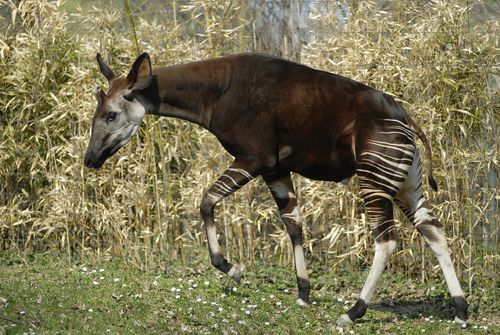
Giraffes are large African hoofed mammals. They are the tallest living terrestrial animals and the largest ruminants on Earth. They are classified under the family Giraffidae, along with their closest extant relative, the okapi. Traditionally, giraffes have been thought of as one species, Giraffa camelopardalis, with nine subspecies. Most recently, researchers proposed dividing them into four extant species, with seven subspecies, which can be distinguished morphologically by their fur coat patterns. Six valid extinct species of Giraffa are known from the fossil record. Wikipedia
What it can do
- iReaches leaves up to ~5.5–6 m high
- iiHas a heart of over 10 kg that drives blood pressure about twice a human's
- iiiTight skin on its legs works like a compression stocking to stop blood pooling
- ivStrips thorny acacia with a dark, prehensile tongue about 45 cm long
- vCan kill a lion with a kick
In the field
Field marks
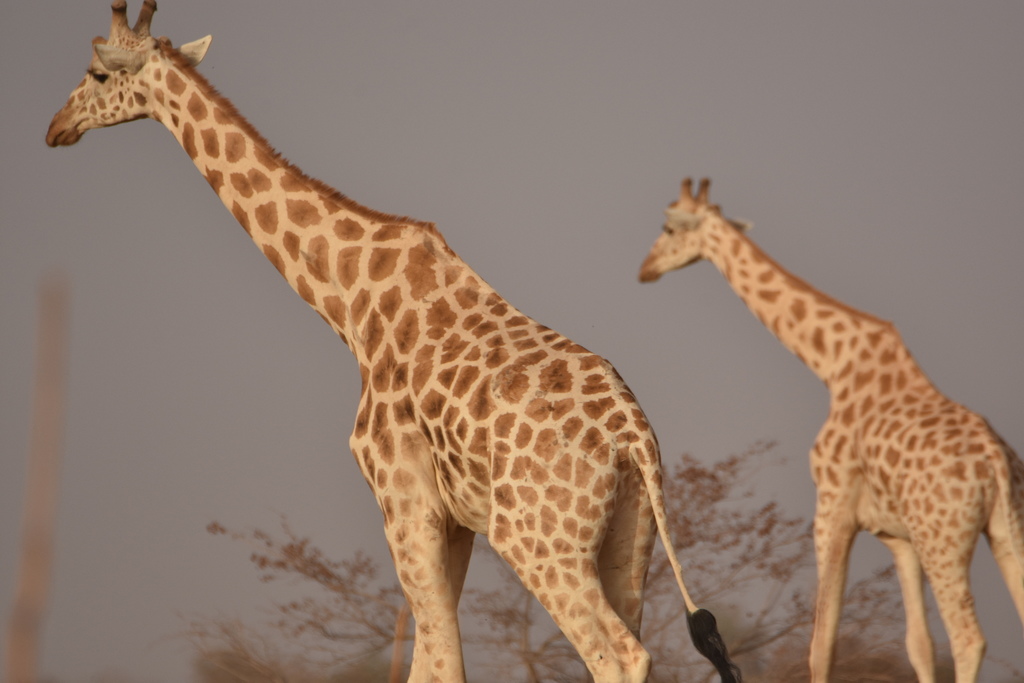
- aTallest animal
- bPatched coat
- cLong neck and legs
- dOssicones on the head
- Not to be confused with
- Patterns vary between giraffe species and subspecies.
- Where to see it
- Etosha (Namibia), Maasai Mara (Kenya) and Kruger (South Africa)
- When
- Resident
Listen
Looking for field recordings…
Life & habits
- Diet
- Herbivore: leaves, shoots and flowers, especially of acacia; up to ~30 kg a day
- Habitat
- Savanna and open woodland
- Size
- Males up to ~5.5 m tall and ~1,200 kg; females smaller
- Lifespan
- ~25 years
Males fight by 'necking', swinging their necks to hit each other with their ossicones. Giraffes sleep only briefly, often standing up.
Where it lives
Recorded sightings
—
geo-referenced records in GBIF, from museums, herbaria and field observers.
Native range
Savannas and woodlands of Sub-Saharan Africa, from Niger and Chad to South Africa
Drag the globe to turn it. Dots are where records exist, not a range map; darker means more records.
In the old herbals & bestiaries
Woodcuts and engravings matched from the Source Library’s scanned books by name. Plates marked “relative” show a close kin rather than this exact species. Click a plate to read the page it came from, with translation.


In the stacks
Searching the stacks…
Every page naming Giraffa camelopardalis in the Biodiversity Heritage Library →
Marginalia
A giraffe from Malindi reached the Ming court in 1414 with Zheng He's fleets and was hailed as a qilin, an auspicious beast. Lorenzo de' Medici's giraffe caused a sensation in Florence in 1486, as did 'Zarafa', sent by Egypt's ruler to Charles X of France in 1827.
Curiosity
Despite its length, a giraffe's neck has only seven vertebrae, the same number as a human's.
Kinship




Photographs: iNaturalist contributors under the licences shown. Records: GBIF.org. Historical plates: Source Library (CC BY-SA 4.0; originals public domain). Summary text: Nature Library editors and Wikipedia (CC BY-SA). Medicinal and edibility notes are historical and educational, not advice. iNaturalist taxon 42157.