 NL·0347
Herbarium of the Nature Library
- Name
- Macrochelys temminckii
- Family
- Chelydridae
- Native to
- Rivers draining into the Gulf of Mexico in the southeastern United States, from eastern Texas to the Florida Panhandle and up the Mississippi basin
- Habitat
- Rivers, Swamps, Oxbow lakes
Alligator snapping turtle
Macrochelys temminckii
Also calledLoggerhead snapper · Tortuga caimán (Spanish)
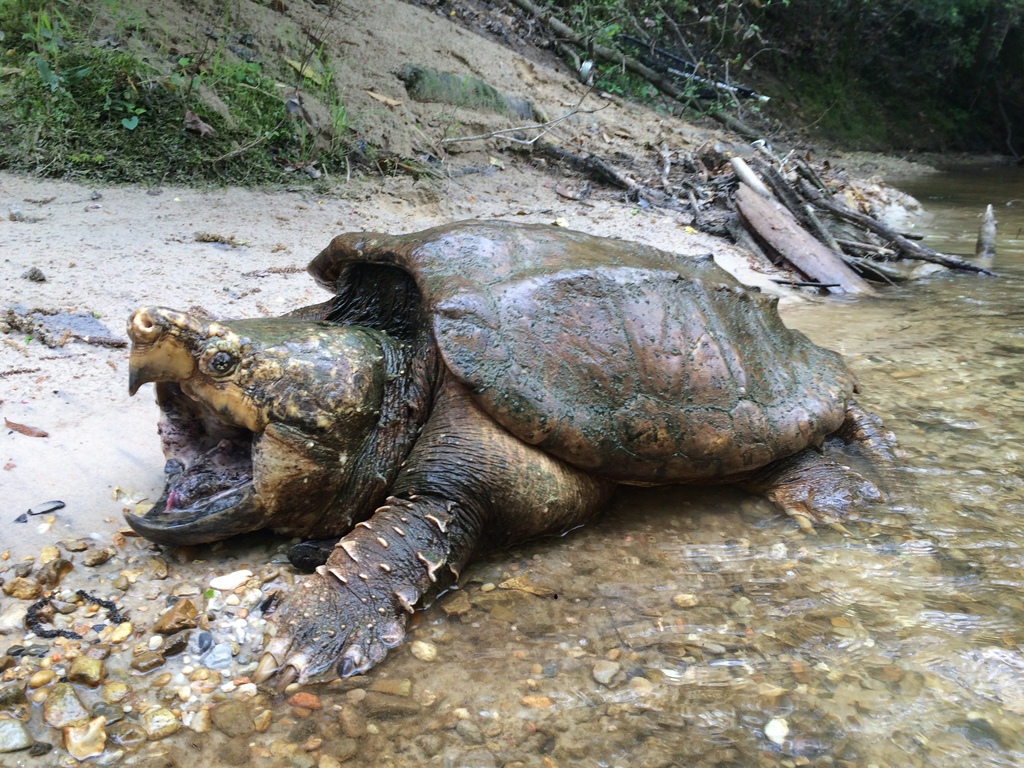
North America's heaviest freshwater turtle, with three rows of spiky ridges on its shell and a hooked beak. It lies still on the riverbed with its mouth open, wiggling a pink worm-like lure on its tongue to attract fish.
The alligator snapping turtle is a large species of turtle in the family Chelydridae. They are the largest freshwater turtle in North America. The species is endemic to freshwater habitats in the United States. M. temminckii is one of the heaviest living freshwater turtles in the world. It is often associated with, but not closely related to, the common snapping turtle, which is in the genus Chelydra. The specific epithet temminckii is in honor of Dutch zoologist Coenraad Jacob Temminck. Wikipedia
What it can do
- iLures fish with a pink, worm-like flap on its tongue
- iiBites hard enough to sever fingers
- iiiCan stay underwater for long periods, surfacing only occasionally to breathe
In the field
Field marks
- aThree prominent rows of spiky ridges running along the shell
- bMassive head with a strongly hooked beak
- cEyes on the sides of the head, ringed with fleshy points
- dExtra row of scutes (supramarginals) along the sides of the shell
- Not to be confused with
- The common snapping turtle (Chelydra serpentina) has a smoother shell, eyes visible from above, and a long, saw-crested tail. The Suwannee alligator snapping turtle (M. suwanniensis) of the Suwannee River in Florida and Georgia was split as a separate species in 2014.
- Where to see it
- Rivers of Louisiana, Arkansas, Mississippi and Texas; seen basking rarely; best seen at aquariums and zoos
- When
- Resident; nests in late spring
Life & habits
- Diet
- Fish, other turtles, snakes, crayfish, mussels, carrion, fallen fruit and nuts
- Habitat
- Deep rivers, oxbow lakes, swamps and canals
- Size
- Shell up to ~80 cm; males up to ~80 kg, exceptionally more
- Lifespan
- Probably several decades; possibly 70+ years
Rarely leaves the water except for females coming ashore to nest. It is mostly inactive by day.
Where it lives
Recorded sightings
—
geo-referenced records in GBIF, from museums, herbaria and field observers.
Native range
Rivers draining into the Gulf of Mexico in the southeastern United States, from eastern Texas to the Florida Panhandle and up the Mississippi basin
Drag the globe to turn it. Dots are where records exist, not a range map; darker means more records.
In the stacks
Searching the stacks…
Every page naming Macrochelys temminckii in the Biodiversity Heritage Library →
Marginalia
Commercial trapping for turtle soup in the 20th century took huge numbers from Gulf Coast rivers, and commercial harvest is now banned in most of its range.
Curiosity
As in many turtles, the sex of the hatchlings is set by the temperature of the nest.
Kinship




Fact-checked: 1 correction made to this sheet. Photographs: iNaturalist contributors under the licences shown. Records: GBIF.org. Historical plates: Source Library (CC BY-SA 4.0; originals public domain). Summary text: Nature Library editors and Wikipedia (CC BY-SA). Medicinal and edibility notes are historical and educational, not advice. iNaturalist taxon 521318.