 NL·0572
Herbarium of the Nature Library
- Name
- Odontodactylus scyllarus
- Family
- Odontodactylidae
- Native to
- Indo-Pacific from East Africa to Guam, the Philippines and northern Australia
- Habitat
- Coral reef, Rubble and sand flats
Peacock mantis shrimp
Odontodactylus scyllarus
Also calledUdang mantis (Indonesian) · Mon-hanashako (Japanese) · Quèwěi tángláng xiā 雀尾螳螂虾 (Chinese) · Thumb-splitter (aquarists' slang)
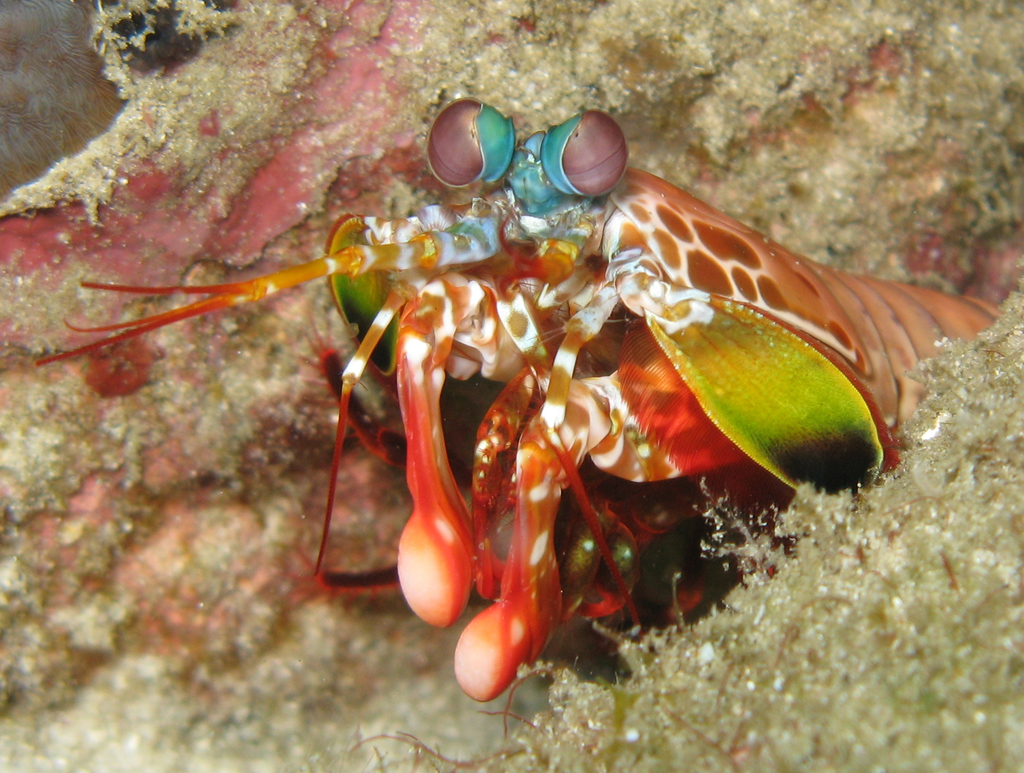
A rainbow-coloured crustacean of Indo-Pacific reefs with one of the fastest punches in the animal kingdom. Its spring-loaded clubs smash snail shells and crab armour, and its eyes see colours and light polarisation in ways no other animal is known to.
Odontodactylus scyllarus, commonly known as the peacock mantis shrimp, harlequin mantis shrimp, painted mantis shrimp, clown mantis shrimp, rainbow mantis shrimp, peacock odontodactyl, thumb splitter, or simply mantis shrimp, is a large odontodactylid stomatopod native to the epipelagic seabed across the Indo-Pacific, ranging from the Marianas to East Africa, and as far South as Northern KwaZulu Natal in South Africa. It is one of roughly 480 species of mantis shrimp, which are well known for their raptorial claws, exceptional vision, and their unique way of interacting with other marine species. Wikipedia
What it can do
- iStrikes with its club at about 23 m/s, with an acceleration comparable to a .22-calibre bullet
- iiEach strike forms collapsing cavitation bubbles that deliver a second shock to prey
- iiiHas 12–16 types of photoreceptor and sees ultraviolet and circularly polarised light
- ivEach eye judges depth on its own, using three separate zones
- vIts club's spiral (helicoidal) structure absorbs impacts and has inspired new composite materials
In the field
Field marks
- aBrightly coloured green, red and blue
- bClub-like raptorial limbs folded under the head
- cLarge stalked eyes
- dLives in burrows
- Not to be confused with
- Other mantis shrimps. Its strike can break aquarium glass and cut fingers; do not handle.
- Where to see it
- Lembeh Strait (Indonesia) and Anilao (Philippines)
- When
- Resident
Life & habits
- Diet
- Carnivore: snails, crabs, clams, worms
- Habitat
- U-shaped burrows in rubble and sand near coral reefs, 3–40 m
- Size
- 3–18 cm
- Lifespan
- Several years
It lines the entrance of its burrow with rubble and is known to strike at divers' fingers, which is why aquarists call it a 'thumb-splitter'.
Where it lives
Recorded sightings
—
geo-referenced records in GBIF, from museums, herbaria and field observers.
Native range
Indo-Pacific from East Africa to Guam, the Philippines and northern Australia
Drag the globe to turn it. Dots are where records exist, not a range map; darker means more records.
In the old herbals & bestiaries
Woodcuts and engravings matched from the Source Library’s scanned books by name. Plates marked “relative” show a close kin rather than this exact species. Click a plate to read the page it came from, with translation.


In the stacks
Searching the stacks…
Every page naming Odontodactylus scyllarus in the Biodiversity Heritage Library →
Marginalia
Linnaeus described it in 1758 as Cancer scyllarus. Hobbyists tell stories of mantis shrimps cracking aquarium glass, and their punch has been studied with high-speed cameras since the 2000s.
Curiosity
A mantis shrimp's club regrows each time the animal moults.
Kinship





Photographs: iNaturalist contributors under the licences shown. Records: GBIF.org. Historical plates: Source Library (CC BY-SA 4.0; originals public domain). Summary text: Nature Library editors and Wikipedia (CC BY-SA). Medicinal and edibility notes are historical and educational, not advice. iNaturalist taxon 119395.