 NL·0428
Herbarium of the Nature Library
- Name
- Oxyuranus microlepidotus
- Family
- Elapidae
- Native to
- Channel Country of southwestern Queensland and northeastern South Australia, with outlying records in New South Wales and the Northern Territory
- Habitat
- Desert, Arid floodplain, Gibber and clay plains
Inland taipan
Oxyuranus microlepidotus
Also calledFierce snake · Small-scaled snake · Dandarabilla (Aboriginal name recorded in the Channel Country)
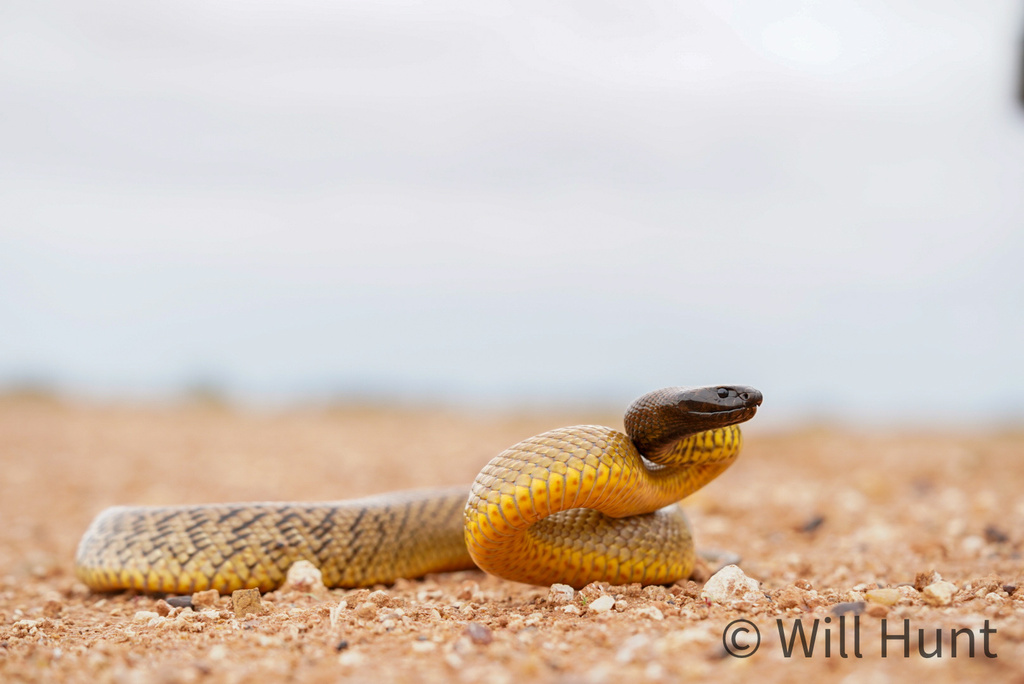
In standard mouse tests it has the most toxic venom of any land snake. It is also shy and lives in the remote cracking-clay floodplains of central Australia, and no human death from it has been recorded.
The inland taipan, also commonly known as the western taipan, small-scaled snake, or fierce snake, is a species of extremely venomous snake in the family Elapidae. It is endemic to semiarid regions of central‑eastern Australia. Aboriginal Australians living in areas where Karnic languages are spoken refer to this species as dandarabilla. Wikipedia
What it can do
- iIts venom, rich in neurotoxins and clotting toxins, is the most lethal of any land snake in mouse LD50 tests
- iiChanges colour with the seasons: dark in winter to absorb heat, paler in summer
- iiiHunts rats in their deep soil cracks and burrows, delivering several quick bites
In the field
Field marks
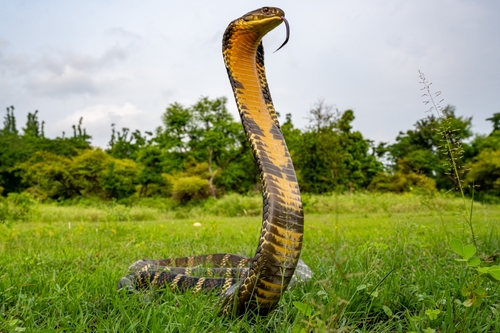
- aGlossy, rounded head that is darker than the body, almost black in winter
- bBody light brown to olive, many scales dark-edged, forming a faint herringbone pattern
- cLarge dark eyes; smooth scales
- dSlender, medium-large build
- Not to be confused with
- Easily confused with brown snakes (Pseudonaja), especially the eastern brown and the western brown or gwardar, which share its range and are also dangerous. Those lack the inland taipan's glossy dark head in cool months. The coastal taipan (O. scutellatus) lives far away in northern and eastern coastal Australia. No harmless species here can be safely told apart in the field; any medium-to-large brown snake in Australia should be treated as dangerous.
- Where to see it
- Rarely seen; remote Channel Country around Diamantina and Cooper Creek; best seen in reptile parks such as the Australian Reptile Park
- When
- Resident; most active in the early morning in spring and early summer
Life & habits
- Diet
- Almost entirely mammals, especially the long-haired rat (Rattus villosissimus)
- Habitat
- Deep soil cracks and burrows in black-soil floodplains with little vegetation
- Size
- Usually ~1.8 m; up to ~2.5 m
Usually slips away into a crack rather than face a person; almost all known bites have been to people handling the snake. Australian first aid for elapid bites is a firm pressure-immobilisation bandage along the whole bitten limb, a splint, keeping the person still and calling emergency services. Do not wash the bite site, because hospital venom-detection kits use the venom on the skin.
Where it lives
Recorded sightings
—
geo-referenced records in GBIF, from museums, herbaria and field observers.
Native range
Channel Country of southwestern Queensland and northeastern South Australia, with outlying records in New South Wales and the Northern Territory
Drag the globe to turn it. Dots are where records exist, not a range map; darker means more records.
In the stacks
Searching the stacks…
Every page naming Oxyuranus microlepidotus in the Biodiversity Heritage Library →
Marginalia
Frederick McCoy described it in 1879 from specimens collected near the Murray–Darling junction. It then went almost unrecorded by science for about 90 years until it was rediscovered in 1972.
Curiosity
Its seasonal colour change is among the strongest of any snake: the same individual can be almost black-headed in winter and pale straw in summer.
Kinship


Fact-checked: 1 correction made to this sheet. Photographs: iNaturalist contributors under the licences shown. Records: GBIF.org. Historical plates: Source Library (CC BY-SA 4.0; originals public domain). Summary text: Nature Library editors and Wikipedia (CC BY-SA). Medicinal and edibility notes are historical and educational, not advice. iNaturalist taxon 35172.