 NL·0586
Herbarium of the Nature Library
- Name
- Pangasianodon gigas
- Family
- Pangasiidae
- Native to
- Mekong basin of Cambodia, Laos, Thailand, Vietnam and possibly Myanmar and China; farmed in Thai reservoirs
- Habitat
- Large rivers, Deep river pools, Tonlé Sap lake system
Mekong giant catfish
Pangasianodon gigas
Also calledPla buek ปลาบึก (Thai) · Pa beuk (Lao) · Trey reach (Khmer, 'royal fish') · Cá tra dầu (Vietnamese)
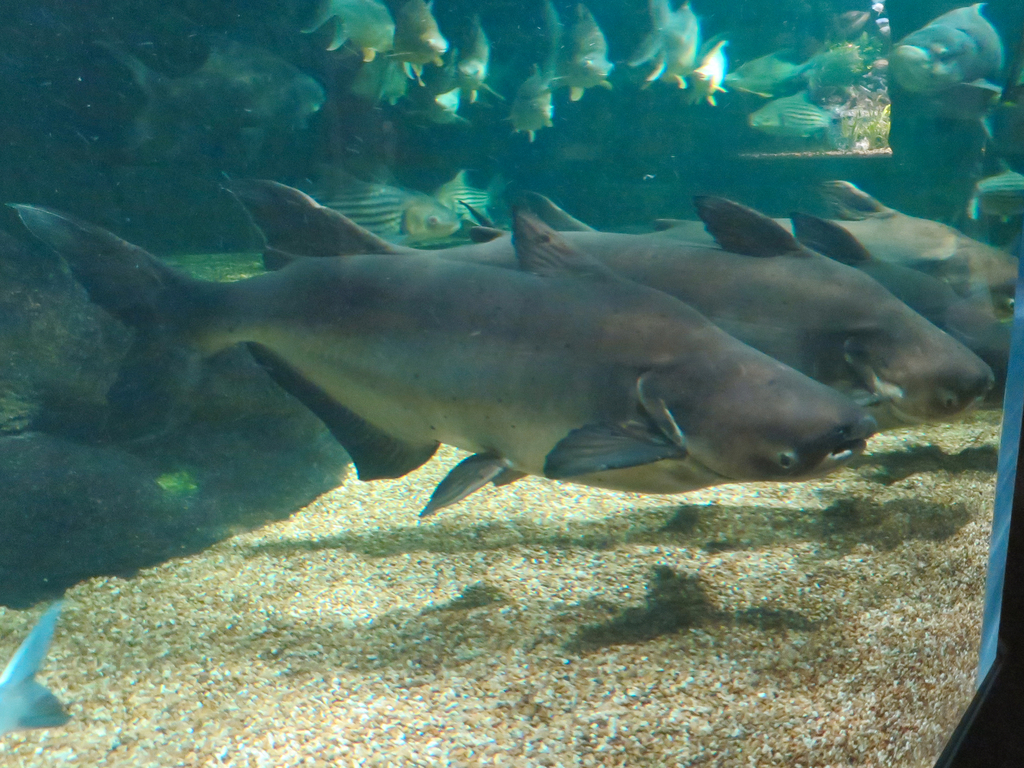
Among the largest freshwater fish ever weighed, a toothless, algae-eating giant of the Mekong that can top 290 kg. Wild numbers have collapsed with dams and overfishing, and it is Critically Endangered.
The Mekong giant catfish is a large species of catfish in the shark catfish family (Pangasiidae), native to the Mekong basin in Southeast Asia and adjacent China. It is considered critically endangered due to overfishing and habitat loss. Wikipedia
What it can do
- iGrows over 2.5 m and nearly 300 kg on a diet mostly of algae and plants
- iiLoses its teeth as it grows
- iiiMakes long migrations along the Mekong, apparently between Cambodian rearing areas and upstream spawning grounds
In the field
Field marks
- aHuge, shark-like, scaleless grey body with a white belly
- bSmall eyes set low on the head, below the line of the mouth
- cAdults have no barbels (juveniles have tiny ones) and no teeth
- dForked tail and a small adipose fin
- Not to be confused with
- Striped catfish (Pangasianodon hypophthalmus), the farmed 'swai' or 'tra', is much smaller, with barbels and stripes in juveniles. Giant pangasius (Pangasius sanitwongsei) has a toothed mouth, long barbels and dark-edged fins.
- Where to see it
- Bueng Boraphet reservoir and fishing parks in Thailand (farmed fish); Chiang Khong on the Mekong (historical fishery); public aquaria
- When
- Upstream migration and spawning April–June as Mekong waters rise
Life & habits
- Diet
- Herbivore as adults: algae and plant matter grazed from the riverbed; juveniles eat zooplankton
- Habitat
- Deep channels and pools of the main Mekong and large tributaries
- Size
- Up to about 3 m and 300 kg; the record 293 kg fish was 2.7 m long
Adults are believed to swim upriver at the end of the dry season to spawn in northern Thailand and Laos as the river rises.
Where it lives
Recorded sightings
—
geo-referenced records in GBIF, from museums, herbaria and field observers.
Native range
Mekong basin of Cambodia, Laos, Thailand, Vietnam and possibly Myanmar and China; farmed in Thai reservoirs
Drag the globe to turn it. Dots are where records exist, not a range map; darker means more records.
In the old herbals & bestiaries
No plate in the Source Library names this exact species, so these show its closest relatives as the old naturalists drew them: same genus, or the same kind of animal. Click a plate to read the page it came from, with translation.

History of Animals, Book II: On Oviparous Quadrupeds
Relative · Conrad Gessner · 1586 · p.698

The natural history of Carolina, Florida, and the Bahama Islands : containing two hundred a...
Relative · Catesby, Mark, bioloog, kunstenaar · 1743 · p.413

The natural history of Carolina, Florida, and the Bahama Islands : containing two hundred a...
Relative · Catesby, Mark, bioloog, kunstenaar · 1743 · p.78

Books on Marine Fishes
Relative · Guillaume Rondelet · 1554 · p.821

Commentaries on the Six Books of Dioscorides on Medical Matter
Relative · Pietro Andrea Mattioli · 1563 · p.305

History of Animals, Book II: On Oviparous Quadrupeds
Relative · Conrad Gessner · 1586 · p.686

Compendium of Materia Medica: Illustrated Volume, Middle of the Lower Part
Relative · 李時珍 · 1596 · p.92

Compendium of Materia Medica: Illustrated Volume, Middle of the Lower Part
Relative · 李時珍 · 1596 · p.90

Sancai Tuhui (Vol. 93)
Relative · 王圻, 王思義 · 1609 · p.60

Historia naturalis Brasiliae
Relative · Willem Piso / Georg Marcgraf · 1648 · p.318
In the stacks
Searching the stacks…
Every page naming Pangasianodon gigas in the Biodiversity Heritage Library →
Marginalia
Fishers at Chiang Khong, Thailand, held ceremonies to the river spirits before the yearly pla buek hunt, a tradition of the Tai Lue and Lao. In May 2005 they landed a 293 kg female, the heaviest freshwater fish weighed and documented at the time.
Curiosity
Even at nearly 300 kg, adults feed mostly on algae, making the Mekong giant catfish one of the largest plant-eating fish known.
Kinship




Photographs: iNaturalist contributors under the licences shown. Records: GBIF.org. Historical plates: Source Library (CC BY-SA 4.0; originals public domain). Summary text: Nature Library editors and Wikipedia (CC BY-SA). Medicinal and edibility notes are historical and educational, not advice. iNaturalist taxon 108331.