 NL·0594
Herbarium of the Nature Library
- Name
- Parus major
- Family
- Paridae
- Native to
- Europe, North Africa, the Middle East and Central Asia east to the Amur; eastern Asian populations are now treated as separate species
- Habitat
- Temperate forest, Woodland, Gardens and parks
On eBird ↗
Great Tit
Live sightings near you, the range map, bar charts of when it is seen, and Macaulay Library photos and recordings.
Great tit
Parus major
Also calledBüyük baştankara (Turkish) · Charkh-risak-e bozorg (Persian) · Kohlmeise (German) · Mésange charbonnière (French) · Carbonero común (Spanish)
The largest European tit, green and yellow with a glossy black head and a black stripe down the belly. It is one of the most studied wild birds in the world, thanks to long-running nest-box projects such as Wytham Woods near Oxford since 1947.
The great tit is a small passerine bird in the tit family Paridae. It is widespread and common throughout Europe, the Middle East, Central Asia and as far east as the Amur River. It also occurs in parts of North Africa where it is generally resident in any sort of woodland. Most great tits do not migrate, except in extremely harsh winters. Until 2005 this species was lumped with numerous other subspecies. However, DNA studies have revealed that these subspecies are distinct from the great tit, and they have now been classified as two distinct species, the cinereous tit of southern Asia, and the Japanese tit of East Asia. The great tit remains the most widespread species in the genus Parus. Wikipedia
What it can do
- iTimes egg-laying to the spring peak of winter-moth caterpillars, a classic climate-change study
- iiLearns new foraging tricks socially; traditions spread through populations in experiments
- iiiIn a Hungarian cave, great tits were recorded hunting and eating hibernating pipistrelle bats
- ivHas dozens of song variants and a large vocabulary of calls
In the field
Field marks
- aGlossy black head with bright white cheeks
- bYellow underparts split by a black central stripe, broader in males
- cGreenish back, blue-grey wings with a white wing bar
- dLarger than blue tit
- Voice
- Extremely varied; the classic song is a ringing two-note 'teacher-teacher' or 'tee-cha'; also a scolding 'churr' and a ringing 'pink'.
- Not to be confused with
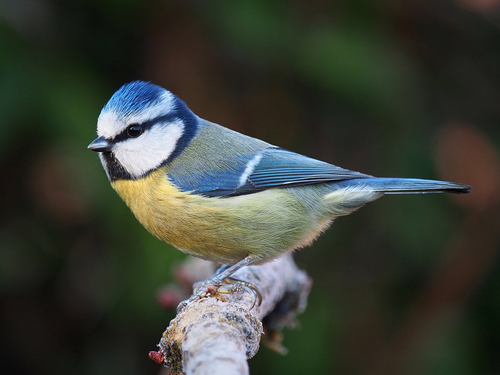
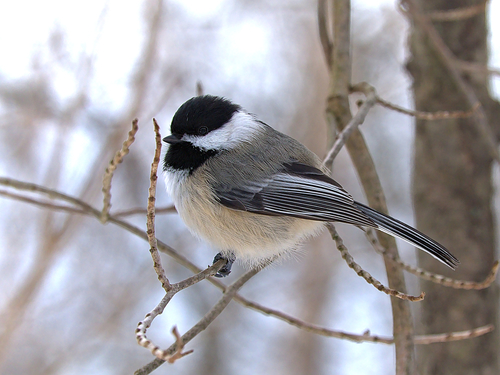
- Coal tit is much smaller with a white nape patch and no yellow. Blue tit has a blue crown and lacks the black breast stripe. Sombre tit (Balkans, Turkey) has a dusky cap and no yellow.
- Where to see it
- Gardens, parks and woods throughout Europe and western Asia; Wytham Woods, Oxford, is its research home.
- When
- Resident year-round; song from late winter
Listen
Looking for field recordings…
Life & habits
- Diet
- Caterpillars and other insects; seeds and nuts, especially beechmast, in winter
- Habitat
- Deciduous and mixed woodland, parks, gardens, orchards
- Size
- 12.5–14 cm; 16–21 g
- Lifespan
- Typically 1–3 years
A bold visitor to feeders that forms mixed flocks with other tits in winter and nests readily in boxes.
Where it lives
Recorded sightings
—
geo-referenced records in GBIF, from museums, herbaria and field observers.
Native range
Europe, North Africa, the Middle East and Central Asia east to the Amur; eastern Asian populations are now treated as separate species
Drag the globe to turn it. Dots are where records exist, not a range map; darker means more records.
In the old herbals & bestiaries
Woodcuts and engravings matched from the Source Library’s scanned books by name. Plates marked “relative” show a close kin rather than this exact species. Click a plate to read the page it came from, with translation.

History of Animals, Book I: On Viviparous Quadrupeds
Conrad Gessner · 1554 · p.801

Historiae Animalium Liber III: De Avium Natura
Conrad Gesner · 1555 · p.656

The Natural History of Carolina, Florida and the Bahama Islands, Vol. 1
Mark Catesby · 1777 · p.194

The Natural History of Carolina, Florida and the Bahama Islands, Vol. 1
Mark Catesby · 1777 · p.188

Notable Commentaries on the History of Plants
Leonhart Fuchs · 1542 · p.178

History of Animals, Book I: On Viviparous Quadrupeds
Conrad Gessner · 1554 · p.803
In the stacks
Searching the stacks…
Every page naming Parus major in the Biodiversity Heritage Library →
Marginalia
Its two-note song was called the 'saw-sharpener' in English country lore, and the Wytham Woods population, studied since 1947 by the Edward Grey Institute, has shaped modern ideas about natural selection in the wild.
Curiosity
Great tit eggs have been laid progressively earlier in the Netherlands and Britain as springs have warmed, one of the best documented biological responses to climate change.
Kinship




Photographs: iNaturalist contributors under the licences shown. Records: GBIF.org. Historical plates: Source Library (CC BY-SA 4.0; originals public domain). Summary text: Nature Library editors and Wikipedia (CC BY-SA). Medicinal and edibility notes are historical and educational, not advice. iNaturalist taxon 203153.