 NL·0735
Herbarium of the Nature Library
- Name
- Phycodurus eques
- Family
- Syngnathidae
- Native to
- Southern and western coasts of Australia, from Jurien Bay (WA) to Wilsons Promontory (Vic)
- Habitat
- Kelp forest, Seagrass, Rocky reef
Leafy seadragon
Phycodurus eques
Also calledGlauert's seadragon · Dragón de mar foliáceo (Spanish) · Dragon de mer feuillu (French)
A relative of the seahorse draped in leaf-like skin flaps, drifting through southern Australian kelp like a fragment of seaweed. As in seahorses, the male carries the eggs.
The leafy seadragon or Glauert's seadragon, is a marine fish. It is the only member of the genus Phycodurus in the family Syngnathidae, which includes seadragons, pipefish, and seahorses. Wikipedia
What it can do
- iLeaf-like appendages are purely for camouflage, not propulsion
- iiMales incubate up to ~250 eggs on a brood patch under the tail
- iiiMoves using nearly transparent pectoral and dorsal fins
- ivSucks tiny mysid shrimp through its tubular snout
In the field
Field marks
- aYellow-brown to olive body with leaf-like lobed appendages on head and body
- bLong tubular snout
- cThin pale bars on the body
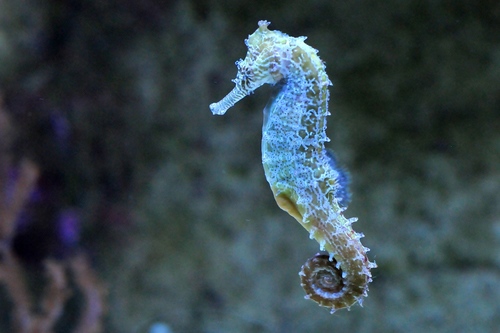
- dUnlike seahorses, the tail is not prehensile
- Not to be confused with
- Weedy seadragon (Phyllopteryx taeniolatus) is red with yellow spots and has few, simple appendages; ruby seadragon is red with no appendages.
- Where to see it
- Rapid Bay and Edithburgh jetties (South Australia), Kangaroo Island, Esperance (WA)
- When
- Year-round; males carry eggs in summer (Nov–Mar)
Life & habits
- Diet
- Mysid shrimp and other small crustaceans
- Habitat
- Rocky reefs, kelp and seagrass beds, 4–50 m
- Size
- Up to about 35 cm
- Lifespan
- Up to about 7–10 years
Sways gently in time with surrounding seaweed; males carry eggs for about 4–6 weeks before they hatch.
Where it lives
Recorded sightings
—
geo-referenced records in GBIF, from museums, herbaria and field observers.
Native range
Southern and western coasts of Australia, from Jurien Bay (WA) to Wilsons Promontory (Vic)
Drag the globe to turn it. Dots are where records exist, not a range map; darker means more records.
In the stacks
Searching the stacks…
Every page naming Phycodurus eques in the Biodiversity Heritage Library →
Marginalia
It is the marine emblem of South Australia and has been fully protected there since 1987.
Curiosity
Leafy seadragons cannot curl their tails to anchor like seahorses, so storms often wash them ashore.
Kinship





Photographs: iNaturalist contributors under the licences shown. Records: GBIF.org. Historical plates: Source Library (CC BY-SA 4.0; originals public domain). Summary text: Nature Library editors and Wikipedia (CC BY-SA). Medicinal and edibility notes are historical and educational, not advice. iNaturalist taxon 49105.