 NL·0530
Herbarium of the Nature Library
- Name
- Psilopogon haemacephalus
- Family
- Megalaimidae
- Native to
- Pakistan (Punjab and northwest), India, Sri Lanka, Nepal and Bangladesh through Southeast Asia to the Philippines and the Greater Sundas
- Habitat
- Urban, Open woodland, Gardens
On eBird ↗
Coppersmith Barbet
Live sightings near you, the range map, bar charts of when it is seen, and Macaulay Library photos and recordings.
Coppersmith barbet
Psilopogon haemacephalus
Also calledTambat (Hindi/Urdu; 'coppersmith') · Chì xiōng nǐ zhuómùniǎo 赤胸拟啄木鸟 (Chinese) · Crimson-breasted barbet
A small green barbet with a crimson forehead and breast patch, whose monotonous metallic 'tuk-tuk-tuk' sounds like a coppersmith hammering a pot. It is a familiar fruit-eater of fig trees in towns from Pakistan to the Philippines.
The coppersmith barbet, also called crimson-breasted barbet and coppersmith, is an Asian barbet with crimson forehead and throat, known for its metronomic call that sounds similar to a coppersmith striking metal with a hammer. It is a resident bird in the Indian subcontinent and parts of Southeast Asia. It carves out holes inside a tree to build its nest. It is predominantly frugivorous, but has been observed eating insects, especially winged termites. Wikipedia
What it can do
- iDisperses the seeds of figs and other fruiting trees
- iiExcavates its own nest hole in soft, dead wood
- iiiCalls for long periods with the throat puffing out on each note
In the field
Field marks
- aSmall, chunky green barbet with a heavy bill
- bCrimson forehead and crimson patch on the upper breast
- cYellow throat and yellow patches above and below the eye, separated by black
- dPale underparts streaked with green
- Voice
- A loud, repetitive, metallic 'tuk… tuk… tuk', kept up for minutes, like a hammer on copper
- Not to be confused with
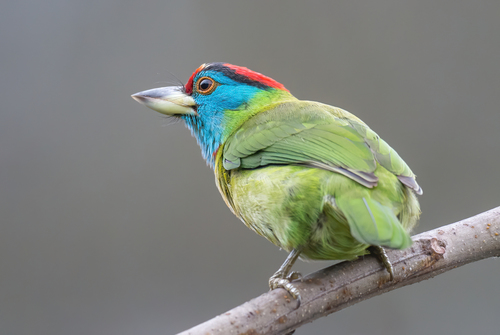
- Brown-headed barbet is larger, brown-headed and streaked, with an orange eye-patch; Blue-throated barbet (Himalaya) has a blue face and throat.
- Where to see it
- Fig and peepal trees in Lahore, Delhi, Kolkata and Colombo; Keoladeo National Park
- When
- Resident; calls loudly from February to May
Listen
Looking for field recordings…
Life & habits
- Diet
- Mainly figs and other fruit; some insects
- Habitat
- Groves, gardens and open woodland with fig and other fruit trees
- Size
- About 15–17 cm long
Often sits on a bare branch at the top of a tree in the morning sun, calling and bobbing its head left and right with each note.
Where it lives
Recorded sightings
—
geo-referenced records in GBIF, from museums, herbaria and field observers.
Native range
Pakistan (Punjab and northwest), India, Sri Lanka, Nepal and Bangladesh through Southeast Asia to the Philippines and the Greater Sundas
Drag the globe to turn it. Dots are where records exist, not a range map; darker means more records.
In the stacks
Searching the stacks…
Every page naming Psilopogon haemacephalus in the Biodiversity Heritage Library →
Marginalia
Its English and Hindi names both describe the call; in north Indian towns its steady hammering is one of the signature sounds of the hot season.
Curiosity
When calling, each 'tuk' is accompanied by a visible bulging of the throat skin, while the bird swings its head so the sound seems to come from different directions.
Kinship
- kingdomAnimalia
- ›phylumChordata
- ›subphylumVertebrata
- ›classAves
- ›orderPiciformes
- ›familyMegalaimidae
- ›genusPsilopogon
Neighbours on the shelf
Photographs: iNaturalist contributors under the licences shown. Records: GBIF.org. Historical plates: Source Library (CC BY-SA 4.0; originals public domain). Summary text: Nature Library editors and Wikipedia (CC BY-SA). Medicinal and edibility notes are historical and educational, not advice. iNaturalist taxon 367521.