 NL·0655
Herbarium of the Nature Library
- Name
- Ptilonorhynchus violaceus
- Family
- Ptilonorhynchidae
- Native to
- Eastern and south-eastern Australia
- Habitat
- Rainforest edge, Eucalyptus forest, Suburban gardens
On eBird ↗
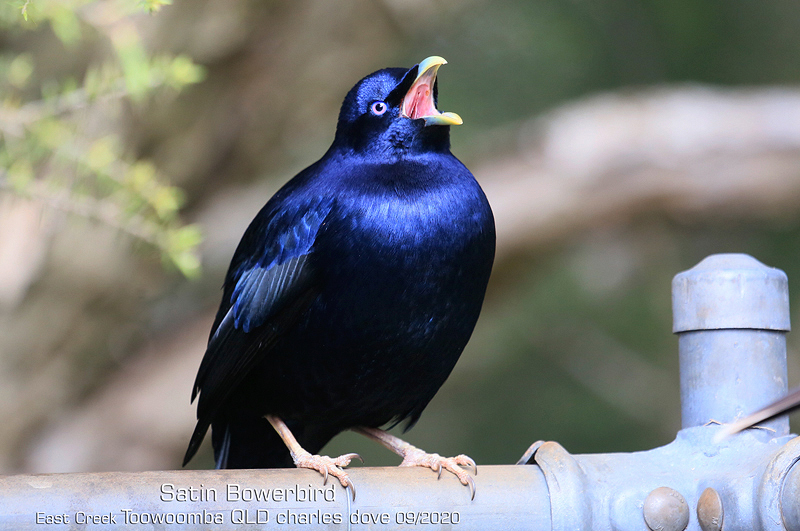
Satin Bowerbird
Live sightings near you, the range map, bar charts of when it is seen, and Macaulay Library photos and recordings.
Satin bowerbird
Ptilonorhynchus violaceus
Also calledJardinero satinado (Spanish) · Satinvogel (German)
An Australian bird whose males build a two-walled stick avenue and decorate it with blue objects to court females. The female chooses a mate by inspecting his bower and display.
The satin bowerbird is a species of passerine bird in the bowerbird family Ptilonorhynchidae that is endemic to eastern Australia. It is the only species placed in the genus Ptilonorhynchus. Wikipedia
What it can do
- iBuilds an avenue bower of hundreds of sticks
- iiCollects blue items such as feathers, flowers, bottle caps and straws
- iiiPaints the bower walls with chewed plant juice, sometimes using a wad of bark as a tool
- ivMimics other birds' calls during display
In the field
Field marks
- aAdult male glossy blue-black with violet-blue eyes
- bFemale and young males olive-green with scalloped underparts
- cPale yellowish bill
- dMales build an avenue bower of sticks decorated with blue objects
- Voice
- Loud whistles, buzzing and mechanical sounds, and mimicry at the bower
- Not to be confused with
- Young males look like females for several years. Regent bowerbird male is black and gold.
- Where to see it
- Lamington National Park (O'Reilly's), Queensland; Blue Mountains, NSW; Canberra's Australian National Botanic Gardens
- When
- Resident; bowers most active in spring and early summer
Listen
Looking for field recordings…
Life & habits
- Diet
- Fruit, leaves and insects
- Habitat
- Moist forest and adjacent woodland and gardens
- Size
- 27–33 cm
- Lifespan
- Around 20 years
Males take seven years to gain their glossy blue-black plumage, and young males build practice bowers while still green.
Where it lives
Recorded sightings
—
geo-referenced records in GBIF, from museums, herbaria and field observers.
Native range
Eastern and south-eastern Australia
Drag the globe to turn it. Dots are where records exist, not a range map; darker means more records.
In the stacks
Searching the stacks…
Every page naming Ptilonorhynchus violaceus in the Biodiversity Heritage Library →
Marginalia
Nineteenth-century naturalists such as John Gould puzzled over bowers as 'playing-places', and Darwin discussed them in 'The Descent of Man' (1871) as evidence of aesthetic choice in sexual selection.
Curiosity
Males steal blue decorations from rivals' bowers and sometimes wreck them.
Kinship





Photographs: iNaturalist contributors under the licences shown. Records: GBIF.org. Historical plates: Source Library (CC BY-SA 4.0; originals public domain). Summary text: Nature Library editors and Wikipedia (CC BY-SA). Medicinal and edibility notes are historical and educational, not advice. iNaturalist taxon 14539.