 NL·0689
Herbarium of the Nature Library
- Name
- Rastrelliger kanagurta
- Family
- Scombridae
- Native to
- Indo-West Pacific from the Red Sea and East Africa to Indonesia, Australia, Samoa and Japan; entered the eastern Mediterranean via the Suez Canal
- Habitat
- Coastal waters, Continental shelf
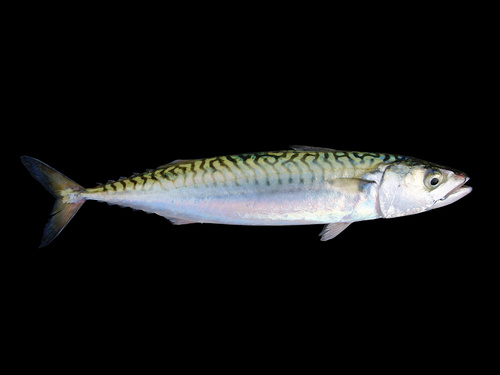
Indian mackerel
Rastrelliger kanagurta
Also calledBangda (Marathi/Hindi) · Ayala (Malayalam) · Bangude (Kannada/Konkani) · Kembung (Malay/Indonesian) · Pla thu (Thai, Rastrelliger spp.)
A small, inexpensive mackerel that feeds millions along the coasts of the Indian Ocean. It swims with its mouth open, filtering plankton through long, feathery gill rakers.
The Indian mackerel or bigmouth mackerel is a species of mackerel in the family Scombridae. It is commonly found in the Indian and West Pacific oceans, and their surrounding seas. It is an important food fish and is commonly used in South and South-East Asian cuisine. Wikipedia
What it can do
- iFilter-feeds by ram ventilation with long, dense gill rakers
- iiForms large schools near upwelling coasts during monsoon seasons
- iiiMatures in under a year
In the field
Field marks
- aDeep, compressed mackerel body with a pointed head
- bNarrow dark longitudinal stripes on the upper back
- cBlack spot near the lower margin of the pectoral fin
- dGolden lateral stripe in fresh fish
- eFive finlets behind dorsal and anal fins
- Not to be confused with
- Short mackerel (R. brachysoma) is deeper-bodied without back stripes; island mackerel (R. faughni) has dark spots instead of lines.
- Where to see it
- Fish markets of Kerala, Goa, Mangalore, Karachi and Colombo; reef dives in the Maldives and Red Sea where schools filter-feed open-mouthed
- When
- Peak fishery Sep–Mar on India's west coast
Life & habits
- Diet
- Phytoplankton, copepods, larval fish
- Habitat
- Coastal waters and bays with temperatures above 17 °C
- Size
- Usually 20–25 cm; up to 35 cm
- Lifespan
- About 3–4 years
Schools travel inshore along the Malabar and Konkan coasts with post-monsoon plankton blooms.
Where it lives
Recorded sightings
—
geo-referenced records in GBIF, from museums, herbaria and field observers.
Native range
Indo-West Pacific from the Red Sea and East Africa to Indonesia, Australia, Samoa and Japan; entered the eastern Mediterranean via the Suez Canal
Drag the globe to turn it. Dots are where records exist, not a range map; darker means more records.
In the old herbals & bestiaries
No plate in the Source Library names this exact species, so these show its closest relatives as the old naturalists drew them: same genus, or the same kind of animal. Click a plate to read the page it came from, with translation.

History of Animals, Book II: On Oviparous Quadrupeds
Relative · Conrad Gessner · 1586 · p.475

Books on Marine Fishes
Relative · Guillaume Rondelet · 1554 · p.254

Books on Marine Fishes
Relative · Guillaume Rondelet · 1554 · p.255

History of Animals, Book II: On Oviparous Quadrupeds
Relative · Conrad Gessner · 1586 · p.474

Historia naturalis Brasiliae
Relative · Willem Piso / Georg Marcgraf · 1648 · p.324

Theater of Earthly Creatures
Relative · Anonymous · 1672 · p.296

The Book of Household Management
Relative · Mrs Isabella Beeton · 1861 · p.193
In the stacks
Searching the stacks…
Every page naming Rastrelliger kanagurta in the Biodiversity Heritage Library →
Marginalia
Ayala and bangda fry and curry are staples of Kerala, Goa and Mangalorean cooking, and the fish has been salted and sun-dried on Indian beaches for centuries.
Curiosity
The species name comes from 'kanagurta', a Telugu name recorded by Patrick Russell in his 1803 account of the fishes of Vizagapatam on the Coromandel coast.
Kinship

Photographs: iNaturalist contributors under the licences shown. Records: GBIF.org. Historical plates: Source Library (CC BY-SA 4.0; originals public domain). Summary text: Nature Library editors and Wikipedia (CC BY-SA). Medicinal and edibility notes are historical and educational, not advice. iNaturalist taxon 133530.