 NL·0361
Herbarium of the Nature Library
- Name
- Sardinops sagax
- Family
- Clupeidae
- Native to
- Temperate upwelling coasts of the Pacific (California, Peru–Chile, Japan, Australia–New Zealand) and southern Africa
- Habitat
- Coastal waters, Upwelling zones
Pacific sardine
Sardinops sagax
Also calledSouth American pilchard · Ma-iwashi (Japanese) · Sardina monterrey (Spanish) · Pilchard (South Africa, Australia) · Sardina española (Peru/Chile)
A boom-and-bust forage fish of the cool upwelling coasts of the Pacific and southern Africa. Its numbers swing over decades, alternating with anchovies, and its collapse emptied Monterey's Cannery Row.
Sardinops is a genus of sardines of the family Alosidae. It is found in the Indo-Pacific, East Pacific, Southeastern Atlantic, and southwestern Indian oceans. Its length is up to 40 cm (16 in). It has numerous common or vernacular names, some of which more appropriately refer to subspecies, including blue pilchard, blue-bait, South American pilchard, Chilean sardine, and Pacific sardine. Wikipedia
What it can do
- iPopulations rise and crash over multi-decade cycles linked to ocean temperature regimes
- iiFilter-feeds on phytoplankton and zooplankton
- iiiSouth Africa's winter 'sardine run' draws dolphins, sharks, gannets and Bryde's whales in one of the ocean's great feeding spectacles
In the field
Field marks
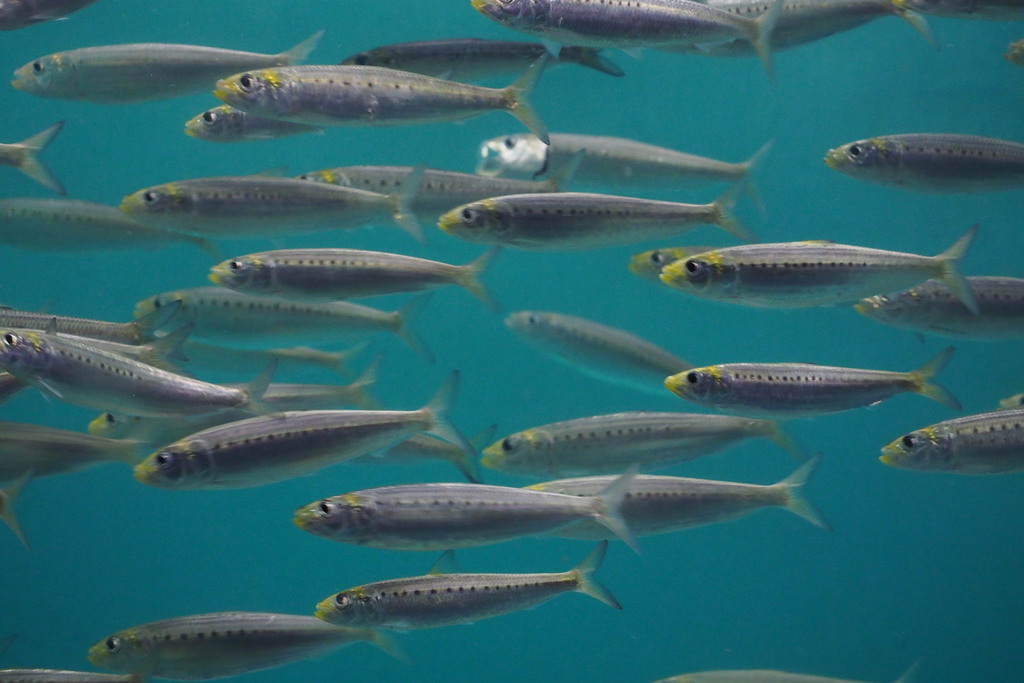
- aRounded, silvery body with a blue-green back
- bOne to three rows of dark spots along the upper sides
- cRadiating bony striae on the gill cover
- dSingle dorsal fin, forked tail
- Not to be confused with
- European pilchard (Sardina pilchardus) is very similar but lives in the NE Atlantic and Mediterranean; Pacific herring lacks the dark spots and gill-cover ridges.
- Where to see it
- Wild Coast and KwaZulu-Natal, South Africa (sardine run); Monterey Bay; California Current upwelling coasts
- When
- South African sardine run Jun–Jul
Life & habits
- Diet
- Phytoplankton and zooplankton
- Habitat
- Coastal pelagic waters, often near upwelling fronts
- Size
- Up to about 40 cm; commonly 15–25 cm
- Lifespan
- Up to about 13 years; most fewer
Migrates seasonally along coasts in vast schools; off South Africa's east coast, shoals move north in a tongue of cool water each winter.
Where it lives
Recorded sightings
—
geo-referenced records in GBIF, from museums, herbaria and field observers.
Native range
Temperate upwelling coasts of the Pacific (California, Peru–Chile, Japan, Australia–New Zealand) and southern Africa
Drag the globe to turn it. Dots are where records exist, not a range map; darker means more records.
In the old herbals & bestiaries
No plate in the Source Library names this exact species, so these show its closest relatives as the old naturalists drew them: same genus, or the same kind of animal. Click a plate to read the page it came from, with translation.


In the stacks
Searching the stacks…
Every page naming Sardinops sagax in the Biodiversity Heritage Library →
Marginalia
Monterey's sardine canneries, immortalised in John Steinbeck's Cannery Row (1945), closed after the stock collapsed in the late 1940s and 1950s.
Curiosity
Fish scales preserved in Santa Barbara Basin sediments show sardine booms and busts occurred for centuries before industrial fishing.
Kinship




Photographs: iNaturalist contributors under the licences shown. Records: GBIF.org. Historical plates: Source Library (CC BY-SA 4.0; originals public domain). Summary text: Nature Library editors and Wikipedia (CC BY-SA). Medicinal and edibility notes are historical and educational, not advice. iNaturalist taxon 55535.