 NL·0684
Herbarium of the Nature Library
- Name
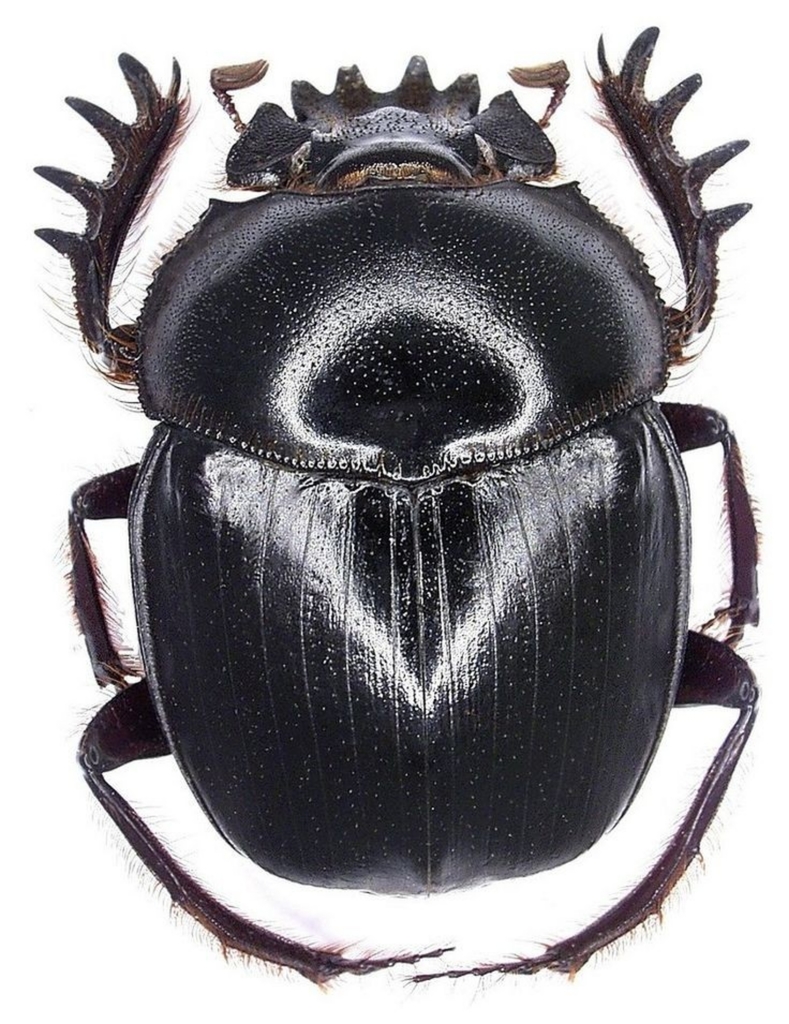
- Scarabaeus satyrus
- Family
- Scarabaeidae
- Native to
- Southern Africa
- Habitat
- Savanna, Grassland
Dung beetle (South African ball-roller)
Scarabaeus satyrus
Also calledMiskruier (Afrikaans) · Kheper (Ancient Egyptian, for scarabs) · Scarabée (French)
A nocturnal African dung beetle that shapes dung into a ball and rolls it away in a straight line. It is the first animal known to orient by the band of the Milky Way.
Scarabaeus satyrus is an African species of dung beetle. These beetles roll a ball of dung for some distance from where it was deposited, and bury it, excavating an underground chamber to house it. An egg is then laid in the ball, the growing larva feeding on the dung, pupating, and eventually emerging as an adult. Wikipedia
What it can do
- iHolds a straight course using the light gradient of the Milky Way on moonless nights
- iiClimbs onto its ball and 'dances' to take a celestial snapshot before rolling
- iiiBuries dung, recycling nutrients and aerating soil
- ivReduces fly breeding and parasite loads in grazing land
In the field
Field marks
- aMatte black beetle about 2–3 cm long
- bBroad, shovel-like head edged with teeth
- cFront legs flattened and toothed for digging and shaping dung
- dRolls a dung ball backwards with its hind legs
- Not to be confused with
- Southern Africa has many similar ball-rolling Scarabaeus species; telling them apart needs close examination of the head, legs and body sculpture.
- When
- Active in the southern summer and rainy season, when fresh dung is plentiful
Listen
Looking for field recordings…
Life & habits
- Diet
- Dung of herbivores
- Habitat
- Open savanna and grassland with large grazing mammals
- Size
- About 2–3 cm
Each beetle races away from the competitive dung pile in a straight line, the quickest way to escape ball thieves.
Where it lives
Recorded sightings
—
geo-referenced records in GBIF, from museums, herbaria and field observers.
Native range
Southern Africa
Drag the globe to turn it. Dots are where records exist, not a range map; darker means more records.
In the old herbals & bestiaries
Woodcuts and engravings matched from the Source Library’s scanned books by name. Plates marked “relative” show a close kin rather than this exact species. Click a plate to read the page it came from, with translation.


In the stacks
Searching the stacks…
Every page naming Scarabaeus satyrus in the Biodiversity Heritage Library →
Marginalia
Ancient Egyptians saw the ball-rolling scarab as Khepri pushing the sun across the sky, and carved scarab amulets by the thousands. In 2013 Marie Dacke and colleagues showed this species navigates by the Milky Way, testing it in the Johannesburg planetarium.
Curiosity
Researchers fitted beetles with tiny cardboard caps to block their view of the sky; capped beetles wandered in circles.
Kinship



Photographs: iNaturalist contributors under the licences shown. Records: GBIF.org. Historical plates: Source Library (CC BY-SA 4.0; originals public domain). Summary text: Nature Library editors and Wikipedia (CC BY-SA). Medicinal and edibility notes are historical and educational, not advice. iNaturalist taxon 1080637.