 NL·0705
Herbarium of the Nature Library
- Name
- Spheniscus demersus
- Family
- Spheniscidae
- Native to
- Coasts and islands of Namibia and South Africa
- Habitat
- Coastal, Island, Marine
On eBird ↗
African Penguin
Live sightings near you, the range map, bar charts of when it is seen, and Macaulay Library photos and recordings.
African penguin
Spheniscus demersus
Also calledBrilpikkewyn (Afrikaans) · Manchot du Cap (French) · Jackass penguin (English)
The only penguin that breeds in Africa, nesting on islands and beaches from Namibia to Algoa Bay. In 2024 it became the first penguin species classified as Critically Endangered.
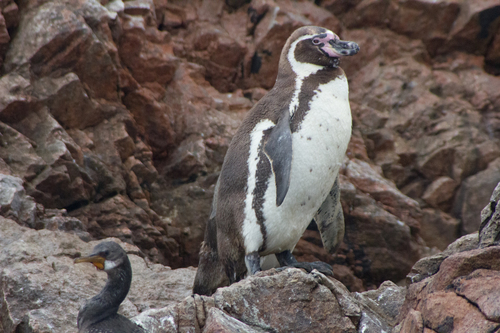
The African penguin, also known as the Cape penguin or the South African penguin, is a species of penguin confined to southern African waters. It is the only penguin found in the Old World. Like all penguins, it is flightless, with a streamlined body and wings stiffened and flattened into flippers for a marine habitat. Adults weigh an average of 2.2–3.5 kg (4.9–7.7 lb) and are 60–70 cm (24–28 in) tall. The species has distinctive pink patches of skin above the eyes and a black facial mask. The body's upper parts are black and sharply delineated from the white underparts, which are spotted and marked with a black band. Wikipedia
What it can do
- iDives to around 130 m and swims at up to about 20 km/h
- iiHas bare pink skin above the eye that helps shed heat
- iiiNests in burrows dug into guano or under bushes
In the field
Field marks
- aBlack back and white front
- bSingle black band across the chest
- cBare pink skin patch above the eye
- dWhite stripe curving from above the eye to the breast
- eUnique black spots on the chest
- Voice
- A loud, donkey-like braying, given with the head thrown back.
- Not to be confused with
- Magellanic penguin (South America) has two chest bands; Humboldt penguin has a broader pink face and one band. No other penguin breeds in Africa.
- Where to see it
- Boulders Beach (Simon's Town), Stony Point (Betty's Bay), Robben Island, Bird Island in Algoa Bay
- When
- Present year-round; breeds in most months, with peaks varying by colony
Listen
Looking for field recordings…
Life & habits
- Diet
- Sardines, anchovies and other small shoaling fish
- Habitat
- Rocky islands, sheltered beaches and the Benguela current
- Size
- About 60–70 cm; 2.2–3.5 kg
- Lifespan
- 10–25 years
Pairs reunite at the same burrow each season and greet each other with loud braying.
Where it lives
Recorded sightings
—
geo-referenced records in GBIF, from museums, herbaria and field observers.
Native range
Coasts and islands of Namibia and South Africa
Drag the globe to turn it. Dots are where records exist, not a range map; darker means more records.
In the old herbals & bestiaries
Woodcuts and engravings matched from the Source Library’s scanned books by name. Plates marked “relative” show a close kin rather than this exact species. Click a plate to read the page it came from, with translation.

In the stacks
Searching the stacks…
Every page naming Spheniscus demersus in the Biodiversity Heritage Library →
Marginalia
Its nests were destroyed by 19th- and 20th-century guano harvesting and its eggs collected for food; millions of eggs were taken from Dassen Island alone.
Curiosity
The breeding population has fallen below 10,000 pairs, down from perhaps over a million birds a century ago.
Kinship

Photographs: iNaturalist contributors under the licences shown. Records: GBIF.org. Historical plates: Source Library (CC BY-SA 4.0; originals public domain). Summary text: Nature Library editors and Wikipedia (CC BY-SA). Medicinal and edibility notes are historical and educational, not advice. iNaturalist taxon 3813.