 NL·0723
Herbarium of the Nature Library
- Name
- Strigops habroptila
- Family
- Strigopidae
- Native to
- New Zealand; now survives only on predator-free islands such as Whenua Hou and Anchor Island
- Habitat
- Temperate rainforest, Scrubland
On eBird ↗
Kakapo
Live sightings near you, the range map, bar charts of when it is seen, and Macaulay Library photos and recordings.
Kākāpō
Strigops habroptila
Also calledKākāpō (Māori, 'night parrot') · Owl parrot (English) · Perroquet-hibou (French)
The world's only flightless parrot and the heaviest parrot, a nocturnal, moss-green bird from New Zealand. Every surviving individual has a name and is closely monitored.
The kākāpō, sometimes known as the owl-parrot, is a species of large, nocturnal, ground-dwelling parrot of the superfamily Strigopoidea. It is endemic to New Zealand. Wikipedia
What it can do
- iHeaviest parrot, up to ~4 kg
- iiMales 'boom' with a call that can carry several kilometres
- iiiBreeds only in years when rimu trees fruit heavily
- ivCan live 60–90 years, among the longest-lived birds
- vClimbs trees and parachutes down on short wings
In the field
Field marks
- aLarge, flightless, moss-green parrot finely barred with black and yellow
- bOwl-like facial disc of whiskery feathers
- cHeavy grey bill
- dNocturnal; climbs trees and walks
- Voice
- Males 'boom' with a deep, resonant sound that carries kilometres, followed by a metallic 'ching'
- Not to be confused with
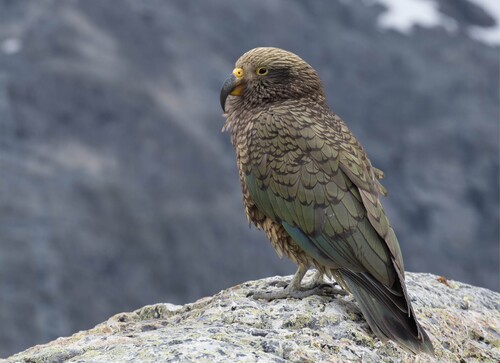
- Kea and kākā are flying parrots; kea is olive-green with orange underwings and lives in the mountains.
- Where to see it
- Its predator-free breeding islands are closed to the public
- When
- Breeds only in years when rimu trees fruit heavily; males boom in summer (about Dec–Mar) of those years
Listen
Looking for field recordings…
Life & habits
- Diet
- Leaves, shoots, seeds, fruit and pollen; rimu fruit in breeding years
- Habitat
- Native forest and scrub on predator-free islands
- Size
- 58–64 cm; males 2–4 kg
- Lifespan
- Estimated 60–90 years
Males gather at leks and dig bowl-shaped hollows from which they boom nightly for months to attract females.
Where it lives
Recorded sightings
—
geo-referenced records in GBIF, from museums, herbaria and field observers.
Native range
New Zealand; now survives only on predator-free islands such as Whenua Hou and Anchor Island
Drag the globe to turn it. Dots are where records exist, not a range map; darker means more records.
In the stacks
Searching the stacks…
Every page naming Strigops habroptila in the Biodiversity Heritage Library →
Marginalia
Māori hunted kākāpō for food and made feather cloaks (kahu kākāpō). By 1995 only 51 birds remained; a national recovery programme has since more than quadrupled the population.
Curiosity
A male named Sirocco became famous for trying to mate with a zoologist's head on television in 2009.
Kinship



Photographs: iNaturalist contributors under the licences shown. Records: GBIF.org. Historical plates: Source Library (CC BY-SA 4.0; originals public domain). Summary text: Nature Library editors and Wikipedia (CC BY-SA). Medicinal and edibility notes are historical and educational, not advice. iNaturalist taxon 1584019.