 NL·0725
Herbarium of the Nature Library
- Name
- Strongylocentrotus purpuratus
- Family
- Strongylocentrotidae
- Native to
- Pacific coast of North America from British Columbia (and parts of Alaska) to Baja California
- Habitat
- Kelp forest, Rocky intertidal, Rocky subtidal
Pacific purple sea urchin
Strongylocentrotus purpuratus
Also calledOursin violet (French) · Erizo de mar morado (Spanish)
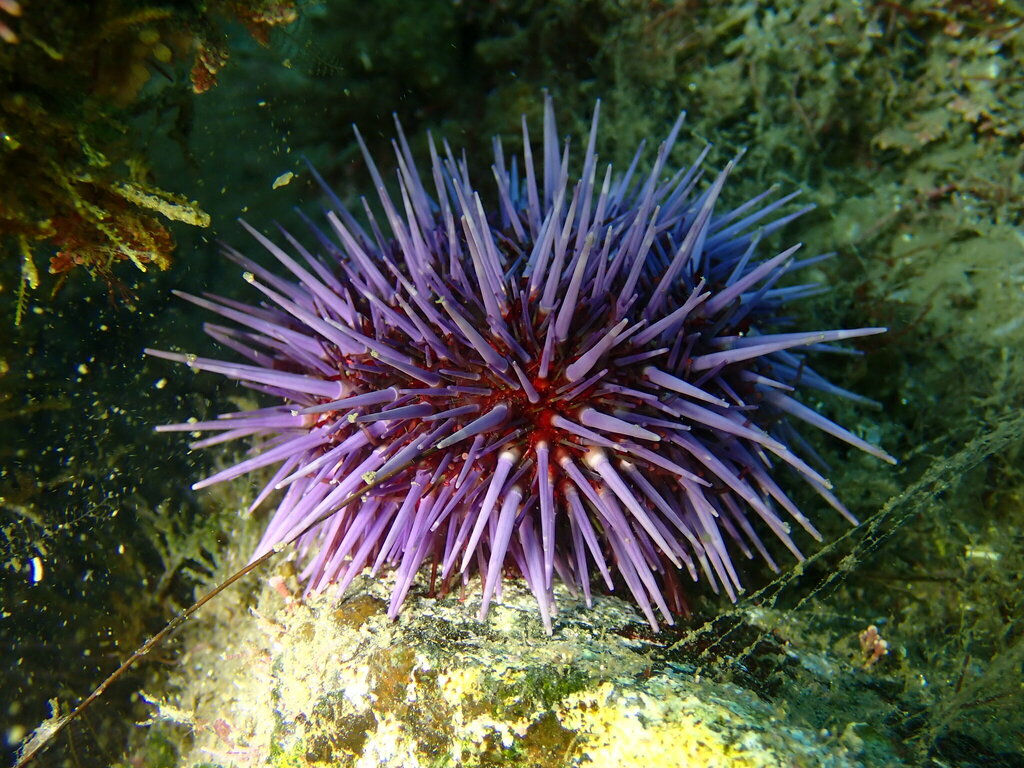
A spiny purple urchin of North America's Pacific coast that, when its predators decline, can mow down kelp forests and leave bare 'urchin barrens'. It is also a classic laboratory animal for studying fertilisation and embryo development.
Strongylocentrotus purpuratus is a species of sea urchin in the family Strongylocentrotidae, which is commonly known as the purple sea urchin or Pacific purple sea urchin. It lives along the eastern edge of the Pacific Ocean extending from Ensenada, Mexico, to British Columbia, Canada. Wikipedia
What it can do
- iGrinds algae and kelp with a five-toothed jaw called Aristotle's lantern
- iiBores pits into solid rock with its teeth and spines
- iiiSenses light with its tube feet, using its whole body as an eye
- ivCan survive years of starvation in barrens in a dormant-like state
- vSome individuals live 50 years or more
In the field
Field marks
- aRound, spiny urchin with dense, short, bright purple spines
- bJuveniles may be greenish
- cOften packed into rock pits it has bored itself
- dTube feet extend between the spines
- Not to be confused with
- Red sea urchin (Mesocentrotus franciscanus) is larger (to about 18 cm) with long red to maroon spines. Green urchin (S. droebachiensis) has greenish spines and lives mainly further north.
- Where to see it
- Tide pools and kelp reefs from Oregon to southern California; dense barrens off Mendocino and Sonoma counties since 2014.
- When
- Year-round
Life & habits
- Diet
- Kelp and other algae, especially drift kelp
- Habitat
- Rocky shores and reefs from the low intertidal to about 160 m
- Size
- Test about 5–10 cm across
- Lifespan
- Often decades; some over 50 years
When drift kelp is plentiful urchins hide in crevices; when it runs short they emerge and graze living kelp, sometimes creating barrens.
Where it lives
Recorded sightings
—
geo-referenced records in GBIF, from museums, herbaria and field observers.
Native range
Pacific coast of North America from British Columbia (and parts of Alaska) to Baja California
Drag the globe to turn it. Dots are where records exist, not a range map; darker means more records.
In the old herbals & bestiaries
No plate in the Source Library names this exact species, so these show its closest relatives as the old naturalists drew them: same genus, or the same kind of animal. Click a plate to read the page it came from, with translation.

A voyage to the islands Madera Barbados Jamaica Vol. 1
Relative · Hans Sloane · 1707 · p.607

Georg Wolfgang Knorr; Johann Ernst Immanuel Walch — Schnecken und Muscheln (1770)
Relative · Georg Wolfgang Knorr; Johann Ernst Immanuel Walch · 1770 · p.111

Books on Marine Fishes
Relative · Guillaume Rondelet · 1554 · p.601

Books on Marine Fishes
Relative · Guillaume Rondelet · 1554 · p.602

History of Animals, Book II: On Oviparous Quadrupeds
Relative · Conrad Gessner · 1586 · p.625

Museum of the Royal Society
Relative · Nehemiah Grew · 1681 · p.508

Observationes circa viventia, quae in rebus non viventibus reperiuntur cum micrographia curiosa
Relative · Buonanni, Filippo · 1691 · p.538

History of Animals, Book II: On Oviparous Quadrupeds
Relative · Conrad Gessner · 1586 · p.625
In the stacks
Marginalia
Curiosity
Its genome, sequenced in 2006, was the first of any echinoderm and revealed genes for vision-related proteins despite it having no eyes.
Kinship



Photographs: iNaturalist contributors under the licences shown. Records: GBIF.org. Historical plates: Source Library (CC BY-SA 4.0; originals public domain). Summary text: Nature Library editors and Wikipedia (CC BY-SA). Medicinal and edibility notes are historical and educational, not advice. iNaturalist taxon 48035.