 NL·0790
Herbarium of the Nature Library
- Name
- Zosterops japonicus
- Family
- Zosteropidae
- Native to
- Japan (including the Ryukyu and Ogasawara islands) and South Korea; populations in the Philippines and Indonesia formerly called Mountain white-eye; introduced to Hawaii
- Habitat
- Temperate forest, Gardens, Urban
On eBird ↗
Warbling White-eye
Live sightings near you, the range map, bar charts of when it is seen, and Macaulay Library photos and recordings.
Warbling white-eye
Zosterops japonicus
Also calledMejiro メジロ (Japanese) · Rì fēi xiù yǎn niǎo 日菲绣眼鸟 (Chinese) · Dongbaksae 동박새 (Korean) · Japanese white-eye
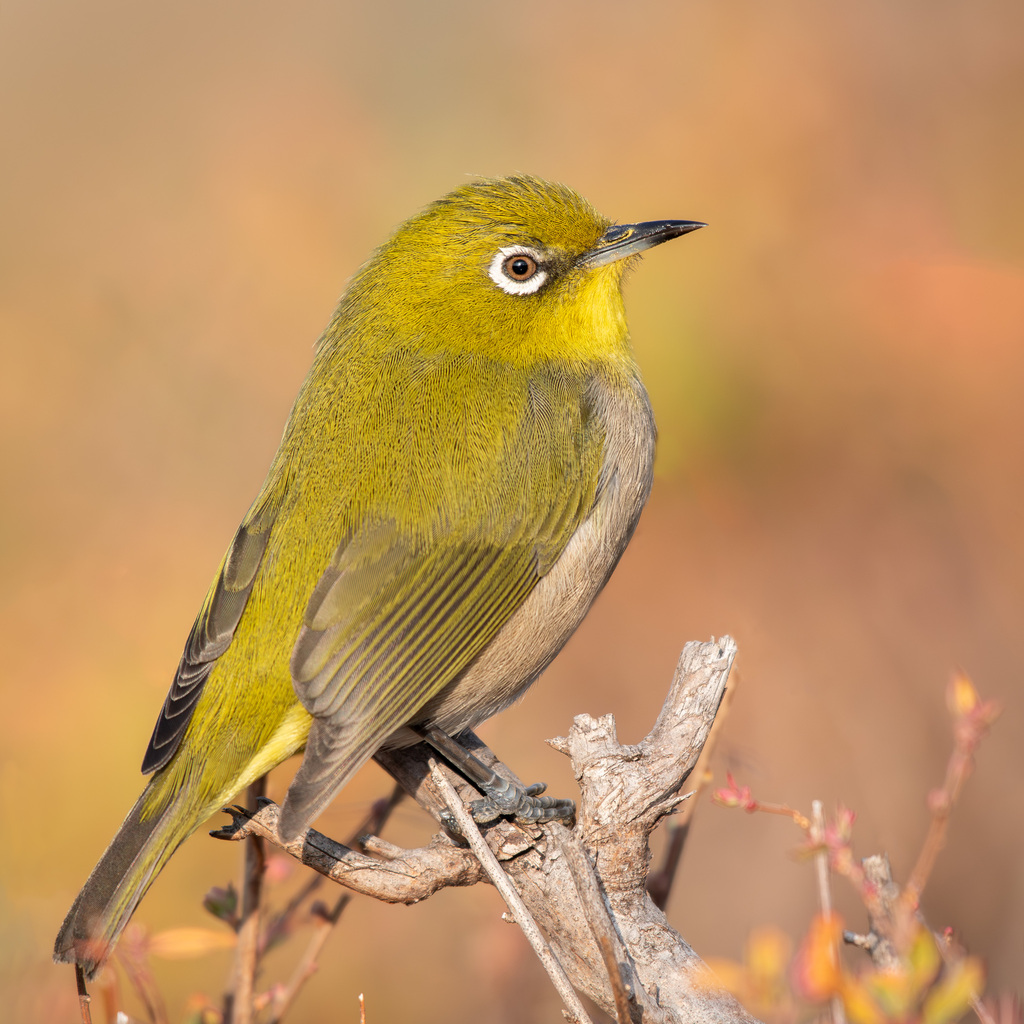
A small yellow-green bird with a crisp white ring around each eye, a lively flocking visitor to flowering camellias and plum blossom in Japanese winter gardens. It is a major pollinator of camellias in its native range.
The warbling white-eye is a small passerine bird in the white-eye family. The specific epithet is occasionally written japonica, but this is incorrect due to the gender of the genus. Its native range includes much of East Asia, including the Russian Far East, Japan, Indonesia, Korea, and the Philippines. It has been intentionally introduced to other parts of the world as a pet and as pest control, with mixed results. As one of the native species of the Japanese islands, it has been depicted in Japanese art on numerous occasions, and historically was kept as a cage bird. Wikipedia
What it can do
- iPollinates camellias and other winter flowers by feeding on their nectar
- iiFlocks huddle tightly side by side on branches
- iiiBrush-tipped tongue laps nectar
In the field
Field marks
- aSmall olive-green bird with a bright yellow throat
- bBold white eye-ring
- cPale greyish-white belly
- dThin, slightly curved, pointed bill
- Voice
- A thin, high 'chii' contact call; song is a fast, twittering warble
- Not to be confused with
- Swinhoe's white-eye (China, Taiwan, SE Asia) has paler flanks and a smaller yellow throat; Chestnut-flanked white-eye has rufous flanks; Japanese bush warbler is drabber with no eye-ring.
- Where to see it
- Plum and cherry gardens in Tokyo, Kyoto and Osaka in winter and spring; Jeju Island in Korea
- When
- Resident year-round; most conspicuous in winter at flowers
Listen
Looking for field recordings…
Life & habits
- Diet
- Nectar, fruit and small insects
- Habitat
- Broadleaf forest, parks, orchards and gardens
- Size
- About 11–12 cm long
Moves in active groups through blossom, hanging upside down to reach flowers; in winter flocks roost pressed close together.
Where it lives
Recorded sightings
—
geo-referenced records in GBIF, from museums, herbaria and field observers.
Native range
Japan (including the Ryukyu and Ogasawara islands) and South Korea; populations in the Philippines and Indonesia formerly called Mountain white-eye; introduced to Hawaii
Drag the globe to turn it. Dots are where records exist, not a range map; darker means more records.
In the stacks
Searching the stacks…
Every page naming Zosterops japonicus in the Biodiversity Heritage Library →
Marginalia
The Japanese expression mejiro-oshi ('white-eye pushing') describes people crowded together, after the way these birds line up shoulder to shoulder on a branch. Mejiro paired with plum blossom is a classic motif in Japanese painting.
Curiosity
Many Japanese think of the green bird at plum blossom as the uguisu (bush warbler), but the bird most often seen there is the mejiro; the real uguisu is drab and secretive.
Kinship


Fact-checked: 1 correction made to this sheet. Photographs: iNaturalist contributors under the licences shown. Records: GBIF.org. Historical plates: Source Library (CC BY-SA 4.0; originals public domain). Summary text: Nature Library editors and Wikipedia (CC BY-SA). Medicinal and edibility notes are historical and educational, not advice. iNaturalist taxon 980262.