- Animals
- ›Arthropods
- ›Hexapods
- ›Insects
- ›Winged and Once-winged Insects
- ›Dragonflies and Damselflies
- ›Dragonflies
- ›Gomphoidea
- ›Clubtails
- ›Epigomphus
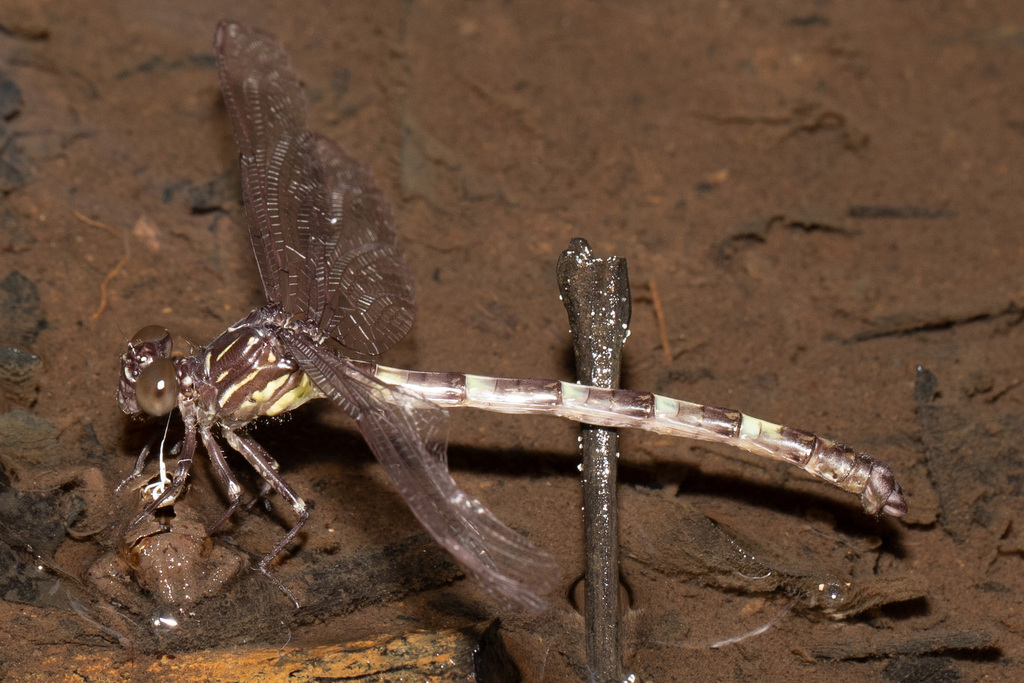
Plate-crowned Knobtail
Epigomphus echeverrii
Epigomphus echeverrii, also known as the volcano knobtail, is a species of dragonfly in the family Gomphidae. It has a dark brown prothorax, a black pterothorax marked with a number of blue-green stripes and spots, and a black abdomen. The dragonfly is endemic to Costa Rica, where it is found in streams in lowland rainforests in the provinces of Guanacaste and San José. It is classified as being of least concern by the IUCN.
From the article Epigomphus echeverrii on Wikipedia (CC BY-SA), quoted section by section
Description
In adult males, the head has a black labrum, brown postclypeus, light blue-green labium, and brown and blue-green frons. The prothorax is dark brown with blue-green markings. The pterothorax is black with a number of blue-green stripes and spots. The abdomen is black and has ten segments, with light blue-green stripes and spots. The wings have red-brown pterostigma and black veins. Like other Costa Rican endemic Epigomphus, E. echeverrii females have a unique pair of postocellar "horns". In the holotype male, the abdominal length is 43.8 mm, the hind-wing length is 36 mm and the total length is 58.4 mm. In the allotype female, the abdominal length is 41 mm, the hind-wing length is 40.5 mm and the total length is 62 mm.
Range & habitat
Endemic to Costa Rica, Epigomphus echeverrii is known from the provinces of Guanacaste and San José. It is found in a large extent of coastal mountains from the Nicaraguan border south to San José. It inhabits rocky streams in rainforests at elevations of around 600–1,150 m (1,970–3,770 ft). The species has a total range that is estimated to be around 2,000 km², but likely also occurs in many currently unsurveyed areas with suitable streams. The species is classified as being of least concern by the IUCN as it occurs in some well-protected areas, such as Guanacaste National Park and El Rodeo Forest Reserve, and shows no indications of population decline.
== References ==
Wikipedia: “Distribution and conservation”
Listen
Looking for field recordings…
Where it lives
Recorded sightings
—
geo-referenced records in GBIF, from museums, herbaria and field observers.
Drag the globe to turn it. Dots are where records exist, not a range map; darker means more records.
In the stacks
Searching the stacks…
Every page naming Epigomphus echeverrii in the Biodiversity Heritage Library →
This page is assembled live from iNaturalist, GBIF, Wikipedia, the Source Library and the Internet Archive. It is not yet part of the hand-edited codex. iNaturalist taxon 100045.