- Plants
- ›Vascular Plants
- ›flowering plants
- ›Dicots
- ›begonias, gourds, and allies
- ›gourd family
- ›Sicyoeae
- ›Luffa
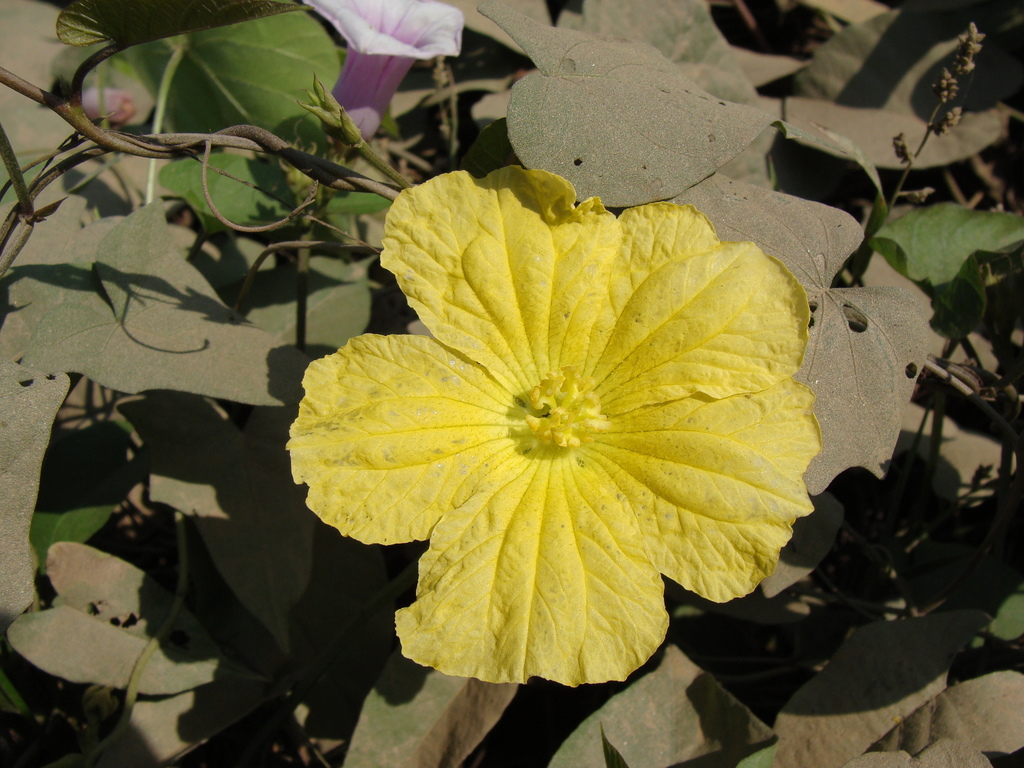
Sponge Gourd
Luffa aegyptiaca
Luffa cylindrica, the sponge gourd, Egyptian cucumber, or Vietnamese luffa, is a species of Luffa cultivated for its fruit. The plant is an annual vine, native to South Asia and Southeast Asia.
From the article Luffa aegyptiaca on Wikipedia (CC BY-SA), quoted section by section
Description
The three-lobed leaves are 7.5–20 centimetres (3–8 inches) wide. The fruit, approximately 30 cm (12 in) long and maturing to brown, resembles a cucumber in shape and size.
At the table
The young fruit is eaten as a vegetable and is commonly grown for that purpose in tropical Asia. The young shoots, flowers and leaves can be cooked, and the mature seeds can be roasted for consumption.
Wikipedia: “Culinary”
How it is grown
Luffa has been cultivated throughout Asia for centuries for use as a household cleaning agent and is now, due to the gently abrasive quality of the natural fibers, a popular exfoliating agent in the eco-friendly cosmetic industry. Owing to its striking yellow flowers, the plant is occasionally grown as an ornamental.
Climate. It requires much heat and a lot of water to thrive. However, Luffa aegyptiaca can be cultivated in temperate climates. Research from North Carolina suggests that commercial production of luffa in the United States could be economically viable.
Growth. Techniques that contribute to success in growing luffa include using black mulch to warm soil temperatures and transplants to increase the germination rate and extend the growing season. Narrow spacing may result in poorer quality sponges. It is best grown with a trellis support for its curled tendrils to hang on to.
Wikipedia: “Cultivation”
In human culture
The synonymous botanical specific epithet "aegyptiaca" was given to this plant in the 16th century when European botanists were introduced to the plant from its cultivation in Egypt. In the European botanical literature, the plant was first described by Johann Veslingius in 1638, who named it "Egyptian cucumber". Veslingius also introduced the name "Luffa".
Wikipedia: “Etymology”
Where it lives
Recorded sightings
—
geo-referenced records in GBIF, from museums, herbaria and field observers.
Drag the globe to turn it. Dots are where records exist, not a range map; darker means more records.
In the old herbals & bestiaries


In the stacks
Searching the stacks…
Every page naming Luffa aegyptiaca in the Biodiversity Heritage Library →
This page is assembled live from iNaturalist, GBIF, Wikipedia, the Source Library and the Internet Archive. It is not yet part of the hand-edited codex. iNaturalist taxon 1004655.