- Fungi Including Lichens
- ›Basidiomycete Fungi
- ›Higher Basidiomycetes
- ›Mushrooms, Bracket Fungi, Puffballs, and Allies
- ›Hymenochaetales
- ›Schizoporaceae
- ›Lyomyces
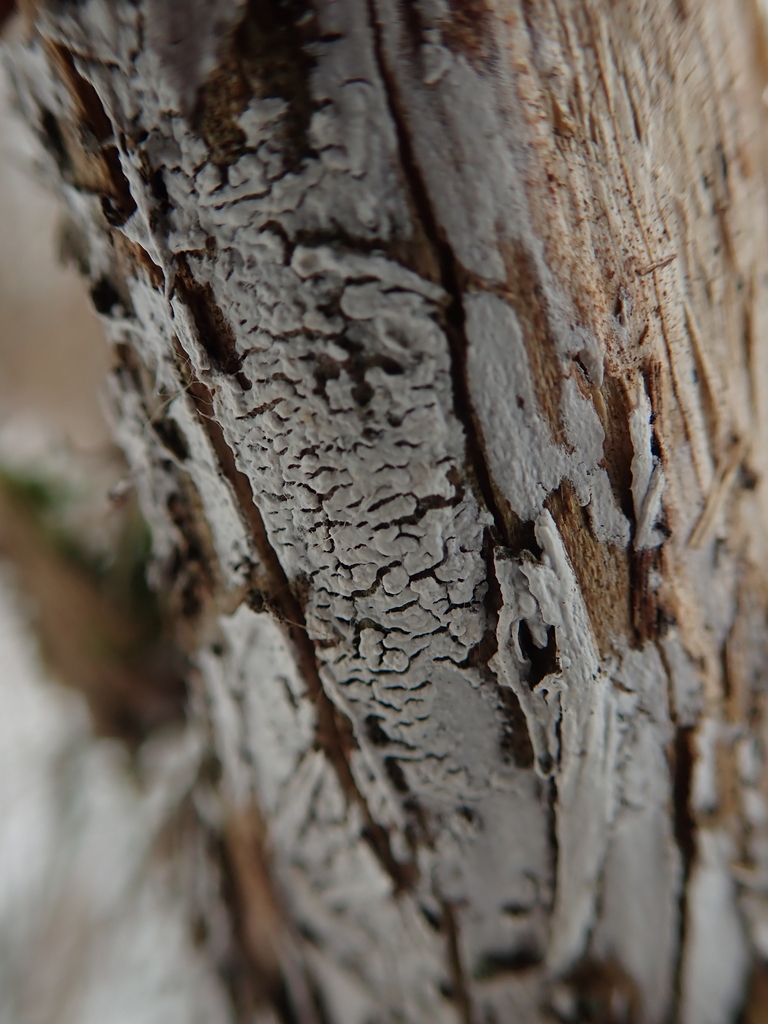
Elder Whitewash
Lyomyces sambuci
Hyphodontia sambuci, the elder whitewash, is a basidiomycete fungal pathogen on deadwood, especially elder.
It is resupinate, forming a very thin structure which is white, pruinose (flour-like dusting) or chalky in appearance. It is inedible. It also grows on dead but still hanging branches of Fraxinus, Berberis, Nothofagus, Ulmus, Populus, Hedera, Ribes, Symphoricarpos and rarely on conifers such as Cryptomeria.
From the article Hyphodontia sambuci on Wikipedia (CC BY-SA), quoted section by section
What it does
As stated, H. sambuci occurs in North Europe mostly on Sambucus nigra, but there is a much bigger spectrum of substrates in warmer regions in southern areas. The variability of micromorphology increases in the tropics, but the macromorphological characteristics however always stay the same: the basidiocarp with chalky white color and often growing as aerophyte on dead branches of trees and bushes, that are still attached to the tree. H. sambuci consists of a complex of species. Similar species with capitate cystidia; thin-walled hyphae and exactly the same chalky white fruit body are H. griselinae and H. fimbriata. They can be differentiated by their spores and morphology of their basidiocarp.
Wikipedia: “Ecology”
Where it lives
Recorded sightings
—
geo-referenced records in GBIF, from museums, herbaria and field observers.
Drag the globe to turn it. Dots are where records exist, not a range map; darker means more records.
In the stacks
Searching the stacks…
Every page naming Lyomyces sambuci in the Biodiversity Heritage Library →
This page is assembled live from iNaturalist, GBIF, Wikipedia, the Source Library and the Internet Archive. It is not yet part of the hand-edited codex. iNaturalist taxon 1019876.