- Animals
- ›Molluscs
- ›Gastropods
- ›Heterobranchs
- ›Euthyneura
- ›Tectipleura
- ›Eupulmonata
- ›Common Land Snails and Slugs
- ›Helicina
- ›Helicoidei
- ›Helicoidea
- ›Helix Snails
- ›Helicinae
- ›Helicini
- ›Helix
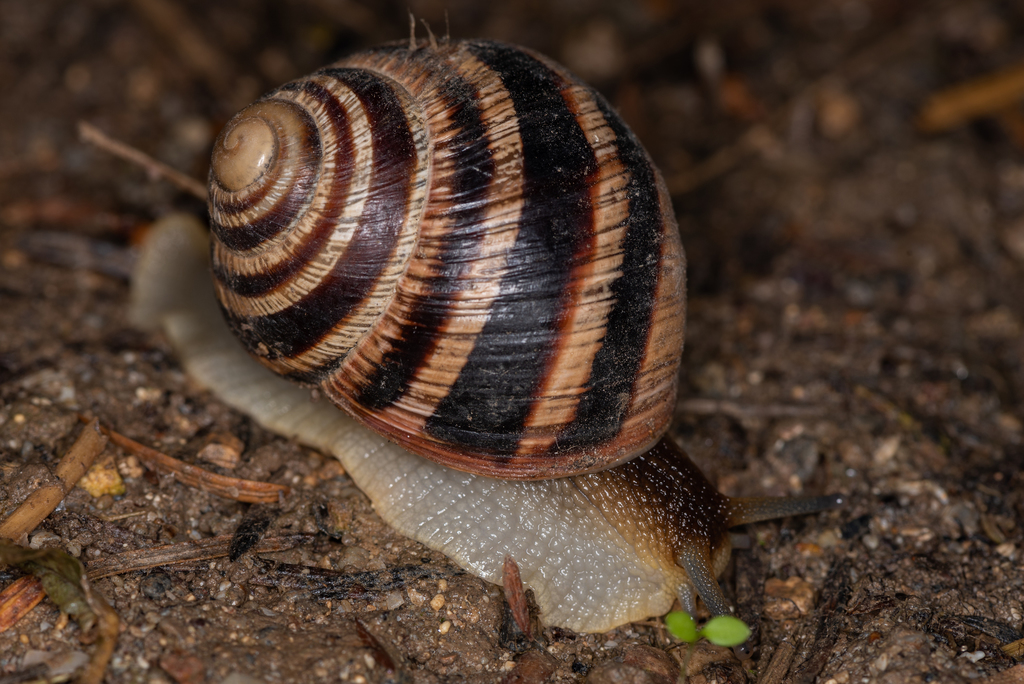
Helix albescens
Helix albescens is a species of large air-breathing land snail from eastern Europe belonging to the family Helicidae.
From the article Helix albescens on Wikipedia (CC BY-SA), quoted section by section
Description
Helix albescens is a relatively small Helix species with globular shell, which is whitish to cream-brown, usually with five reddish-brown bands of which especially the second and third may partly fuse. Umbilicus closed, apertural margins may be brown. Characteristic is a very large protoconch (the embryonal shell). The animal is yellow, usually with a dark, brown back. On the genital system, typical characters are a missing diverticulum of bursa copulatrix (gametolytic gland) and a very short flagellum.
Range & habitat
Helix albescens is distributed in southern Ukraine, southwestern Russia (Ciscaucasia) and the Caucasus (Georgia, Armenia, Azerbaijan). The distribution of mitochondrial genetic lineages suggests that the species originates from Crimea. The species naturally occurs in shrubby habitats (with Christ's thorn, blackthorn, hawthorn, etc.).
Wikipedia: “Distribution and habitat”
What it does
As all stylommatophoran land snails, H. albescens is a hermaphrodite. It lays its eggs in small clutches in cavities dug 5-6 cm deep into a damp soil. Egg laying takes many hours, because laying one egg can takes as much as two hours. Recorded clutch size ranges between 6 and 25 eggs, with an average of 18 eggs. Oval eggs are large relative to the animal, with a maximum diameter of 6-11 mm.
== References ==
Wikipedia: “Reproduction”
Where it lives
Recorded sightings
—
geo-referenced records in GBIF, from museums, herbaria and field observers.
Drag the globe to turn it. Dots are where records exist, not a range map; darker means more records.
In the stacks
Searching the stacks…
Every page naming Helix albescens in the Biodiversity Heritage Library →
This page is assembled live from iNaturalist, GBIF, Wikipedia, the Source Library and the Internet Archive. It is not yet part of the hand-edited codex. iNaturalist taxon 102434.