- Plants
- ›Vascular Plants
- ›flowering plants
- ›Dicots
- ›saxifrages, stonecrops, and allies
- ›Gooseberry Family
- ›Ribes
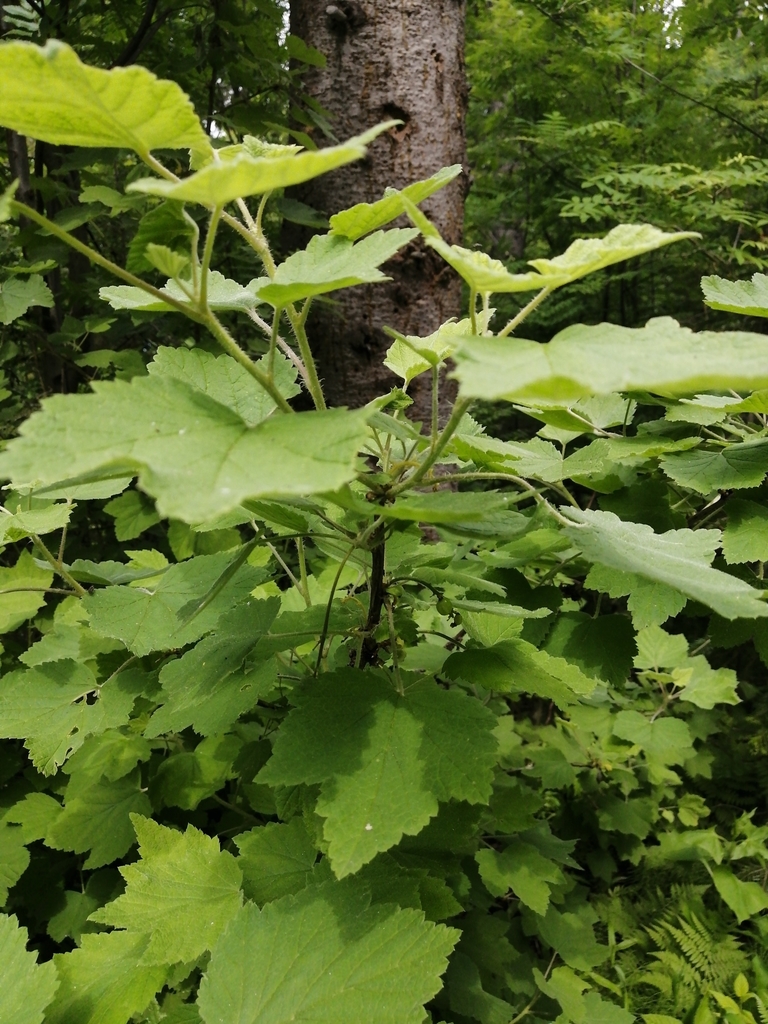
Jostaberry
Ribes × nidigrolaria
The jostaberry (Ribes × nidigrolaria) is a complex-cross fruit bush in the genus Ribes, involving three original species: the blackcurrant R. nigrum, the North American coastal black gooseberry, R. divaricatum, and the European gooseberry, R. uva-crispa. It is similar to Ribes × culverwellii, the jochelbeere (sometimes also called black negus), which is descended from just two of these species, R. nigrum and R. uva-crispa.
From the article Jostaberry on Wikipedia (CC BY-SA), quoted section by section
Description
The nearly black berry, which is smaller than a gooseberry and a bit larger than a blackcurrant, is edible both raw and cooked. It is described as having a taste intermediate between a gooseberry and a blackcurrant, with the gooseberry flavor more dominant in the unripe fruit, and the blackcurrant notes developing as the fruit ripens. The ripe fruit will hang on the bush in good condition through late summer, and is eaten by birds. The somewhat unripe fruit can be used in cooking recipes as a gooseberry. Like blackcurrants, the fruit freezes well, and like many other members of the genus Ribes, it is rich in vitamin C. Commercial production of jostaberries is limited because they are not well-suited to mechanical harvesting. Compared to most other fruits, harvesting jostaberries is relatively labor-intensive per kilogram. Although harder to pick than blackcurrants, the plant is thornless. The plant itself grows to a maximum height of about 2 m, flowering in mid-spring, with fruit setting and ripening on a similar timetable to the blackcurrant. The plant displays hybrid vigor, growing and fruiting well and being resistant to a number of common diseases afflicting other Ribes. In particular the plant is resistant to mildew, leaf spot, white pine blister rust, and big bud gall mite. Flowers are hermaphrodite and the plant is self-fertile following insect pollination. …
In human culture
The name Jostaberry was created by combining the German words for blackcurrant and gooseberry, namely Johannisbeere ("Jo") and Stachelbeere ("Sta"). Following German pronunciation of "J", it may be pronounced "yostaberry" in English.
Wikipedia: “Etymology”
Where it lives
Recorded sightings
—
geo-referenced records in GBIF, from museums, herbaria and field observers.
Drag the globe to turn it. Dots are where records exist, not a range map; darker means more records.
In the stacks
Searching the stacks…
Every page naming Ribes × nidigrolaria in the Biodiversity Heritage Library →
This page is assembled live from iNaturalist, GBIF, Wikipedia, the Source Library and the Internet Archive. It is not yet part of the hand-edited codex. iNaturalist taxon 1028040.