- Animals
- ›Chordates
- ›Vertebrates
- ›Ray-finned Fishes
- ›Spiny-rayed fishes
- ›Pipefishes and Allies
- ›Syngnathoidei
- ›Pipefishes, Seahorses, and Seadragons
- ›Tail-brooding Pipefishes
- ›Hippocampus
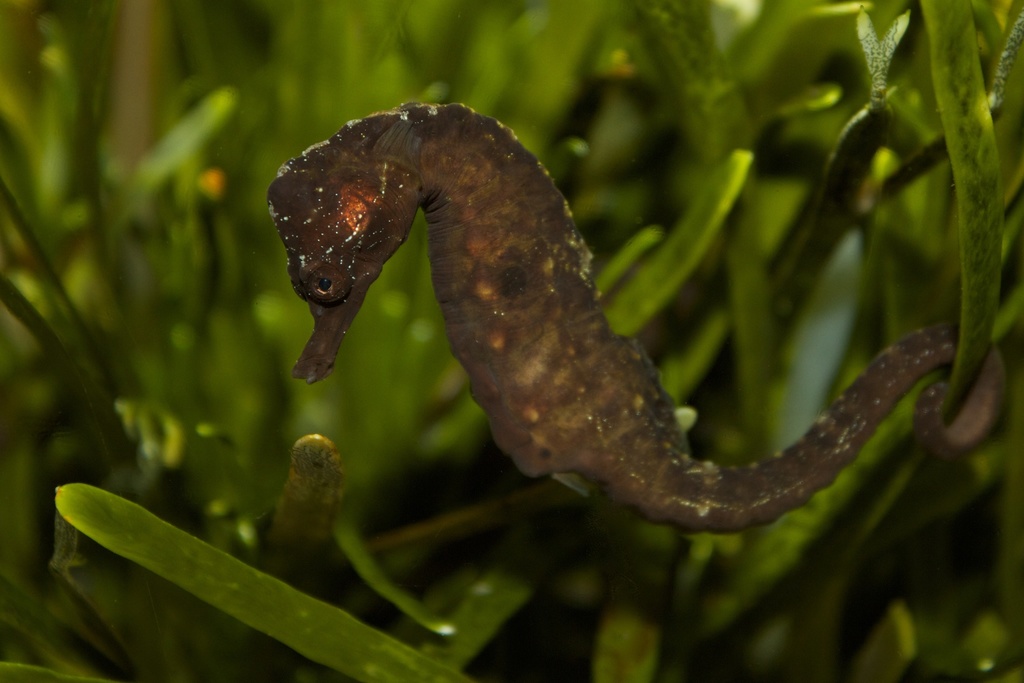
Knysna Seahorse
Hippocampus capensis
The Knysna /ˈnaɪznə/ seahorse or Cape seahorse (Hippocampus capensis) is a species of fish in the family Syngnathidae. It is endemic to the south coast of South Africa, where it has been found in only three brackish water habitats: the estuary of the Keurbooms River in Plettenberg Bay, the Knysna Lagoon, and the estuarine portion of the Swartvlei system in Sedgefield. The limited range of this seahorse puts it at great risk of extinction.
From the article Knysna seahorse on Wikipedia (CC BY-SA), quoted section by section
Description
The Knysna seahorse is a small, delicate creature with a standard length of up to 12 centimetres. Colouration is strongly influenced by the surrounding environment and a particular individual's mood. It varies from pale green to brown (often with darker speckles) to purplish black. The body is encased in a series of bony rings, the snout is relatively short, and the neck arches in a smooth curve without a crown. The tail is muscular and is used to grasp a mate during courtship or to anchor the fish to the substrate.
Range & habitat
The Knysna seahorse occurs mostly in areas with high vegetation cover (at least 75%), and is associated with five dominant aquatic plants: Zostera capensis, Caulerpa filiformis, Codium extricatum, Halophila ovalis and Ruppia cirrhosa. While the Keurbooms and Swartvlei estuaries both have very dense plant cover, vegetated sites only make up approximately 11% of the Knysna Lagoon. Large areas of habitat in this system may thus be unsuitable for H. capensis. The fish is well adapted to estuarine habitat and can tolerate a wide range of environmental conditions, such as salinities ranging from 1–59 ‰. Breeding occurs in the austral summer when water temperatures approach 20 °C. Sexual maturity is attained in about one year at 65 mm standard length.
Wikipedia: “Habitat and ecology”
Where it lives
Recorded sightings
—
geo-referenced records in GBIF, from museums, herbaria and field observers.
Drag the globe to turn it. Dots are where records exist, not a range map; darker means more records.
In the stacks
Searching the stacks…
Every page naming Hippocampus capensis in the Biodiversity Heritage Library →
This page is assembled live from iNaturalist, GBIF, Wikipedia, the Source Library and the Internet Archive. It is not yet part of the hand-edited codex. iNaturalist taxon 102815.