- Animals
- ›Chordates
- ›Vertebrates
- ›Ray-finned Fishes
- ›Spiny-rayed fishes
- ›Pipefishes and Allies
- ›Syngnathoidei
- ›Pipefishes, Seahorses, and Seadragons
- ›Tail-brooding Pipefishes
- ›Hippocampus
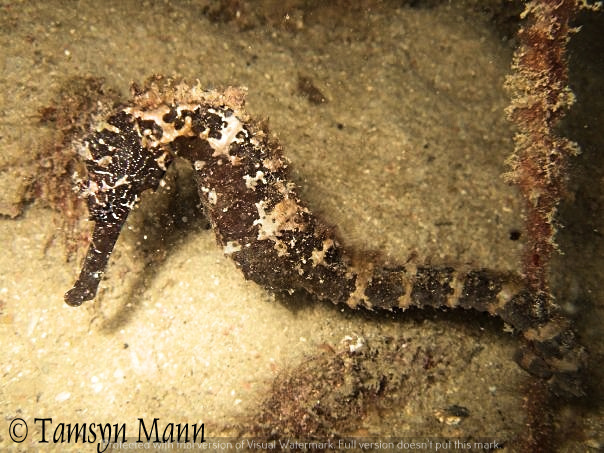
Tiger Tail Seahorse
Hippocampus comes
The tiger tail seahorse (Hippocampus comes) is a species of fish in the family Syngnathidae. The species was first described by Theodore Cantor in 1850. It is found in India, Indonesia, Malaysia, the Philippines, Singapore, Thailand and Vietnam. Its natural habitats are subtidal aquatic beds and coral reefs. It is threatened by habitat loss.
The tiger tail sea horse lives in Western Central Pacific: Malaysia, Singapore, Thailand, Vietnam, and the Philippines. It lives from 0-1.5 years in captivity and in the wild, 1–5 years. It is harmless. Its climate in water is tropical; 15°N – 1°N and Its maximum size is 18.7 cm. Its snout is 2.2 in head length; it is used to suck up food. They eat small fish, coral, small shrimp, and plankton. The most common pattern is alternating yellow and black. The tail has stripes from the belly to the tip of the tail.
From the article Tiger tail seahorse on Wikipedia (CC BY-SA), quoted section by section
Description
A medium-sized seahorse, the tiger tail seahorse reaches a maximum total length of around 15 centimetres (5.9 in). The coloration of this species is variable, generally being black or brown in adults with yellow saddle shapes on the upper surface and yellow stripes on the tail, hence the common name. Thin white stripes may be present in a radiating pattern around the eyes, as well as mottled patterns across the body. Like other seahorses, the tiger tail seahorse has bony plates arranged in rings throughout its body, with this species in particular having 11 trunk rings and 33 to 37 tail rings. The dorsal fin has 17 to 19 rays, while the pectoral fin has 16 to 19 rays. Two spines extend from each cheek, in addition to a prominent spine on the nose. The coronet (the crown-like spine on the head) is low and has five knobs.
Where it lives
Recorded sightings
—
geo-referenced records in GBIF, from museums, herbaria and field observers.
Drag the globe to turn it. Dots are where records exist, not a range map; darker means more records.
In the stacks
Searching the stacks…
Every page naming Hippocampus comes in the Biodiversity Heritage Library →
This page is assembled live from iNaturalist, GBIF, Wikipedia, the Source Library and the Internet Archive. It is not yet part of the hand-edited codex. iNaturalist taxon 102816.