- Animals
- ›Chordates
- ›Vertebrates
- ›Ray-finned Fishes
- ›Spiny-rayed fishes
- ›Pipefishes and Allies
- ›Syngnathoidei
- ›Pipefishes, Seahorses, and Seadragons
- ›Tail-brooding Pipefishes
- ›Hippocampus
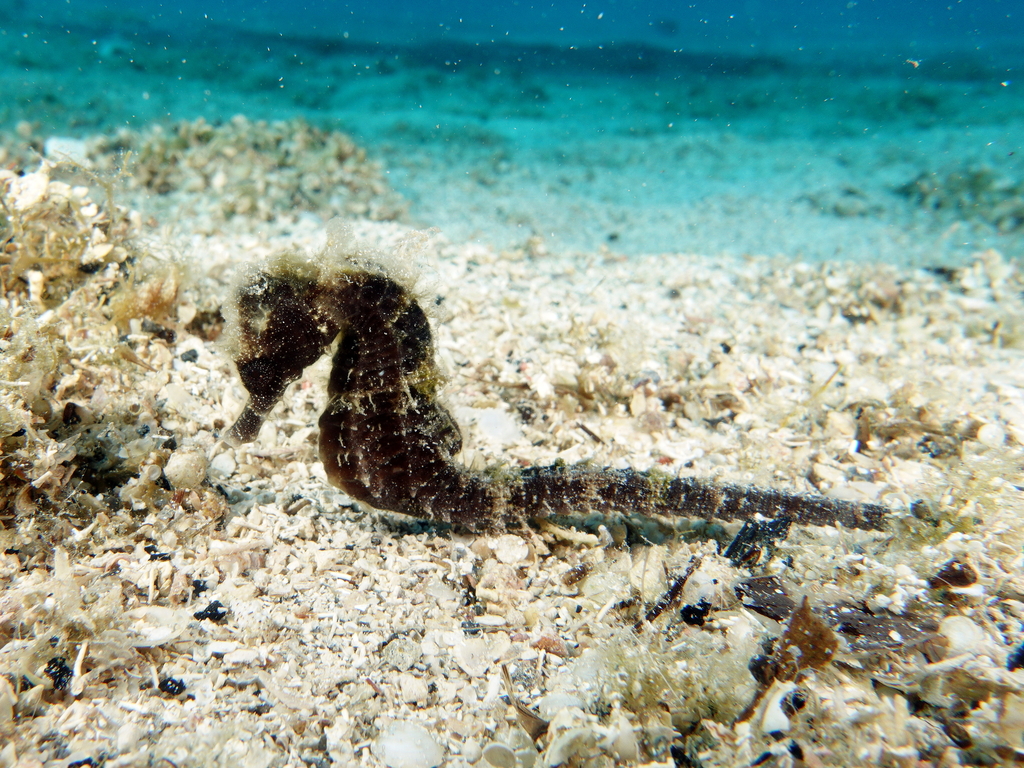
Sea Pony
Hippocampus fuscus
The sea pony (Hippocampus fuscus) is a species of fish in the family Syngnathidae. It is found in Djibouti, India, Saudi Arabia, Sri Lanka, possibly Madagascar, possibly Mauritius, possibly Réunion, and possibly South Africa. It has also been recorded as a Lessepsian migrant in the eastern Mediterranean. Its natural habitat is subtidal aquatic beds.
From the article Hippocampus kuda on Wikipedia (CC BY-SA), quoted section by section
Range & habitat
Hippocampus kuda inhabits waters from the Persian Gulf to Southeast Asia, Australia, Japan, and several Pacific islands including Hawaii, and is also found the eastern coast of Africa from Tanzania to South Africa, including the Indo-Pacific region ranging from the northwest Indian Ocean to the central areas of the Pacific Ocean. The majority of H. kuda populates the Chinese coast down to Australia. H. kuda inhabit estuaries, lagoons, harbors, littoral zones, and coastal seagrass beds, where they are found in shallow waters of up to fifty-five meters in depth. Their habitat regions can include (but are not limited to) tropical, saltwater, or marine regions.
Wikipedia: “Distribution and habitat”
What it does
The mating system of H. kuda is completely monogamous. The species engages in a unique courtship ritual before engaging in mating. The male will change its color patterns and dance around the female and while producing a clicking with the coronet. Eventually, the tails of the male and female intertwine and the female will place her eggs into the male's ventral brood pouch via an ovipositor. There may be up to one-thousand eggs in a singular pouch, where the developmental process can last from twenty to twenty-eight days. Birth, however, depends largely on the monsoon patterns, lunar cycles, and water temperature. Males typically go into labor during a full moon, and after birth, the baby seahorses average a length of seven millimeters.
Wikipedia: “Biological development and reproduction”
Where it lives
Recorded sightings
—
geo-referenced records in GBIF, from museums, herbaria and field observers.
Drag the globe to turn it. Dots are where records exist, not a range map; darker means more records.
In the stacks
Searching the stacks…
Every page naming Hippocampus fuscus in the Biodiversity Heritage Library →
This page is assembled live from iNaturalist, GBIF, Wikipedia, the Source Library and the Internet Archive. It is not yet part of the hand-edited codex. iNaturalist taxon 102820.