- Plants
- ›Vascular Plants
- ›flowering plants
- ›Dicots
- ›proteas, lotuses, planes, and allies
- ›Protea family
- ›Primitive Proteas
- ›Persoonieae
- ›Persoonia
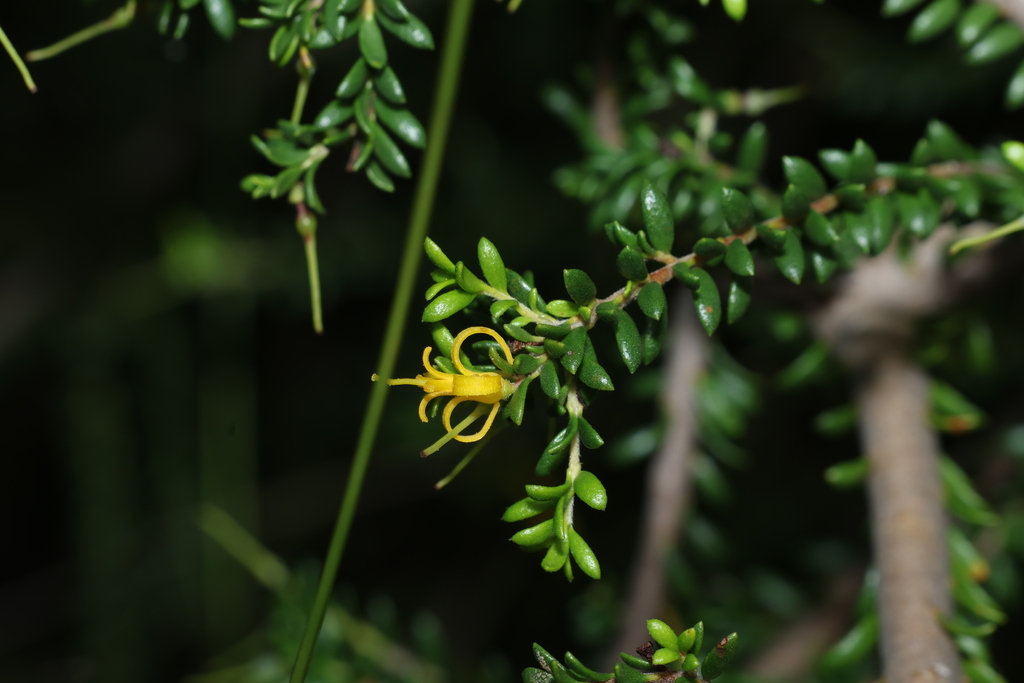
Persoonia terminalis
Persoonia terminalis, also known as the Torrington geebung, is a shrub belonging to the family Proteaceae, and native to northern New South Wales and southern Queensland in eastern Australia. Reported as a subspecies of Persoonia nutans in 1981, it was described as a species by Lawrie Johnson and his colleague Peter Weston in 1991.
Two subspecies—P. t. terminalis and P. t. recurva—are recognised; both are found on well-drained acidic soils in sclerophyll forests, and P. t. terminalis is also found on granite outcrops. Although similar in appearance, they differ in leaf length and curvature. Both have a restricted range, with P. t. terminalis found in an area of under 100 square kilometres (39 square miles; 25,000 acres).
From the article Persoonia terminalis on Wikipedia (CC BY-SA), quoted section by section
Description
Persoonia terminalis grows as a shrub reaching a height of 0.7–1.5 metres (2+1⁄4–5 ft), with an upright or spreading habit. It has smooth bark, although new growth is covered in fine hair. The small, narrow leaves are 1.2–2 millimetres (1⁄16–3⁄32 inch) wide and 3.5–10 millimetres (1⁄8–3⁄8 in) long, with a convex upper surface and margins curved downwards. New leaves can be hairless or slightly hairy; if the latter, they lose the hair with age. They are concolorous—that is, both leaf surfaces are the same colour, or slightly discolorous (surfaces slightly different). The leaves are rougher than those of other persoonias. The yellow flowers mainly appear in December and January (summer in the temperate zone of Australia), although occasional flowers have been seen as late as July. They are terminal, that is, arising at the ends of branchlets, where they appear in groups of one to five. P. terminalis is described as mostly anauxotelic, which means each stalk bears an individual flower that is subtended by a scale leaf at its junction with the stem. A proportion of flowers have a true leaf at this junction instead, and are described as auxotelic. Each individual flower consists of a cylindrical perianth that splits into four segments or tepals, and contains both male and female parts. …
Range & habitat
Persoonia t. subsp. terminalis is found in the Torrington-Binghi area on the western parts of the far Northern Tablelands in New South Wales, roughly halfway between Glen Innes and the Queensland border, at an altitude of between 900 and 1,100 metres (3,000 and 3,600 ft) above sea level. It grows on acidic, sandy or stony granite soils in dry sclerophyll forest. The region is dotted with granite outcrops, where the subspecies is a component of Babingtonia odontocalyx–Brachyloma saxicola shrubland and Prostanthera staurophylla–Kunzea bracteolata low shrubland in the Torrington area, and Allocasuarina brachystachya shrubland in the Severn River Reserve. It is rated 2R on the ROTAP list. Persoonia t. subsp. recurva has two disjunct populations. One is found on the North Western Slopes in New South Wales, near Warialda north west of Inverell, and the other is southwest of Inglewood in southeastern Queensland, between 350 and 450 metres (1,150 and 1,480 ft) above sea level. It grows on acidic sandstone-based sandy soils in dry sclerophyll forest. Within the Warialda State Conservation Area, it is found in black cypress pine (Callitris endlicheri)—dirty gum (Eucalyptus chloroclada) woodland and smooth-barked apple (Angophora leiocarpa)—black cypress pine woodland. Although P. t. …
Wikipedia: “Distribution and habitat”
What it does
Persoonia terminalis grows in a bushfire-prone habitat, where fire is essential for many species to regenerate. P. t. terminalis is killed by bushfire and regenerates from seed, which lies dormant in the soil. Large numbers of Persoonia seedlings appear after fire. However, rocky outcrop habitat is vulnerable to fires occurring at too-frequent intervals of less than five years, which puts many species that regenerate by seed at risk of local extinction as plants are unable to mature to set seed before the next fire. Colletid bees of subgenus Cladocerapis within the genus Leioproctus exclusively forage on and pollinate flowers of many species of Persoonia. Bees of subgenus Filiglossa in the same genus also specialise in feeding on Persoonia flowers, but do not appear to be effective pollinators. The fruit are adapted to be eaten by vertebrates, such as kangaroos and possums, as well as currawongs and other large birds.
Wikipedia: “Ecology”
How it is grown
Horticulturists and scientists Rodger Elliot and David L. Jones have proposed that cultivating the plant would aid in its conservation. Cultivating the plant would most likely require good water drainage, a sunny or part-shaded position and acidic soil. P. terminalis is hardy to heavy frosts, and is expected to fare better in a temperate rather than subtropical garden climate. Propagation would theoretically be by seed or by taking cuttings of new growth, though plants of the genus Persoonia are generally difficult to propagate by any means in cultivation.
Wikipedia: “Cultivation potential”
Where it lives
Recorded sightings
—
geo-referenced records in GBIF, from museums, herbaria and field observers.
Drag the globe to turn it. Dots are where records exist, not a range map; darker means more records.
In the stacks
Searching the stacks…
Every page naming Persoonia terminalis in the Biodiversity Heritage Library →
This page is assembled live from iNaturalist, GBIF, Wikipedia, the Source Library and the Internet Archive. It is not yet part of the hand-edited codex. iNaturalist taxon 1032824.