- Plants
- ›Vascular Plants
- ›flowering plants
- ›Dicots
- ›proteas, lotuses, planes, and allies
- ›Protea family
- ›Singlet Proteas
- ›Smokebushes and Blueboys
- ›Conosperminae
- ›Synaphea
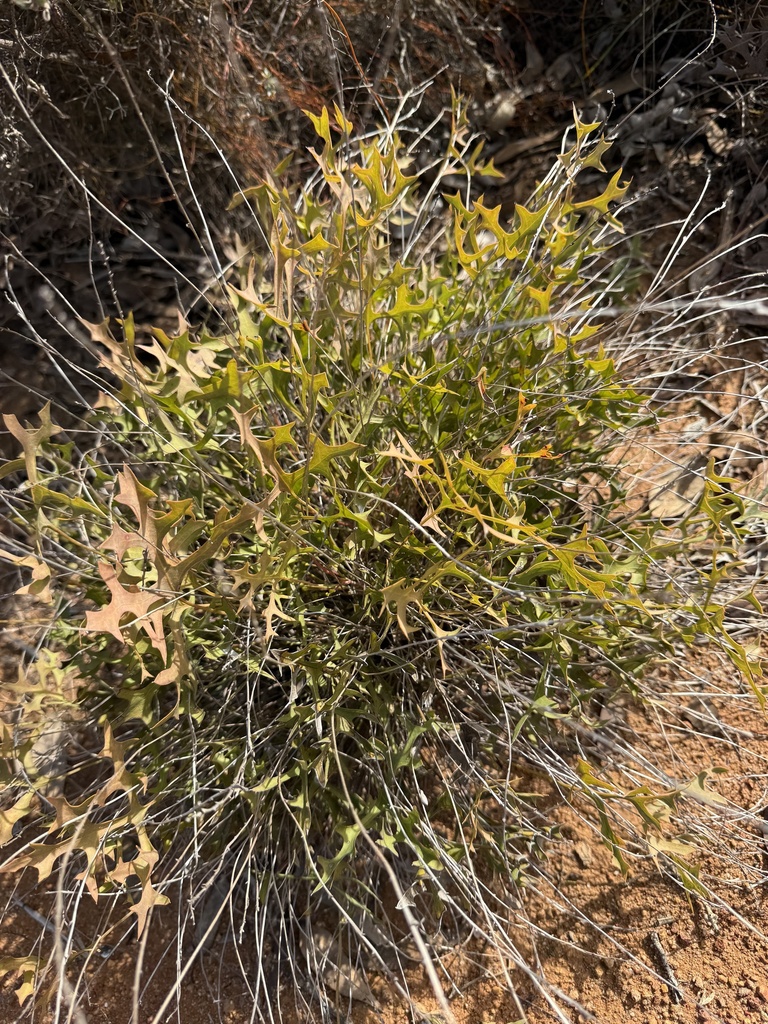
Synaphea panhesya
Synaphea panhesya is a species of flowering plant in the family Proteaceae and is endemic to the south west of Western Australia. It is a shrub with many hairy branches, pinnatipartite leaves, the end lobes more or less triangular, and spikes of more or less crowded yellow flowers.
From the article Synaphea panhesya on Wikipedia (CC BY-SA), quoted section by section
Description
Synaphea panhesya is an erect shrub with many branches up to 130 mm (5.1 in) long and covered with soft hairs. The leaves are pinnatipartite, 50–90 mm (2.0–3.5 in) long and 50–100 mm (2.0–3.9 in) wide on a petiole 70–200 mm (2.8–7.9 in) long, the end lobes more or less triangular 3–10 mm (0.12–0.39 in) wide and a sometimes sharp point on the end. The flowers are yellow and crowded, borne in spikes 50–100 mm (2.0–3.9 in) long on a branched peduncle up to 300 mm (12 in) long. The bracts are egg-shaped, 1.0–1.5 mm (0.039–0.059 in) long with hairy edges. The perianth is ascending, curved with a more or less wide opening and glabrous the upper tepal 3–4 mm (0.12–0.16 in) long and 1.5 mm (0.059 in) wide and strongly curved, the lower tepal 4.5–5.5 mm (0.18–0.22 in) long and 1.8–2.0 mm (0.071–0.079 in) wide with the edges curved downwards. The stigma is trapezoid-shaped and shallowly notched, 0.7–0.9 mm (0.028–0.035 in) long, 0.9–1.0 mm (0.035–0.039 in) wide and slightly concave, and the ovary is hairy. Flowering occurs from August to September.
Range & habitat
This species of Synaphea grows in gravelly loam and sandy gravel in woodland in the Bindoon-Mogumber area.
Wikipedia: “Distribution and habitat”
Where it lives
Recorded sightings
—
geo-referenced records in GBIF, from museums, herbaria and field observers.
Drag the globe to turn it. Dots are where records exist, not a range map; darker means more records.
In the stacks
Searching the stacks…
Every page naming Synaphea panhesya in the Biodiversity Heritage Library →
This page is assembled live from iNaturalist, GBIF, Wikipedia, the Source Library and the Internet Archive. It is not yet part of the hand-edited codex. iNaturalist taxon 1032999.