- Plants
- ›Vascular Plants
- ›flowering plants
- ›Dicots
- ›Heathers, Balsams, Primroses, and Allies
- ›heath family
- ›Epacrids, Styphelias and Allies
- ›Styphelieae
- ›Leucopogon
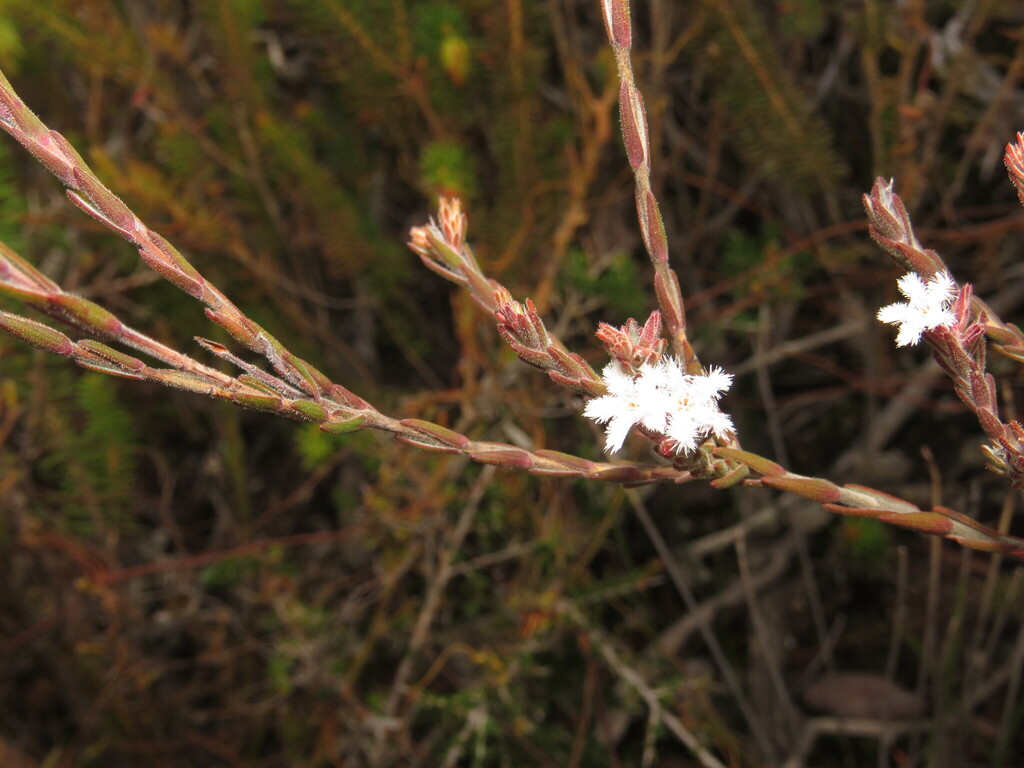
Leucopogon lasiophyllus
Leucopogon lasiophyllus is a species of flowering plant in the heath family Ericaceae and is endemic to the south-west of Western Australia. It is an erect shrub with linear to lance-shaped leaves and small, dense spikes of tube-shaped white flowers on the ends of branches and in leaf axils.
From the article Leucopogon lasiophyllus on Wikipedia (CC BY-SA), quoted section by section
Description
Leucopogon lasiophyllus is an erect shrub that typically grows to a height of 0.3–1 m (1 ft 0 in – 3 ft 3 in) and has its branches and foliage covered with short, rigid hairs. The leaves are linear to lance-shaped with a blunt tip, 4–9 mm (0.16–0.35 in) long and prominently ribbed. The flowers are arranged in small, short, dense spike on the ends of branches or in upper leaf axils with leaf-like bracts and tapering bracteoles about half as long as the sepals. The sepals are softly hairy, 2.6–3.1 mm (0.10–0.12 in) long and the petals white and 4.2 mm (0.17 in) long, the lobes about the same length as the petal tube.
Range & habitat
This leucopogon grows on hillsides in sandy or stony soils in the Esperance Plains bioregion of south-western Western Australia.
Wikipedia: “Distribution and habitat”
Where it lives
Recorded sightings
—
geo-referenced records in GBIF, from museums, herbaria and field observers.
Drag the globe to turn it. Dots are where records exist, not a range map; darker means more records.
In the stacks
Searching the stacks…
Every page naming Leucopogon lasiophyllus in the Biodiversity Heritage Library →
This page is assembled live from iNaturalist, GBIF, Wikipedia, the Source Library and the Internet Archive. It is not yet part of the hand-edited codex. iNaturalist taxon 1033957.