 NL·0512
Herbarium of the Nature Library
- Name
- Lates niloticus
- Family
- Latidae
- Native to
- Nile, Niger, Chad, Senegal, Volta and Congo basins and lakes Albert and Turkana; introduced to lakes Victoria, Kyoga and others
- Habitat
- Large rivers, Great lakes, Reservoirs
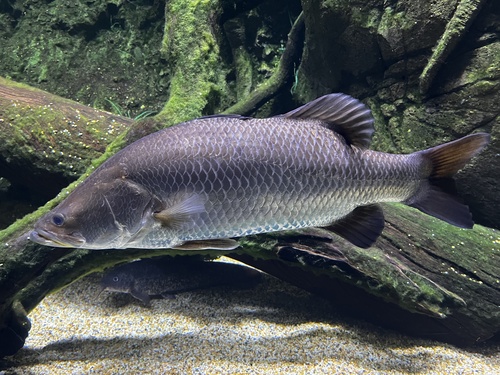
Nile perch
Lates niloticus
Also calledQishr bayad قشر بياض (Egyptian Arabic) · Mbuta (Luganda/Luo) · Giwan ruwa (Hausa) · Capitaine (French, West Africa)
A giant predator of the Nile, Niger, Congo and Lake Chad that can reach 2 m and 200 kg. Its introduction into Lake Victoria in the 1950s caused one of the largest vertebrate extinction events of the 20th century and built a fillet-export industry.
The Nile perch, also known as the African snook, Goliath perch, Nile lates, African lates, Goliath lates, Victoria lates, African barramundi, Goliath barramundi, Giant lates or the Victoria perch, is a species of freshwater fish in the family Latidae of the order Carangiformes. It is widespread throughout much of the Afrotropical realm, being native to the Congo, Nile, Senegal, Niger and Lake Chad, Volta, Lake Turkana, and other river basins. It also occurs in the brackish waters of Lake Maryut in Egypt. The Nile perch is a fish of substantial economic and food-security importance in East Africa. Originally described as Labrus niloticus, among the marine wrasses, the species has also been referred to as Centropomus niloticus. Common names include African snook, Victoria perch, and many local names in various African languages, such as the Luo name mbuta or mputa. In Tanzania, it is called sangara, sankara, or chenku. In Francophone African countries, it is known as capitaine. Its name in the Hausa language is giwan ruwa, meaning "water elephant". Wikipedia
What it can do
- iEats almost any fish, including smaller Nile perch
- iiGrows fast, so it dominates a lake food web within a few decades of arriving
- iiiA large female can spawn millions of eggs per season
In the field
Field marks
- aRobust, perch-like silvery body with blue-grey to greenish back
- bTwo dorsal fins, almost separated: a high spiny first and a soft second
- cLarge mouth with the jaw extending behind the eye; large eye that shines in torchlight
- dRounded tail; concave head profile in large fish
- Not to be confused with
- Other Lates species of Lake Tanganyika (L. angustifrons, L. mariae) are hard to separate and limited to that lake. Barramundi (L. calcarifer) is Asian and Australian only.
- Where to see it
- Lake Nasser (Egypt) and Murchison Falls on the Victoria Nile (Uganda) for sport fishing; fish landings at Kisumu and Mwanza on Lake Victoria
- When
- Resident; breeds through much of the year, with peaks in the rains
Life & habits
- Diet
- Carnivore: fish (cichlids, cyprinids, Nile perch), prawns and insects as juveniles
- Habitat
- Open water and deep zones of lakes and large rivers; juveniles in shallow inshore water
- Size
- Commonly 1 m; up to about 2 m and 200 kg
- Lifespan
- Up to about 16 years
Juveniles feed on invertebrates in shallow inshore water, then switch to hunting fish as they grow.
Where it lives
Recorded sightings
—
geo-referenced records in GBIF, from museums, herbaria and field observers.
Native range
Nile, Niger, Chad, Senegal, Volta and Congo basins and lakes Albert and Turkana; introduced to lakes Victoria, Kyoga and others
Drag the globe to turn it. Dots are where records exist, not a range map; darker means more records.
In the old herbals & bestiaries
No plate in the Source Library names this exact species, so these show its closest relatives as the old naturalists drew them: same genus, or the same kind of animal. Click a plate to read the page it came from, with translation.

Garden of Health (Hortus Sanitatis)
Relative · Jacob Meydenbach · 1491 · p.587

Garden of Health (Hortus Sanitatis)
Relative · Jacob Meydenbach · 1491 · p.552

Ortus sanitatis
Relative · 1491 · p.662

Books on Marine Fishes
Relative · Guillaume Rondelet · 1554 · p.837

De Piscibus Libri V et De Cetis Liber Unus
Relative · Ulisse Aldrovandi · 1661 · p.681

Books on Marine Fishes
Relative · Guillaume Rondelet · 1554 · p.203

History of Animals, Book II: On Oviparous Quadrupeds
Relative · Conrad Gessner · 1586 · p.670

History of Animals, Book II: On Oviparous Quadrupeds
Relative · Conrad Gessner · 1586 · p.441

Compendium of Materia Medica: Illustrated Volume, Middle of the Lower Part
Relative · 李時珍 · 1596 · p.72

Compendium of Materia Medica: Illustrated Volume, Middle of the Lower Part
Relative · 李時珍 · 1596 · p.69
In the stacks
Searching the stacks…
Every page naming Lates niloticus in the Biodiversity Heritage Library →
Marginalia
Ancient Egyptians mummified Nile perch at Esna, which the Greeks called Latopolis, 'city of the Lates'. Hubert Sauper's documentary 'Darwin's Nightmare' (2004) showed the social cost of the Lake Victoria Nile perch export trade.
Curiosity
After its introduction, around 200 of Lake Victoria's endemic haplochromine cichlid species are thought to have disappeared or become extremely rare, although a few have since been found again.
Kinship

Fact-checked: 1 correction made to this sheet. Photographs: iNaturalist contributors under the licences shown. Records: GBIF.org. Historical plates: Source Library (CC BY-SA 4.0; originals public domain). Summary text: Nature Library editors and Wikipedia (CC BY-SA). Medicinal and edibility notes are historical and educational, not advice. iNaturalist taxon 104102.