- Animals
- ›Chordates
- ›Vertebrates
- ›Ray-finned Fishes
- ›Spiny-rayed fishes
- ›Freshwater Sunfishes, Grunters, and Allies
- ›Grunters, Stripeys, and Allies
- ›Grunters
- ›Leiopotherapon
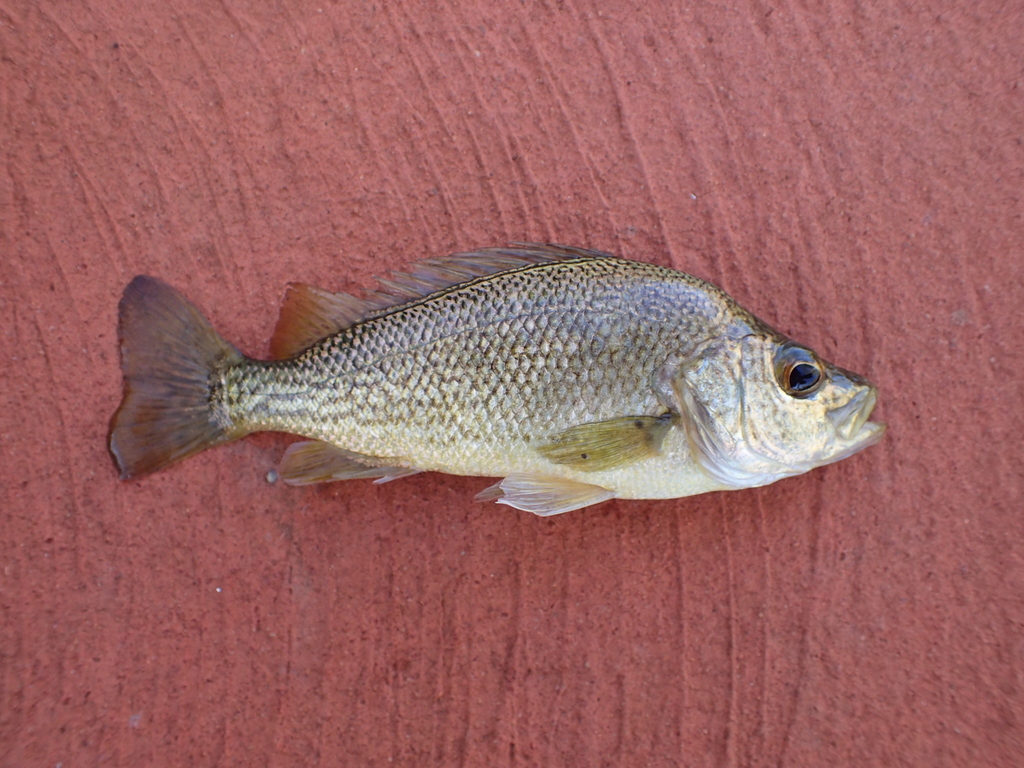
Fortescue Grunter
Leiopotherapon aheneus
The Fortescue grunter (Leiopotherapon aheneus) is a species of freshwater fish in the Terapontidae family. It is endemic to Australia. It can be found in rivers of coastal northwestern Australia, such as the Ashburton and Fortescue Rivers. It is a resident of Karijini National Park.
From the article Fortescue grunter on Wikipedia (CC BY-SA), quoted section by section
Description
The Fortescue grunter has a moderately deep, slightly compressed oval body with convex dorsal profile and a largely straight ventral profile. It has an oblique mouth, which reaches as far as the level of the front of the eye. The upper and lower jaws are equipped with conical teeth with the outer row being enlarged and there are no teeth on the roof of the mouth. The body is covered in finely ctenoid and there is a continuous, smoothly curved lateral line. The dorsal fin is continuous, the spiny part contains 11–13 spines and is arched with the fifth spine being the longest, the spines behind that decreasing in size. There are 8–9 soft rays in the dorsal fin and the longest of these are shorter than longest dorsal spines. The anal fin has 3 spines and 8–9 rays. The caudal fin is emarginate. They are bronze in colour with the young fish having vertical bars. The colour is brown to blackish and there may be 10–15 fine, wavy lines along the body. The intensity of the colour varies between river systems. The head is dark above and paler below. The caudal fin is darker towards the base and slightly dusky along its edge, particularly on the upper lobe. The fins on the body can be clear to dusky in pigment.
Range & habitat
The Fortescue grunter is endemic to the Pilbara region of Western Australia and has been recorded from the Ashburton River to the upper reaches of the Fortescue River.
Wikipedia: “Distribution”
In human culture
The Fortescue grunter was first formally described as Therapon aheneus in 1963 by the Dutch ornithologist and ichthyologist Gerlof Mees (1926-2013) with the type locality given as Millstream Pool. Western Australia. The specific name aheneus refers to the bronze colour shown by this species.
== References ==
Wikipedia: “Species description and etymology”
Where it lives
Recorded sightings
—
geo-referenced records in GBIF, from museums, herbaria and field observers.
Drag the globe to turn it. Dots are where records exist, not a range map; darker means more records.
In the stacks
Searching the stacks…
Every page naming Leiopotherapon aheneus in the Biodiversity Heritage Library →
This page is assembled live from iNaturalist, GBIF, Wikipedia, the Source Library and the Internet Archive. It is not yet part of the hand-edited codex. iNaturalist taxon 104132.