- Animals
- ›Arthropods
- ›Hexapods
- ›Insects
- ›Winged and Once-winged Insects
- ›Beetles
- ›Water, Rove, Scarab, Long-horned, Leaf, and Snout Beetles
- ›Elateriform Beetles
- ›Buprestoidea
- ›Jewel Beetles
- ›Agrilinae
- ›Tracheini
- ›Brachys
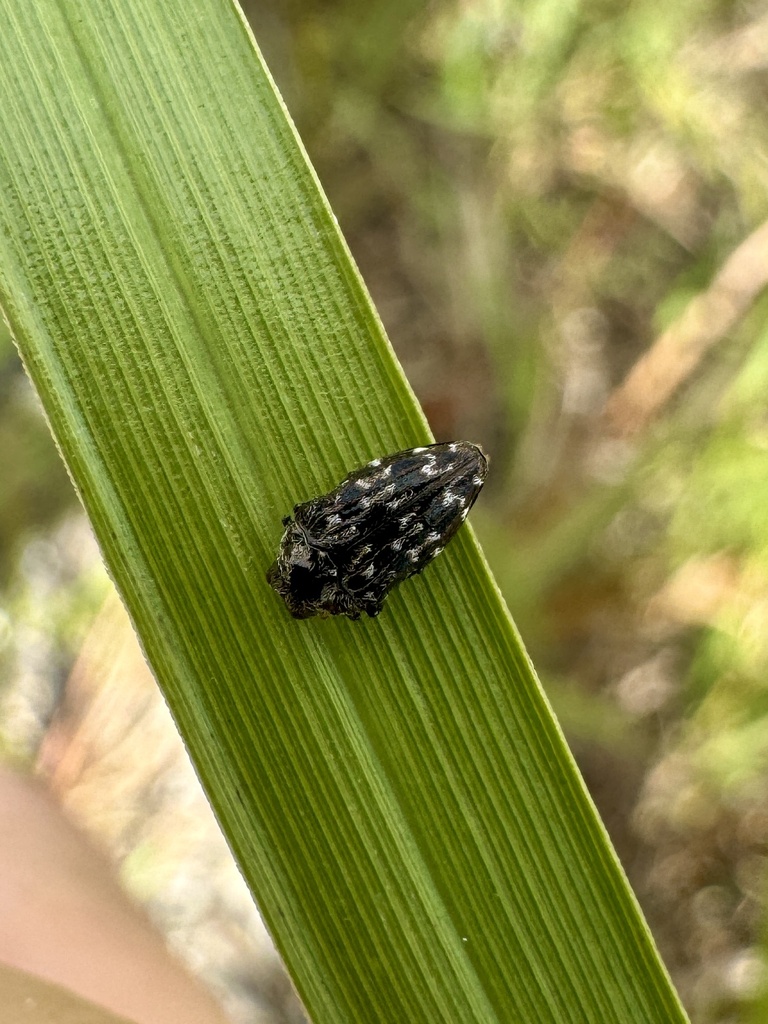
Brachys tesselatus
Brachys tesselatus is a species of a leaf-mining beetle, primarily distributed along the southeast coast of the United States. Its distribution corresponds with the turkey oak, its main host plant. Although B. tesselatus primarily feeds and mines on turkey oak leaves, its impact on the host species is limited, allowing for the survival of both species.
The maturation of B. tesselatus spans approximately a year, starting from egg to adult emergence. Adults feed on buds in early March and ovipositing from mid-April to June. Oviposition preferences are hierarchical among oak species, influenced by factors like host abundance and light conditions.
From the article Brachys tesselatus on Wikipedia (CC BY-SA), quoted section by section
Range & habitat
B. tesselatus is confined to the southeast coast of the United States, occurring north to New Jersey, south to Florida, and west to Texas. It is also found in Indiana, Louisiana, and Mississippi. This distribution largely coincides with the turkey oak, which occupies the dry, deep, sandy soils of the region. B. tesselatus feeding and mining activities are found to be restricted to the leaves of turkey oak. Adult beetles may occur on leaves of other oak species in the area, but they do not feed and mine on these leaves. B. tesselatus exhibits selective preferences for microhabitats within its range. Factors such as light conditions, temperature gradients, and moisture levels influence the distribution and abundance of B. tesselatus populations. In particular, individuals show a preference for thermally favored microclimates, which may influence their activity patterns, feeding behavior, and reproductive activities.
Wikipedia: “Distribution and habitat”
What it does
Mating occurs in early April, with females often continuing to feed while mating. Oviposition begins in mid-April and continues through June. Eggs are laid singly on the upper leaf surface, near veins or leaf margins, covered with a waxy secretion. Females use their abdominal sternite to place and smooth eggs. Eggs darken with age and hatch within two weeks. There's no significant difference in hatch success between eggs laid in exposed versus shaded positions. Beetle activities are not random regarding crown strata; they prefer thermally favored microclimates. Early-season feeding and oviposition primarily occur in the upper crown, shifting to more shaded areas as the season progresses. From the egg stage to emerging from pupation as an adult takes about one year. Adult beetles emerge in early March, coinciding with or just before bud break in host trees. They start feeding on buds at the top of tree crowns and move downward as leaves expand, beginning at leaf margins and progressing inward, consuming all leaf layers. Eggs are distributed contagiously on leaves, indicating a non-random pattern. Most oviposition events are single, with leaf and mine dimensions limiting successful development to one individual per leaf. Eggs hatch from late April into May. Larvae have five instars, with the first instar starting in May. …
Wikipedia: “Life cycle”
At the table
Cannibalism may occur when multiple larvae attempt development within a single leaf. However, such encounters are rare, and successful development of multiple larvae in a single leaf is generally unlikely due to limited space. The effects of B. tesselatus feeding and mining activities on Q. laevis (turkey oak) are limited. Leaf function in unmined areas was minimally impaired, with most reduction in photosynthetic surface occurring during the penultimate and ultimate larval stages when seasonal growth in the host was largely completed. The tolerance of turkey oak and minimal interference from B. tesselatus appear to reduce the impact of the host-parasite interaction, thereby enhancing the survival of both species. Intrageneration developmental mortality is high (>99.1%), but survivorship is comparable to other natural insect populations studied. Fecundity likely compensates for these losses, with potential immigration balancing losses locally. However, the intergeneration impacts of various mortality agents can not be determined with available data.
== References ==
Wikipedia: “Other causes”
Listen
Looking for field recordings…
Where it lives
Recorded sightings
—
geo-referenced records in GBIF, from museums, herbaria and field observers.
Drag the globe to turn it. Dots are where records exist, not a range map; darker means more records.
In the stacks
Searching the stacks…
Every page naming Brachys tesselatus in the Biodiversity Heritage Library →
This page is assembled live from iNaturalist, GBIF, Wikipedia, the Source Library and the Internet Archive. It is not yet part of the hand-edited codex. iNaturalist taxon 1043434.