- Plants
- ›Vascular Plants
- ›flowering plants
- ›Dicots
- ›Mints, Plantains, Olives, and Allies
- ›figwort family
- ›Buddlejeae
- ›Buddleja
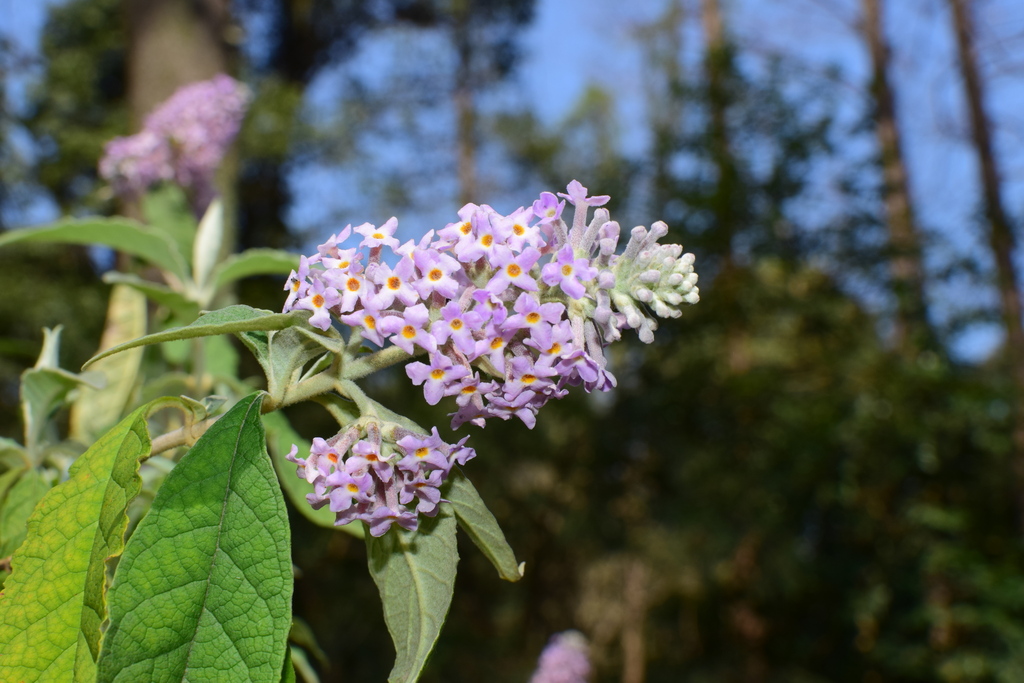
pole butterflybush
Buddleja officinalis
Buddleja officinalis is a deciduous early-spring flowering shrub native to west Hubei, Sichuan, and Yunnan provinces in China. Discovered in 1875 by Pavel Piasetski, a surgeon in the Russian army, B. officinalis was named and described by Maximowicz in 1880. Introduced to western cultivation in 1908, B. officinalis was accorded the Royal Horticultural Society's Award of Merit three years later, and the Award of Garden Merit (record 689) in 2002.
From the article Buddleja officinalis on Wikipedia (CC BY-SA), quoted section by section
Description
Buddleja officinalis largely resembles the commoner B. davidii in shape and size, growing to less than 2.5 m in height. The inflorescences are honey-scented mauve panicles, shorter (under 8 cm) than those of davidii, and more conical. The leaves are lanceolate, under 15 cm long, softly pubescent, the upper surface rich green in colour, the underside grey. 2n = 38.
How it is grown
Buddleja officinalis is not fully frost hardy, unable to survive temperatures lower than −10° C, and is best grown against a south-facing wall. The shrub should be cut back hard each year immediately after flowering in spring. Propagation by softwood cuttings is easily accomplished, using vermiculite as a rooting medium. In the UK the shrub is often grown as a nectar source for vanessid butterflies such as the peacock on emergence from hibernation. Hardiness: RHS H2, USDA zones 8 – 9. One notable cultivar of B. officinalis is Buddleja 'Winter Sun'.
Wikipedia: “Cultivation”
Where it lives
Recorded sightings
—
geo-referenced records in GBIF, from museums, herbaria and field observers.
Drag the globe to turn it. Dots are where records exist, not a range map; darker means more records.
In the old herbals & bestiaries


In the stacks
Searching the stacks…
Every page naming Buddleja officinalis in the Biodiversity Heritage Library →
This page is assembled live from iNaturalist, GBIF, Wikipedia, the Source Library and the Internet Archive. It is not yet part of the hand-edited codex. iNaturalist taxon 1045236.