- Animals
- ›Arthropods
- ›Hexapods
- ›Insects
- ›Winged and Once-winged Insects
- ›Dragonflies and Damselflies
- ›Dragonflies
- ›Libelluloidea
- ›Skimmers
- ›Leucorrhinia
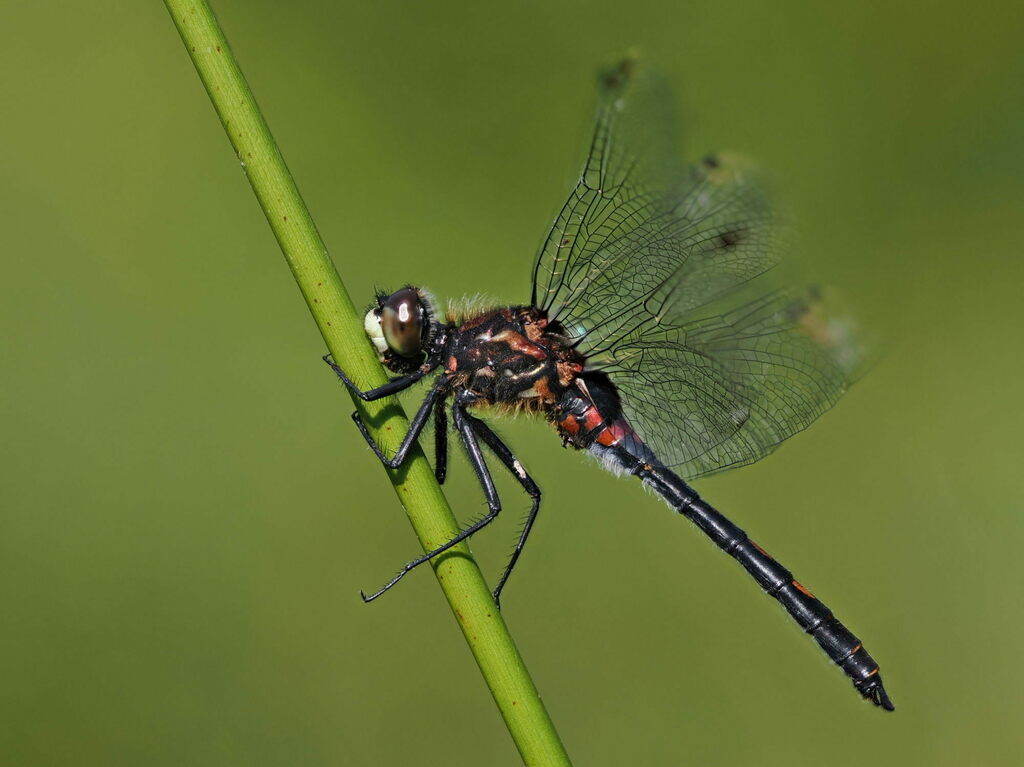
Small Whiteface
Leucorrhinia dubia
The white-faced darter or small whiteface (Leucorrhinia dubia) is a dragonfly belonging to the genus Leucorrhinia in the family Libellulidae, characterised by red and black markings and a distinctive white patch on the head. It is found in wetlands and peat bogs from northern Europe eastwards to Siberia, and the adults are active from around April till September, which is known as the "flight period". It breeds in acidic bodies of water, laying its eggs in clumps of sphagnum moss that provide a safe habitat for larval development. The larvae are particularly vulnerable to predation by fish, and so are usually found in lakes where fish are not present. L. dubia is listed as a species of least concern (LC) by the IUCN Red List, however, it is potentially threatened by habitat destruction, pollution, and climate change.
From the article White-faced darter on Wikipedia (CC BY-SA), quoted section by section
Description
This species has a predominantly black body, usually 33–37 mm (1.3–1.5 in) in length - the abdomen is 21–27 mm (0.83–1.06 in) long and the hindwing is 23–28 mm (0.91–1.10 in) long. Mature males have striking red and orange markings on the abdomen and thorax which become darker with age, whereas young males and females have pale yellow markings. All individuals have a conspicuous white frons at the front of the head. The wings have a brown patch at the base and noticeable black pterostigma. It may be confused with similar species, including the black darter (Sympetrum danae), ruddy darter (Sympetrum sanguineum) and common darter (Sympetreum striolatum), however is usually distinguishable by its white face patch.
Range & habitat
This dragonfly's range extends from western Europe to Japan, and it is commonly found in western, northern and eastern Europe at higher altitudes, but is rare in southern Europe and the United Kingdom. In recent decades, this species has been observed as far afield as Russia and China, however the vast majority of sightings have occurred in central and northern Europe. In Britain, the majority of individuals of this species are found in the highlands of Scotland, with key populations located in Inverness-shire and Ross-shire. In England, a few isolated populations occur in Cheshire and Cumbria, where biodiversity action plans have been set up to protect them, and as far south as Chartley Moss National Nature Reserve in Staffordshire. However, when British populations are considered overall, this species has been in decline over the past 35 years.
Wikipedia: “Distribution”
Listen
Looking for field recordings…
Where it lives
Recorded sightings
—
geo-referenced records in GBIF, from museums, herbaria and field observers.
Drag the globe to turn it. Dots are where records exist, not a range map; darker means more records.
In the stacks
Searching the stacks…
Every page naming Leucorrhinia dubia in the Biodiversity Heritage Library →
This page is assembled live from iNaturalist, GBIF, Wikipedia, the Source Library and the Internet Archive. It is not yet part of the hand-edited codex. iNaturalist taxon 104547.