- Plants
- ›Vascular Plants
- ›flowering plants
- ›Dicots
- ›Mints, Plantains, Olives, and Allies
- ›broomrape family
- ›Rhinantheae
- ›Rhinanthus
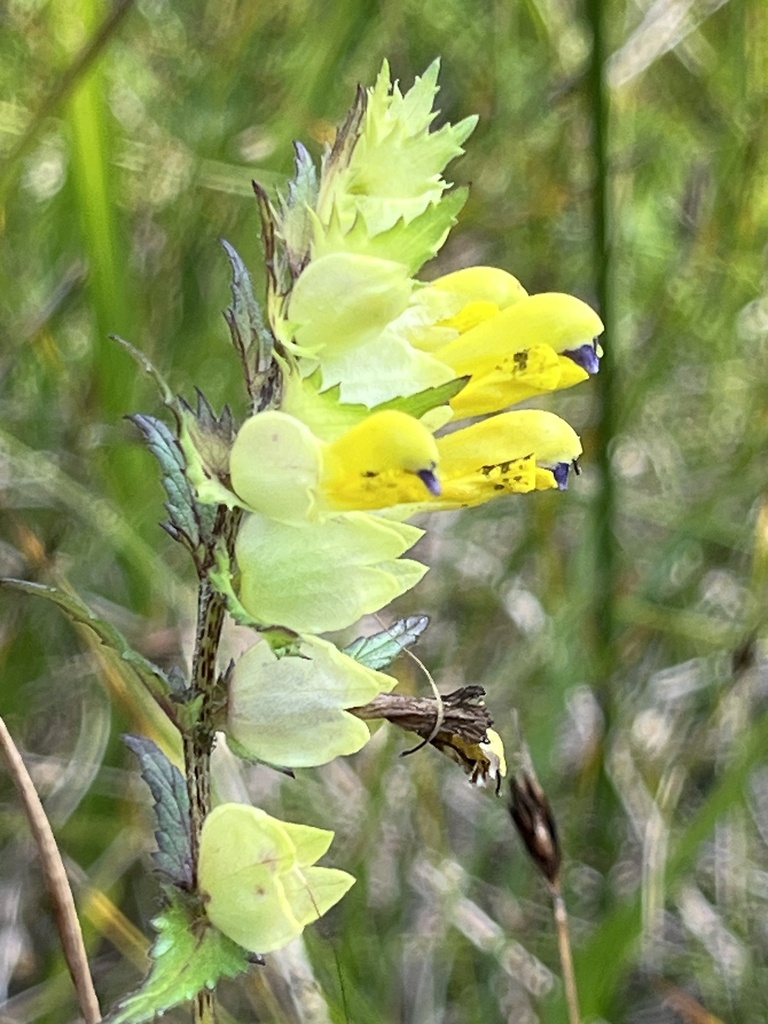
Rhinanthus osiliensis
Rhinanthus osiliensis, in English known by the common name Saaremaa yellow rattle, is a flowering plant in the genus Rhinanthus in the family Orobanchaceae. It is endemic to the Estonian island Saaremaa in the Baltic Sea. Plants growing on the Swedish island Gotland have been ascribed to R. osiliensis, too, but genetic analyses have not supported this hypothesis.
Morphological features of R. osiliensis include glandular hairs on the sepals (calyx) and relatively narrow leaves. It is a late-flowering species of Rhinanthus, flowering from the end of July onwards.
From the article Rhinanthus osiliensis on Wikipedia (CC BY-SA), quoted section by section
Range & habitat
Rhinanthus osiliensis is strictly endemic to the western part of Saaremaa island, Estonia, with a highly restricted geographic range. The species is a habitat specialist that primarily inhabits calcareous spring fens, which are naturally scarce wetland habitats. It also occurs in other wetland environments such as species-rich fens and paludified meadows. The plant can temporarily colonize marginal habitats like ditch verges and stream banks, though such populations tend to be transient. As an annual hemiparasitic plant, R. osiliensis attaches to and derives nutrients from the roots of perennial herbaceous host plants. The species typically begins flowering in the second half of July and early August, with pollination carried out by insects, particularly bumblebees. Its seeds, which ripen by late September or early October, are relatively large and heavy, lacking an active dispersal mechanism. Consequently, most offspring are found in close proximity to the parent plant. The seeds generally maintain viability for only one year, and the species does not form a persistent seed bank. The population of R. osiliensis was estimated at about 26,000–32,000 individuals as of 2010, distributed across several dozen established populations. Many of these populations are located within nature reserves. …
Wikipedia: “Habitat, distribution, and ecology”
Where it lives
Recorded sightings
—
geo-referenced records in GBIF, from museums, herbaria and field observers.
Drag the globe to turn it. Dots are where records exist, not a range map; darker means more records.
In the stacks
Searching the stacks…
Every page naming Rhinanthus osiliensis in the Biodiversity Heritage Library →
This page is assembled live from iNaturalist, GBIF, Wikipedia, the Source Library and the Internet Archive. It is not yet part of the hand-edited codex. iNaturalist taxon 1048064.