- Plants
- ›Vascular Plants
- ›flowering plants
- ›Dicots
- ›Mints, Plantains, Olives, and Allies
- ›Mint Family
- ›Ajugoideae
- ›Clerodendrum
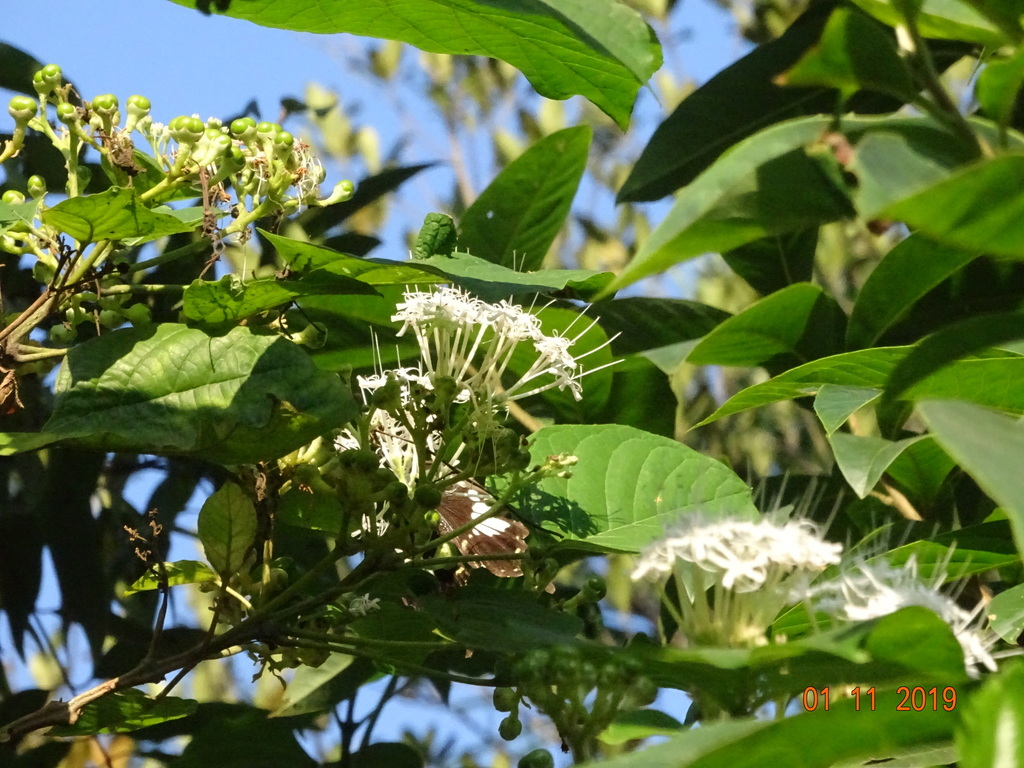
Clerodendrum glandulosum
Clerodendrum glandulosum (syn. Clerodendrum colebrookianum), commonly known as East Indian glory bower, is a perennial shrub belonging to the family Lamiaceae, but sometimes classified under Verbenaceae. It is one of the most well known among ~400 species of Clerodendrum, as it is widely used in traditional practices, such as for vegetable and treatments of diabetes, hypertension, cough and rheumatism.
The species is found in tropical and subtropical regions of Asia including India, Myanmar, Bangladesh, Malaysia, Indonesia, Thailand, Bhutan and Nepal; and also in temperate China. In India it is confined to the north-east region including West Bengal and Sikkim, and is classified under the threat status as vulnerable.
From the article Clerodendrum glandulosum on Wikipedia (CC BY-SA), quoted section by section
Description
C. glandulosum is a flowering shrub or small tree, characterized by a foetid smell. It is erect reaches up to 1.5-3 m in height and is evergreen. Branchlets are usually 4-angled when young. Leaves are simple, opposite or rarely whorled. Leaf base is wedge- shaped to heart-shaped, margin entire to slightly wavy, tip long-pointed to pointed. Flowers are white and borne in 4-6-branched corymbose cymes, at the end of branches. Inflorescences loosely cymose or capitate, in terminal or rarely axillary paniculate thyrses. Calyx is campanulate or cup-shaped, densely pubescent. Corolla with a slender tube; lobes 5, spreading. Stamens 4, ovary 4-locular; ovules pendulous or laterally attached. Style with 2 acute stigmatic lobes. Fruit is a drupe with four 1-seeded pyrenes, sometimes separating into two 2-loculed or four 1-locular mericarps. It flowers during postmonsoon, from August to December.
In medicine
It is a common medicinal plant used for rheumatic pains by the Khasi and Jaintia tribes of Meghalaya. It is believed that the smell of the wood relieves children from many diseases. Leaves and roots are used by Manipuri tribes for skin diseases, cough, and dysentery. The tribal natives of Arunachal Pradesh use the leaf juice mixed with garlic extract given in treating blood pressure or cooked leaf is taken for the same. Among the Mizo, leaves are cooked as vegetable. Locally known as 'Anphui / Phuihnam' is popularly used to control hypertension. Like their Mizo brethren, the Hmar, the Garos of Meghalaya and Kukis of Manipur, Assam, Meghalaya, Nagaland and Myanmar also used the leaves to control hypertension and as a vegetables and is known as 'Anphui' in their dialect. More often than not, is used extensively in the preparation of pork curry. It is a popular folk remedy for hypertension throughout north-eastern India.
Wikipedia: “Traditional medicine”
Where it lives
Recorded sightings
—
geo-referenced records in GBIF, from museums, herbaria and field observers.
Drag the globe to turn it. Dots are where records exist, not a range map; darker means more records.
In the stacks
Searching the stacks…
Every page naming Clerodendrum glandulosum in the Biodiversity Heritage Library →
This page is assembled live from iNaturalist, GBIF, Wikipedia, the Source Library and the Internet Archive. It is not yet part of the hand-edited codex. iNaturalist taxon 1060619.