- Plants
- ›Vascular Plants
- ›flowering plants
- ›Dicots
- ›nightshades, bindweeds, gooseweeds, and allies
- ›bindweed family
- ›Bindweeds, Morning-glories and Allies
- ›Bindweed Tribe
- ›Calystegia
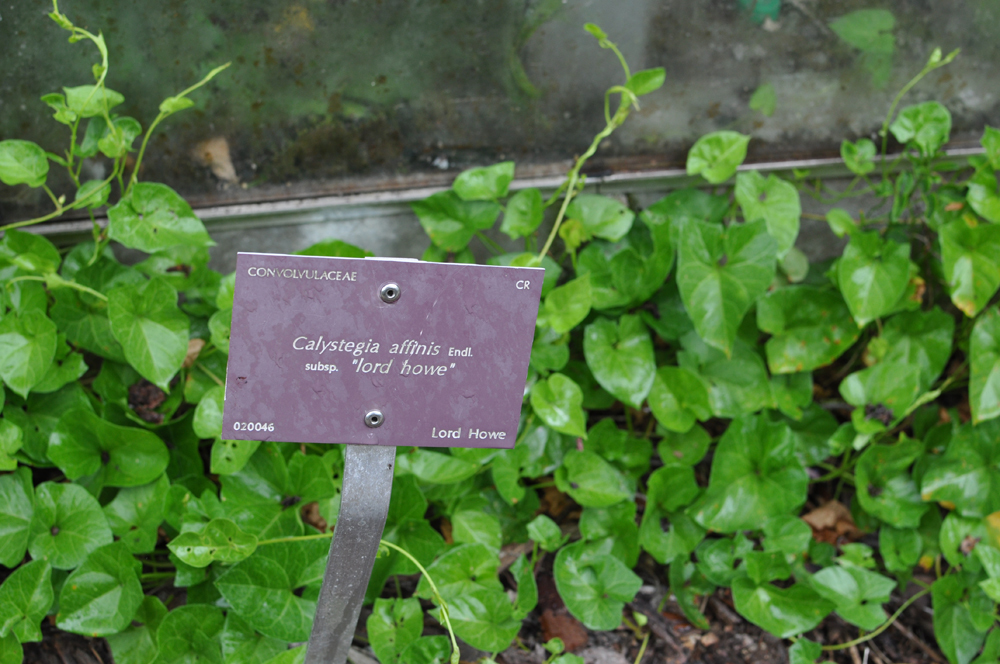
Calystegia affinis
Calystegia affinis is a critically endangered species of climbing or creeping vine in the plant family Convolvulaceae. It is endemic to Lord Howe Island and Norfolk Island. In 2003 only about 45 mature plants were known, with about 40 of those on Norfolk Island.
From the article Calystegia affinis on Wikipedia (CC BY-SA), quoted section by section
Description
Calystegia affinis is a thin-stemmed plant in the genus Calystegia which climbs by twining. It has sparse alternate, arrow-headed leaves about 6 cm x 5 cm. The flowers are axillary, solitary, pink with five cream longitudinal bands and are funnel-shaped. They have large persistent bracteoles enclosing the calyx which has five sepals and five petals. The fruit is a papery capsule which splits longitudinally into four valves. The plant is thought to reproduce both clonally and by seed.
In human culture
The genus name, Calystegia is derived from the Greek: kalux, "cup", and stegos, "a covering", meaning "a covering cup" and refers to the bracteoles enclosing the calyx. The specific epithet, affinis, is Latin for 'neighbouring', which was possibly chosen by Endlicher on the basis of his comment that the species was closely allied to Calystegia marginata.
Wikipedia: “Etymology”
Where it lives
Recorded sightings
—
geo-referenced records in GBIF, from museums, herbaria and field observers.
Drag the globe to turn it. Dots are where records exist, not a range map; darker means more records.
In the stacks
Searching the stacks…
Every page naming Calystegia affinis in the Biodiversity Heritage Library →
This page is assembled live from iNaturalist, GBIF, Wikipedia, the Source Library and the Internet Archive. It is not yet part of the hand-edited codex. iNaturalist taxon 1065130.