- Plants
- ›Vascular Plants
- ›flowering plants
- ›Dicots
- ›Heathers, Balsams, Primroses, and Allies
- ›sapodilla family
- ›Sideroxylon
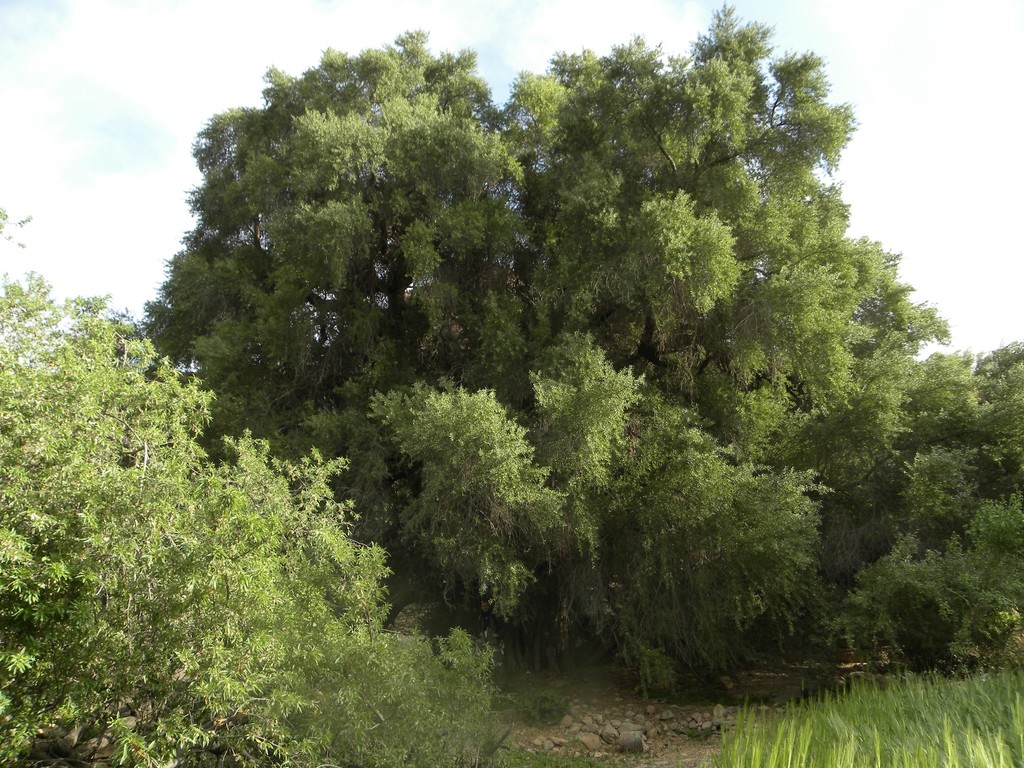
Argan tree
Sideroxylon spinosum
Sideroxylon spinosum, known as argan (Tashelhit: ⴰⵔⴳⴰⵏ, romanized: argan), synonym Argania spinosa, is a species of flowering plant. It is a tree native to the calcareous semi-desert Sous, Chiadma and Haha regions of Morocco, as well as some parts of Tindouf Province in southwestern Algeria, and also to Mauritania and Western Sahara.
Argan trees grow to 8–10 m (26–33 ft) high and live up to approximately 200 years. They are thorny, with gnarled trunks and wide spreading crown. The crown has a circumference of up to 70 m (230 ft) and the branches may lean towards the ground.
From the article Sideroxylon spinosum on Wikipedia (CC BY-SA), quoted section by section
Description
The leaves are small, 2–4 cm (3⁄4–1+5⁄8 in) long, and oval with a rounded apex. The flowers are small, with five pale yellow-green petals; flowering in April. The fruit is 2–4 cm long and 1.5–3 cm (5⁄8–1+1⁄8 in) broad, with a thick, bitter peel surrounding a sweet-smelling but unpleasantly flavoured layer of pulpy pericarp. This surrounds the very hard nut, which contains one (occasionally two or three) small, oil-rich seeds. The fruit takes over a year to mature, ripening in June to July of the following year.
What it does
There are many types of Argan habitats, with varying degrees of aridity based on latitude and distance from the Atlantic Ocean :
Haha region: In the coastal territory where the High Atlas mountains reach the Atlantic, argan trees grow along prominent headlands and seaside cliffs, including Cape Sim, Cape Tafelney, and Cape Ghir. In these areas, they grow alongside companion species like wild Olive (Olea europaea) and Lentisc (Pistacia lentiscus). South of Agadir: South of Agadir, oceanic influences shape the argan woodlands. The pre-steppe environments are characterized by a high concentration of various spurges (including Euphorbia beaumierana, E. echinus, and E. regis-jubae, as well as Salsola longifolia and S. vermiculata). Inland arid zone: Further inland across the Souss Valley and the Anti-Atlas range, the landscape transitions to a more xerophytic community. Here, the argan is found near Acacia gummifera with an understorey dominated by species such as Ziziphus lotus, Withania adpressa, Launaea arborescens, Senecio anteuphorbium, and Genista ferox. Transition borders: Along the fringes of its distribution, the argan integrates with alternative forest communities. It mixes with Barbary arborvitae (Tetraclinis articulata) and Phoenician juniper (Juniperus phoenicea) across the Haha, Chiadma, and Abda regions. …
Wikipedia: “Ecology”
At the table
The argan tree has played a role in the cultures of the Berber people living there for hundreds of years. Argan is a multi-purpose tree and each part of it is usable as a food or economic resource. The fruit can be eaten, oil can be extracted from the nuts and the tree's wood can be used for fuel. The tree has therefore played a vital socio-economic role in local culture, and currently provides a significant source of food and income for around three million people, over two million of whom live in rural areas. In some parts of Morocco, argan takes the place of the olive as a source of forage, oil, timber, and fuel in Berber society.
Fruit. Argan fruit falls in July, when they are black and dry. Until this happens, goats are kept out of the argan woodlands by wardens. Rights to collect the fruit are controlled by law and village traditions. The "nuts" are gathered after fruit consumption and spat out by ruminating goats. Seeds being spat out by the goats constitutes one mechanism of seed dispersal.
Argan oil. Argan oil is produced by several women's co-operatives in the southwestern parts of Morocco. The most labour-intensive part of oil-extraction is removal of the soft pulp (used to feed animals) and the cracking by hand, between two stones, of the hard nut. …
Wikipedia: “Uses”
How it is grown
The argan tree used to grow throughout North Africa, but today it only grows in southwestern Morocco. Argan is perfectly adapted to the region's harsh environment, with the ability to survive extreme heat (over 50 °C), drought and poor soil. Although numbers are dwindling, argan is the second most abundant tree in Moroccan forests, with over twenty million trees living in the region and playing a vital role in the food chain and environment. The tree's roots grow deep into the ground in search of water, which helps bind soil and prevents erosion. Much of the region has resisted the advance of the Sahara desert due to the argan tree, and it therefore plays an irreplaceable part in the ecological balance of the region. In Morocco, arganeraie forests now only cover some 8,280 km2 (3,200 sq mi) and are designated as a UNESCO biosphere reserve. Their area has shrunk by about half during the last 100 years, due to charcoal making, grazing, increasingly intensive cultivation and the expansion of urban and rural settlements. Livestock numbers have increased substantially, with signs of overgrazing and over browsing in the argan forest. Browsing directly harms the existing, mature argan trees as goats will climb high into the branches of an argan tree to reach its fruit. …
Wikipedia: “Cultivation”
In human culture
In 2014, the United Nations Educational, Scientific and Cultural Organization (UNESCO), inscribed "Argan, practices and know-how concerning the argan tree" on the Representative List of the Intangible Cultural Heritage of Humanity, upon Moroccan request, for the protection and safeguarding of traditions, knowledge, practices, and crafts related to the argan tree.
Wikipedia: “Intangible Cultural Heritage”
Where it lives
Recorded sightings
—
geo-referenced records in GBIF, from museums, herbaria and field observers.
Drag the globe to turn it. Dots are where records exist, not a range map; darker means more records.
In the stacks
Searching the stacks…
Every page naming Sideroxylon spinosum in the Biodiversity Heritage Library →
This page is assembled live from iNaturalist, GBIF, Wikipedia, the Source Library and the Internet Archive. It is not yet part of the hand-edited codex. iNaturalist taxon 1066286.