- Fungi Including Lichens
- ›Ascomycete Fungi
- ›Sac Fungi and Lichens
- ›Operculate Ascomycetes
- ›Pezizales
- ›Helvellaceae
- ›Balsamia
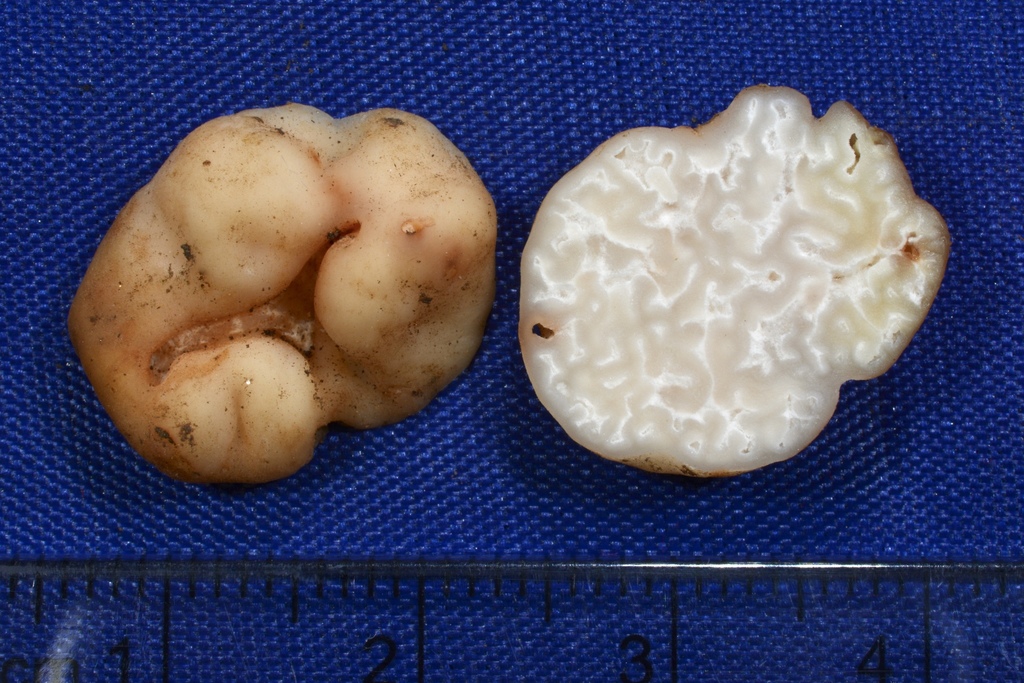
Balsamia oregonensis
Balsamia oregonensis is a species of ascomycete fungus in the family Helvellaceae. It is commonly found in Oregon, which it is named for.
From the article Balsamia oregonensis on Wikipedia (CC BY-SA), quoted section by section
Description
Balsamia oregonensis is reddish-yellow in color and between 1 and 2.5 centimetres (1⁄2 and 1 in) across. Its exterior is roundish to somewhat flat and usually slightly lobed. It has fewer distinct warts than most other truffles. The entirety of the exterior is covered in coarse hyphae. The interior of B. oregonensis consists of whitish-gray canals. Balsamia oregonensis releases its fungal spores seasonally in the spring and into early summertime.
Range & habitat
As its name suggests, B. oregonensis is primarily found in Oregon, United States, although it is not exclusive to the area. Other areas within the United States where the species can be found includes the Great Plains region. B. oregonensis has reportedly also been found in the Polish Tatra Mountains.
Wikipedia: “Distribution and habitat”
What it does
Balsamia oregonensis is commonly found alongside Douglas-fir trees which are considered its primary host. This association is useful in truffling and the best way to locate B. oregonensis in the wild. There is evidence that B. oregonensis is seasonally consumed by wild animals, such as chipmunks, within its ecosystem.
Wikipedia: “Ecology”
At the table
Balsamia oregonensis is an edible species of truffle and is described as having a pleasant taste. Distribution is considered infrequent to rare.
== References ==
Wikipedia: “Uses”
Where it lives
Recorded sightings
—
geo-referenced records in GBIF, from museums, herbaria and field observers.
Drag the globe to turn it. Dots are where records exist, not a range map; darker means more records.
In the stacks
Searching the stacks…
Every page naming Balsamia oregonensis in the Biodiversity Heritage Library →
This page is assembled live from iNaturalist, GBIF, Wikipedia, the Source Library and the Internet Archive. It is not yet part of the hand-edited codex. iNaturalist taxon 1069005.