- Plants
- ›Vascular Plants
- ›flowering plants
- ›Dicots
- ›myrtles, evening primroses, and allies
- ›myrtle family
- ›Myrtoideae
- ›gum trees
- ›Eucalyptus
- ›Eudesmia
- ›Reticulatae
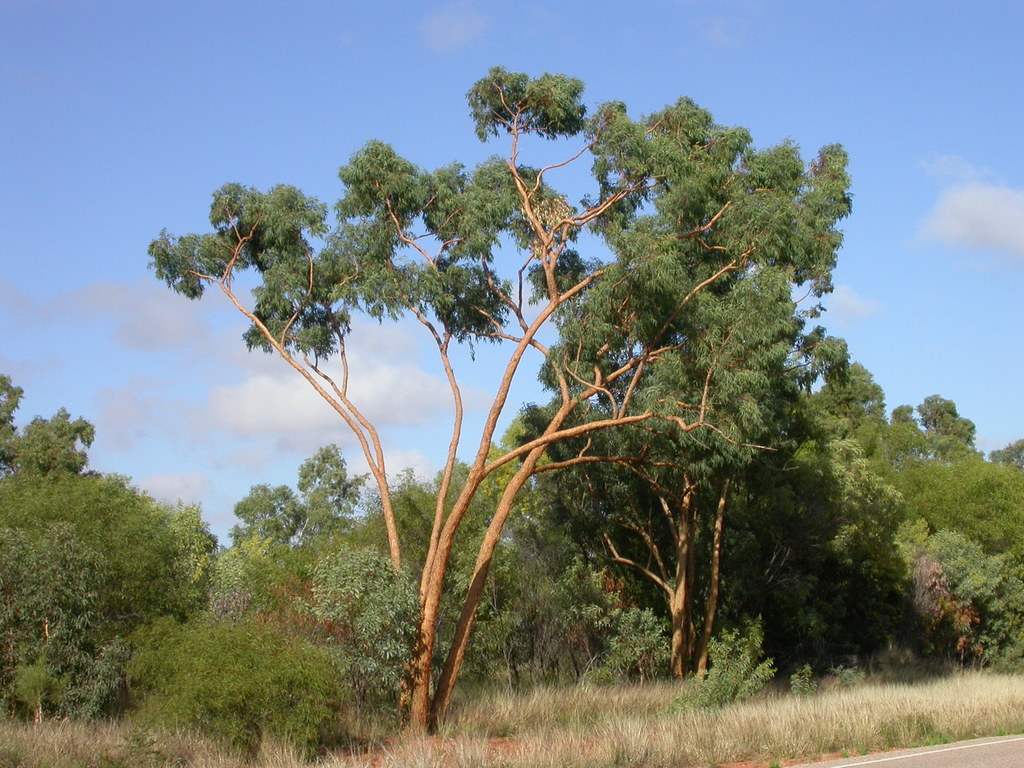
Inland Yellow Jacket
Eucalyptus similis
Eucalyptus similis, commonly known as inland yellowjacket or Queensland yellow jacket, is a species of flowering plant in the family Myrtaceae and is endemic to Queensland, Australia. It is a tree with rough bark, lance-shaped to broadly lance-shaped or sickle-shaped adult leaves, flower buds in groups of seven, white or cream-coloured flowers and cylindrical to cup-shaped or barrel-shaped fruit.
From the article Eucalyptus similis on Wikipedia (CC BY-SA), quoted section by section
Description
Eucalyptus similis is a tree that typically grows to a height of 8 to 14 metres (26 to 46 ft) and has rough, yellow to yellow-brown or red-brown bark over most of the trunk and branches. Leaves on young plants and on coppice regrowth are sometimes arranged in opposite pairs, egg-shaped, 60–130 mm (2.4–5.1 in) long and 30–70 mm (1.2–2.8 in) wide. Adult leaves are lance-shaped to broadly lance-shaped or sickle-shaped, 85–180 mm (3.3–7.1 in) long, 10–35 mm (0.39–1.38 in) wide and tapering to the petiole with the lower surface a lighter shade of green. The flowers are borne in umbels of seven in leaf axils on a peduncle 14–20 mm (0.55–0.79 in) long, each bud on a pedicel 1–8 mm (0.039–0.315 in) long. Mature buds are cylindrical to pear-shaped or spindle-shaped, 8–12 mm (0.31–0.47 in) long and 4–5 mm (0.16–0.20 in) wide with a conical to rounded operculum. Flowering has been observed in December and the flowers are white or cream-coloured, and the fruit is a cylindrical to cup-shaped or barrel-shaped capsule, 8–15 mm (0.31–0.59 in) long and 6–13 mm (0.24–0.51 in) wide. Eucalyptus similis is very similar in appearance to Corymbia leichhardtii.
Range & habitat
Found in woodland communities, Eucalyptus similis grows on gentle slopes and flats in deep clay, loamy or sandy soils, in a narrow north-south band from near Forsayth to the Barcaldine-Jericho region in Central Queensland with two disjunct populations near Laura and east of Strathburn Station on Cape York in North Queensland. E. similis often occurs with Corymbia setosa, forming a sparse canopy. Associated species in the shrub layer, which is also usually sparse, includes Lithomyrtus microphylla, Carissa lanceolata, Gastrolobium grandiflorum and Jacksonia ramosissima. Triodia pungens usually dominants the very sparse to sparse ground layer.
Wikipedia: “Distribution and habitat”
Where it lives
Recorded sightings
—
geo-referenced records in GBIF, from museums, herbaria and field observers.
Drag the globe to turn it. Dots are where records exist, not a range map; darker means more records.
In the stacks
Searching the stacks…
Every page naming Eucalyptus similis in the Biodiversity Heritage Library →
This page is assembled live from iNaturalist, GBIF, Wikipedia, the Source Library and the Internet Archive. It is not yet part of the hand-edited codex. iNaturalist taxon 1074758.