- Plants
- ›Vascular Plants
- ›flowering plants
- ›Dicots
- ›myrtles, evening primroses, and allies
- ›myrtle family
- ›Myrtoideae
- ›gum trees
- ›Eucalyptus
- ›Eudesmia
- ›Limbatae
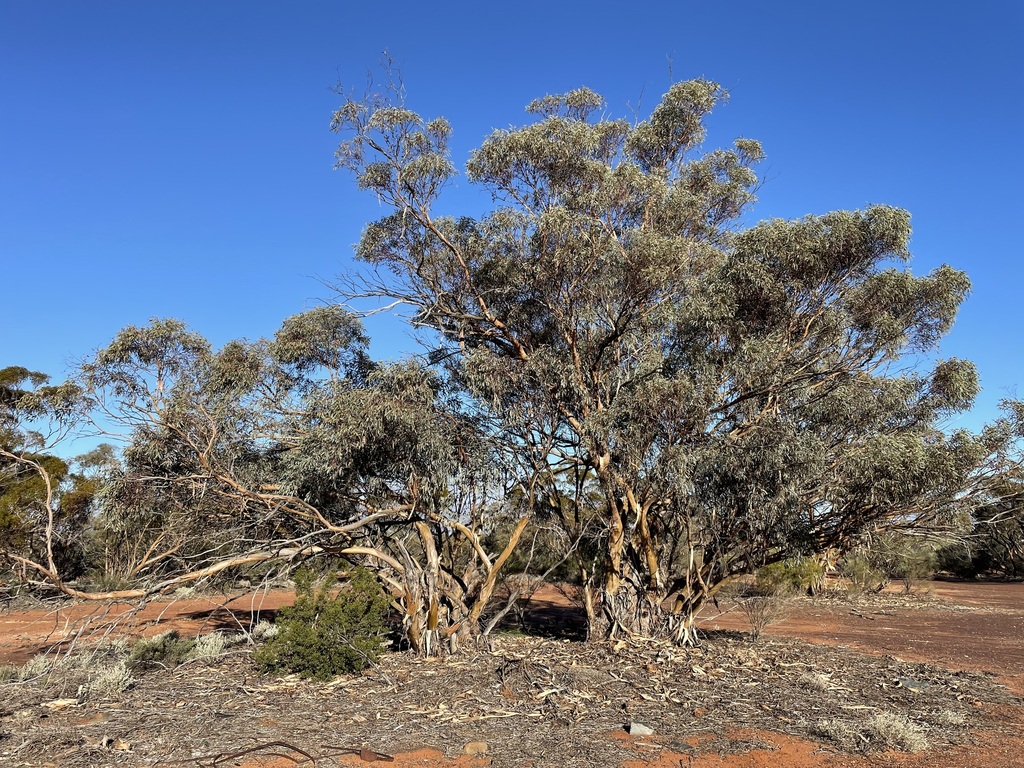
Eucalyptus ebbanoensis
Eucalyptus ebbanoensis, commonly known as the sandplain mallee, is a species of mallee that is endemic to Western Australia. It has smooth greyish bark, lance-shaped to curved adult leaves, flower buds in groups of three, whitish flowers and cup-shaped to hemispherical fruit.
From the article Eucalyptus ebbanoensis on Wikipedia (CC BY-SA), quoted section by section
Description
Eucalyptus ebbanoensis is a mallee that typically grows to a height of 6 m (20 ft), occasionally a tree up to 10 m (33 ft), and forms a lignotuber. Young plants and coppice regrowth have hairy stems and leaves that are petiolate, 45–80 mm (1.8–3.1 in) long and 20–40 mm (0.79–1.57 in) wide. Adult leaves are lance-shaped to curved, 55–125 mm (2.2–4.9 in) long and 7–22 mm (0.28–0.87 in) wide on a petiole 8–20 mm (0.31–0.79 in) long. The flower buds are arranged in groups of three in leaf axils on a peduncle 4–10 mm (0.16–0.39 in) long, the individual buds on a pedicel 1–5 mm (0.039–0.197 in) long. Mature buds are oval to pear-shaped, 4–7 mm (0.16–0.28 in) long and 5–7 mm (0.20–0.28 in) wide with a conical or rounded operculum. Flowering mainly occurs from September to December and the flowers are creamy white. The fruit is a woody cup-shaped to hemispherical or bell-shaped capsule 6–11 mm (0.24–0.43 in) long and 8–12 mm (0.31–0.47 in) wide with the valves near the level of the rim.
Range & habitat
Sandplain mallee has been found in various places among breakaways, on sand plains and granite hills, growing in sandy soils and those derived from laterite. The most widespread subspecies is ebbanoensis which is found through parts of the northern Wheatbelt and Goldfields-Esperance regions to the western edge of the Great Victoria Desert. Subspecies glauciramula is found to the east of this area and subspecies photina has a restricted distribution in the Moresby Range north and east of Geraldton. These are areas of predominantly winter rainfall with an annual average of 250–400 mm (9.8–15.7 in).
Wikipedia: “Distribution and habitat”
Where it lives
Recorded sightings
—
geo-referenced records in GBIF, from museums, herbaria and field observers.
Drag the globe to turn it. Dots are where records exist, not a range map; darker means more records.
In the stacks
Searching the stacks…
Every page naming Eucalyptus ebbanoensis in the Biodiversity Heritage Library →
This page is assembled live from iNaturalist, GBIF, Wikipedia, the Source Library and the Internet Archive. It is not yet part of the hand-edited codex. iNaturalist taxon 1075149.