- Animals
- ›Arthropods
- ›Hexapods
- ›Insects
- ›Winged and Once-winged Insects
- ›Dragonflies and Damselflies
- ›Dragonflies
- ›Gomphoidea
- ›Clubtails
- ›Ophiogomphus
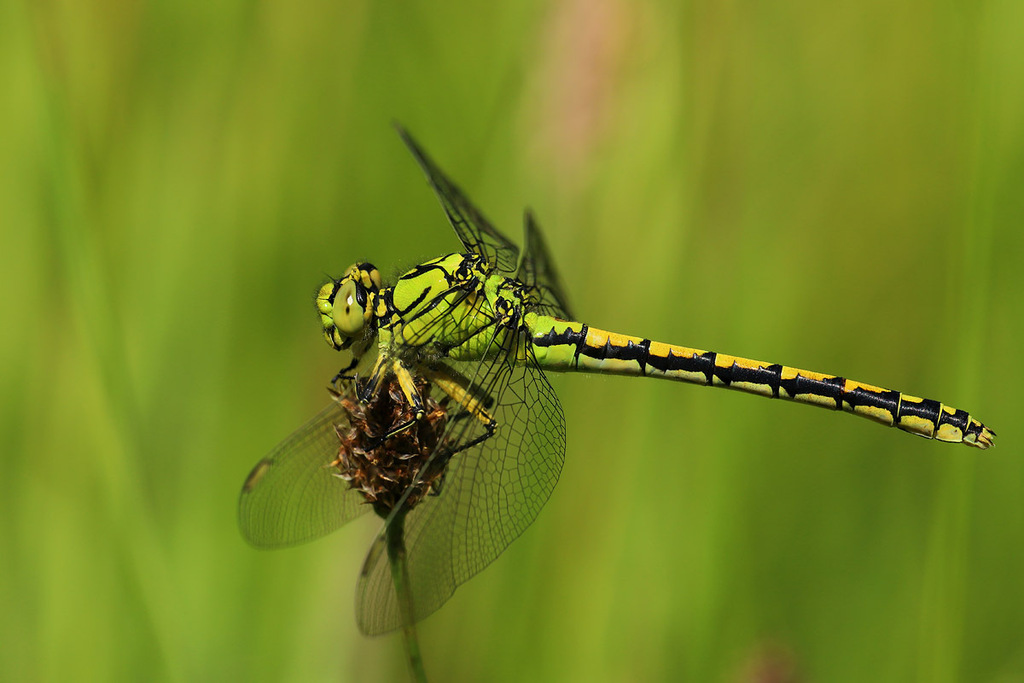
Green Snaketail
Ophiogomphus cecilia
Ophiogomphus cecilia, the green snaketail, green gomphid, or green club-tailed dragonfly is a species of dragonfly in the family Gomphidae. It is found in Austria, Belarus, Bulgaria, China, the Czech Republic, Denmark, Estonia, Finland, France, Germany, Hungary, Italy, Latvia, Lithuania, Luxembourg, Moldova, Poland, Portugal, Romania, Russia, Slovakia, Slovenia, Sweden, Switzerland, Turkey, and Ukraine.
From the article Ophiogomphus cecilia on Wikipedia (CC BY-SA), quoted section by section
Description
The only snaketail in Europe; resembles a large clubtail in general coloration and river habitat, but the 'front-end' is vivid apple green in mature individuals and the male appendages are short. It is the largest of the Gomphidae apart from Bladetail, with green eyes and 'face, and green thorax with thin black lines on top and side, the latter similar to those on Yellow Clubtail and Western Clubtail; at the base of abdomen the green is extending to S2, the rest of the abdomen has a discontinuous yellow pattern to S 10, generally broader than on clubtails and those on S3-7 more triangular in shape, and moderately clubbed at S8-9. The legs are extensively yellow. Male appendages are short and yellowish. Female yellow markings on the abdomen are broader than on males. It shows two tiny 'crests' on the back of the head, between the eyes. Black lines on the thorax reduced in some individuals. Imatures lack any green.
Range & habitat
It is found in Austria, Belarus, Bulgaria, China, the Czech Republic, Denmark, Estonia, Finland, France, Germany, Hungary, Italy, Latvia, Lithuania, Luxembourg, Moldova, North Macedonia, Poland, Portugal, Spain, Romania, Russia, Slovakia, Slovenia, Sweden, Switzerland, Turkey, and Ukraine. The main distribution area is in Eastern Europe. In Asia Ophiogomphus cecilia reaches Kazakhstan; in the north northern Finland and northern Sweden. There are only a few reports of finds from western and southern Europe. In Germany, it occurs mainly in the eastern parts of the country, including in the Lüneburg Heath, on the Oder, the Spree, in Niederlausitz and in the central and eastern parts of Bavaria.
Wikipedia: “Range”
What it does
In Bavaria, hatching begins in some years as early as the second half of May and lasts well into August. The main flight time is from the end of July to mid-August. Observations are possible until the beginning of October. Adult males typically inhabit sunny, exposed sitting areas above running water, including stalks, branches protruding over the water, stones, and sandbanks. These areas are often characterized by agitated water flowing over shallow, sandy bottoms. Males defend these sitting areas against others of the same species, though conflicts are typically brief and non-violent. Territorial boundaries are not established, and males may frequent the same stretch of river for several days. They avoid shaded areas. Areas bordered by wooded banks are usually flown around. Even after they have reached maturity, the adults sometimes move far away from their breeding waters. Males can be detected at distances of up to two kilometres from the inhabited rivers in sun-exposed hillside forests on the edge of a valley. Individuals caught there could be found along the river later. When sexually mature animals were marked, the ratio of males to females was between 16:1 (Rezat) and 67:1 (Aurach). This is to explain the secret behaviour of the females when laying eggs. …
Wikipedia: “Ecology”
Listen
Looking for field recordings…
Where it lives
Recorded sightings
—
geo-referenced records in GBIF, from museums, herbaria and field observers.
Drag the globe to turn it. Dots are where records exist, not a range map; darker means more records.
In the stacks
Searching the stacks…
Every page naming Ophiogomphus cecilia in the Biodiversity Heritage Library →
This page is assembled live from iNaturalist, GBIF, Wikipedia, the Source Library and the Internet Archive. It is not yet part of the hand-edited codex. iNaturalist taxon 107654.