- Fungi Including Lichens
- ›Basidiomycete Fungi
- ›Higher Basidiomycetes
- ›Mushrooms, Bracket Fungi, Puffballs, and Allies
- ›Agaricomycetidae
- ›Common Gilled Mushrooms and Allies
- ›Tricholomatineae
- ›Entolomataceae
- ›Entoloma
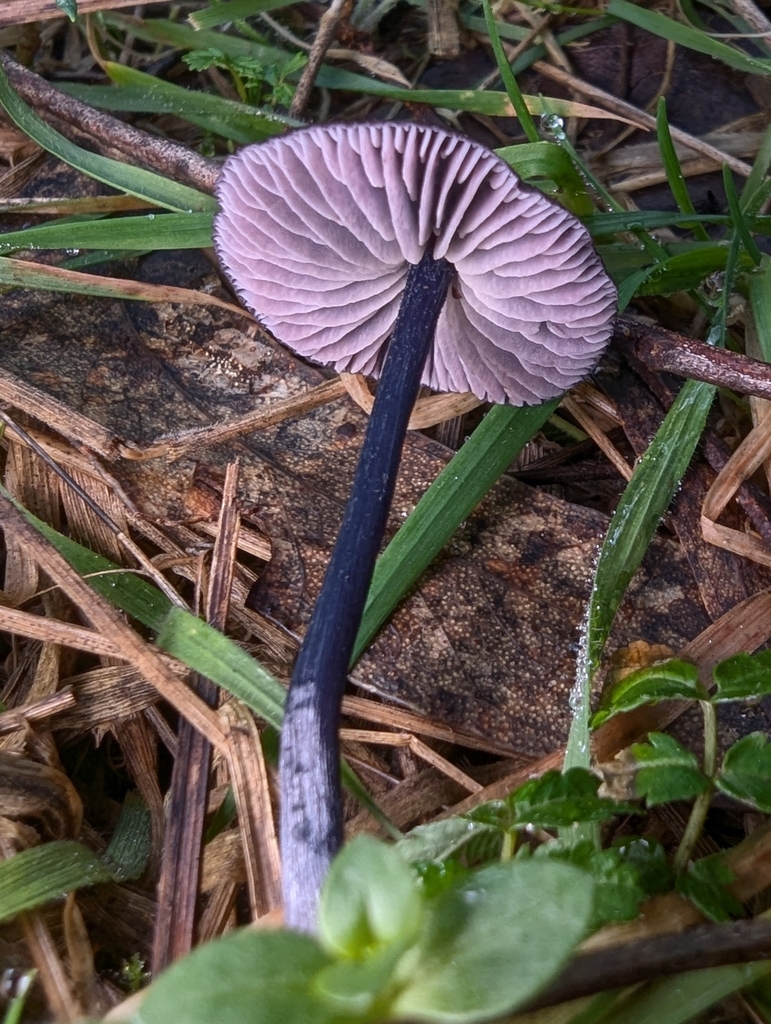
Entoloma moongum
Entoloma moongum is a South Australian species of fungus in the large agaric genus Entoloma (subgenus Leptonia). It was described as new to science by mycologist Cheryl Grgurinovic; the original holotype collections were made from Belair National Park in the 1930s by John Burton Cleland, who erroneously referred the fungus to Leptonia lampropus (now Entoloma lampropus).
The fruitbody has a dark brown to purplish brown cap up to 19 mm (0.75 in) in diameter with a surface that is finely fibrillose, and a cap cuticle consisting of narrow hyphae. The spores measure 9.6–13.6 by 5.6–8.4 μm and have 5–6 blunt angles. Basidia (spore-bearing cells) are club-shaped, measuring 34.4–48.8 by 9.6–12.8 μm, with sterigmata up to 6 μm long. The specific epithet derives from the Aboriginal word moonga, meaning "dark".
Where it lives
Recorded sightings
—
geo-referenced records in GBIF, from museums, herbaria and field observers.
Drag the globe to turn it. Dots are where records exist, not a range map; darker means more records.
In the stacks
Searching the stacks…
Every page naming Entoloma moongum in the Biodiversity Heritage Library →
This page is assembled live from iNaturalist, GBIF, Wikipedia, the Source Library and the Internet Archive. It is not yet part of the hand-edited codex. iNaturalist taxon 1078221.