- Animals
- ›Chordates
- ›Vertebrates
- ›Cartilaginous Fishes
- ›Sharks and Rays
- ›Sharks
- ›Galean Sharks
- ›Carpet Sharks
- ›Wobbegongs
- ›Orectolobus
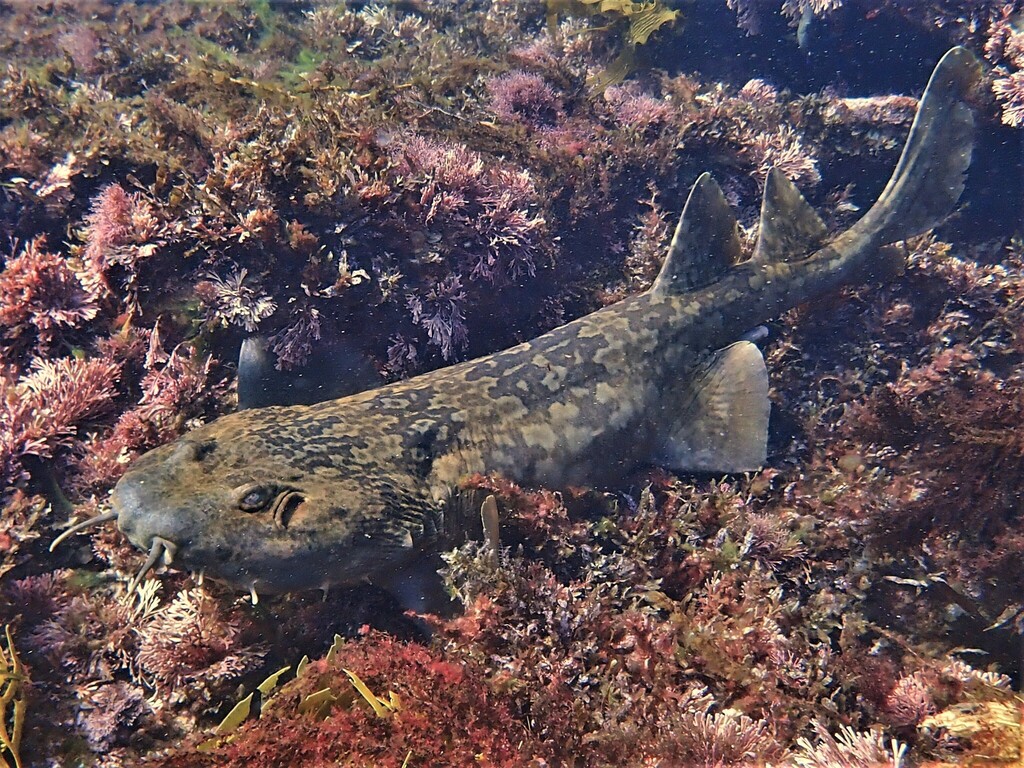
Western Wobbegong
Orectolobus hutchinsi
Orectolobus hutchinsi, the western wobbegong, is a species of carpet shark in the family Orectolobidae. The western wobbegong shark is a moderate sized marine shark found off the coast of Western Australia. Its scientific name is Orectolobus hutchinsi, and it was first identified in 1983 by Dr. Barry Hutchins, but was only recently classified, described, and published in 2006. O. hutchinsi is found on the shallow continental shelf in Western Australia from Coral Bay to Groper Bluff. This species is distinct from other wobbegong sharks because the western wobbegong shark has a yellowish brown upper body and darker brown saddles on their backs. Unlike other wobbegong sharks from the same area, the western wobbegong shark does not have white rings or blotches on their backs.
From the article Orectolobus hutchinsi on Wikipedia (CC BY-SA), quoted section by section
Range & habitat
O. hutchinsi are mainly benthic organisms, meaning they spend most of their lives on the seafloor. Wobbegongs as a genus are usually found in temperate and tropical continental water in the western Pacific and eastern Indian Ocean, but the western wobbegong is part of the recent diversification in Australian waters. O. hutchinsi is one of the 7 wobbegong species to be recorded in Australian waters, out of the 8 total wobbegong species recognized as valid. O. hutchinsi has been found in waters from 0.1 to 106 m, showing that they prefer to live in the shallow water of the continental shelf. They live in rocky reefs or seagrass habitats, and use their high patterned skin to camouflage to their surroundings and await prey.
Wikipedia: “Habitat”
What it does
O. hutchinsi tends to mate in late July, and females can store sperm for up to 6 months. Although more genetic analysis is needed, it is hypothesized that this may be an evolutionary adaptation to make sure the female has a constant supply of sperm, as well as increasing genetic diversity in that females can store sperm from more than one male. In wobbegong sharks, ovulation is hypothesized to occur in a biennial or triennial cycle, meaning it happens 2-3 times per year. The gestation period for O. hutchinsi is 9–11 months, and O. hutchinsi females have litters of about 23 pups. Compared to other wobbegong species, O. hutchinsi can carry a larger litter to term because they are not physiologically constrained by uterus structure or size.
Wikipedia: “Reproduction”
In human culture
Wobbegong sharks are a species located under the elasmobranch subclass of Chondrichthyes, meaning the wobbegongs are cartilaginous fish with 4-7 gill slits. Elasmobranch fish have survived four mass-extinctions, and it is speculated that members of the elasmobranch lineage (including western wobbegong sharks) are related to ancestors from the Mesozoic period. The orectolobidae genus of sharks likely diversified from their other ancestors in the Miocene age, which may explain the high distribution of wobbegongs within the Inso-Australian region. It is suspected that there was a rapid spreading of wobbegong sharks within the last 2 million years, despite there being a lack of an extensive fossil record. This rapid spreading and diversification of wobbegongs was likely caused by two distinct events: major tectonic plate movement in the region causing geological changes, and glacial cycles causing changes in oceanography, coastal geology, and geographic barriers. These two potential changes may have occurred simultaneously or sequentially, but both were likely factors in influencing the present day wobbegong distribution. Genetically, studies have been conducted to analyze the western wobbegong's mitochondrial DNA to determine their relation to other wobbegong species, which found that O. …
Wikipedia: “Evolutionary history”
Where it lives
Recorded sightings
—
geo-referenced records in GBIF, from museums, herbaria and field observers.
Drag the globe to turn it. Dots are where records exist, not a range map; darker means more records.
In the stacks
Searching the stacks…
Every page naming Orectolobus hutchinsi in the Biodiversity Heritage Library →
This page is assembled live from iNaturalist, GBIF, Wikipedia, the Source Library and the Internet Archive. It is not yet part of the hand-edited codex. iNaturalist taxon 107866.