- Animals
- ›Arthropods
- ›Hexapods
- ›Insects
- ›Winged and Once-winged Insects
- ›Dragonflies and Damselflies
- ›Dragonflies
- ›Libelluloidea
- ›Skimmers
- ›Orthetrum
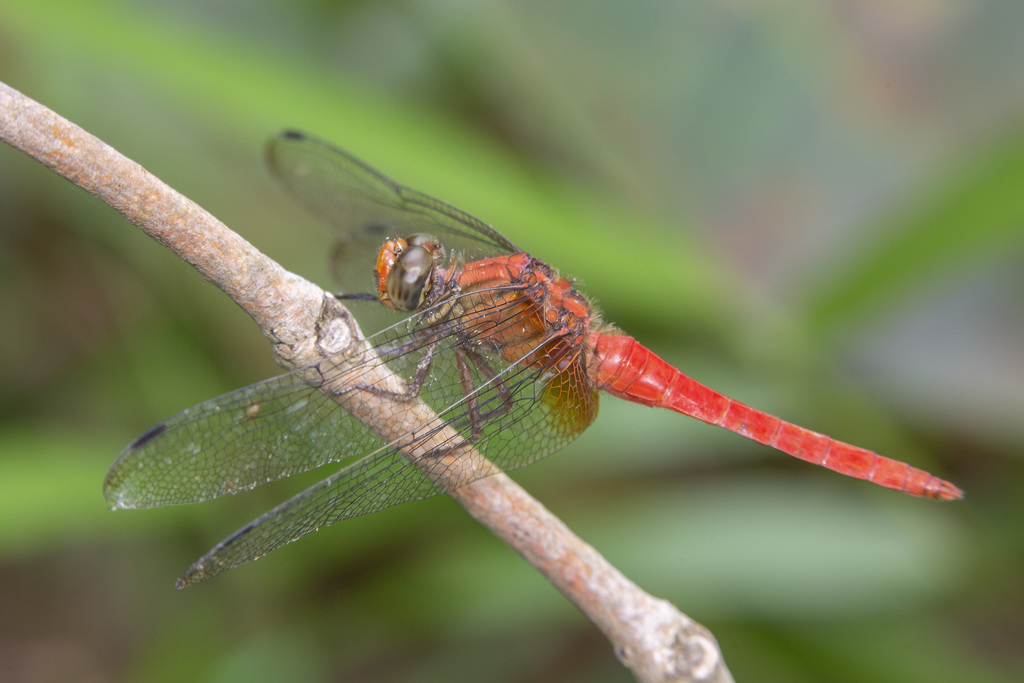
Orange Skimmer
Orthetrum testaceum
Orthetrum testaceum is an Asian freshwater dragonfly species. It is distributed throughout India, Indonesia, Malaysia, Philippines, Singapore and Thailand. One subspecies has been described, Orthetrum testaceum soembanum.
From the article Orthetrum testaceum on Wikipedia (CC BY-SA), quoted section by section
Description
Orthetrum testaceum can reach a body length of about 43–48 mm (1.7–1.9 in), with a hindwing of 34–38 mm (1.3–1.5 in) (in males). In these large dragonflies the thorax of adult males is orange-brown, with a vermilion red abdomen. The eyes are light brownish. The wings are smoky transparent, with an amber patch at the base. In adult females and in recently emerged males the body is olive-green to brown in colour with black markings and a clear base of the hindwings. These dragonflies are rather similar to Orthetrum chrysis, but O. testaceum is more reddish, while O. chrysis has a reddish brown thorax.
Range & habitat
This common species is widespread throughout India, Indonesia, Malaysia, Philippines, Singapore and Thailand. These dragonflies may occur in various areas with standing waters, as in ponds, drains, marshes, around rivers, streams, lakes, and gardens.
Wikipedia: “Distribution and habitat”
What it does
The males regularly perch near ponds, while the females usually fly to water only during mating season and egg-laying. In this case the males guard them by flying over them.
Wikipedia: “Biology and behavior”
Listen
Looking for field recordings…
Where it lives
Recorded sightings
—
geo-referenced records in GBIF, from museums, herbaria and field observers.
Drag the globe to turn it. Dots are where records exist, not a range map; darker means more records.
In the stacks
Searching the stacks…
Every page naming Orthetrum testaceum in the Biodiversity Heritage Library →
This page is assembled live from iNaturalist, GBIF, Wikipedia, the Source Library and the Internet Archive. It is not yet part of the hand-edited codex. iNaturalist taxon 107980.